Schulze Ryan J, Drižytė Kristina, Casey Carol A, McNiven Mark A
Department of Biochemistry and Molecular Biology and the Center for Digestive Diseases, Mayo Clinic, 200 1st St SW, Rochester, MN, 55905, USA.
Biochemistry and Molecular Biology Program, Mayo Clinic Graduate School of Biomedical Sciences, Mayo Clinic, 200 1st St SW, Rochester, MN 55905, USA.
Hepatol Commun. 2017 Jul;1(5):359-369. doi: 10.1002/hep4.1056. Epub 2017 Jun 9.
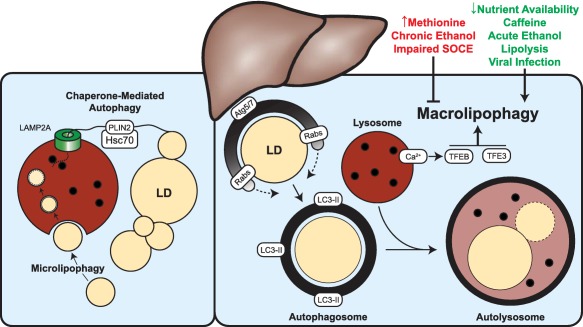
The liver is a central fat-storage organ, making it especially susceptible to steatosis as well as subsequent inflammation and cirrhosis. The mechanisms by which the liver mobilizes stored lipid for energy production, however, remain incompletely defined. The catabolic process of autophagy, a well-known process of bulk cytoplasmic recycling and cellular self-regeneration, is a central regulator of lipid metabolism in the liver. In the past decade, numerous studies have examined a selective form of autophagy that specifically targets a unique neutral lipid storage organelle, the lipid droplet, to better understand the function for this process in hepatocellular fatty acid metabolism. In the liver (and other oxidative tissues), this specialized pathway, lipophagy, likely plays as important of a role in lipid turnover as conventional lipase-driven lipolysis. In this review, we will highlight several recent studies that have contributed to our understanding about the regulation and effects of hepatic lipophagy.
肝脏是一个主要的脂肪储存器官,这使得它特别容易发生脂肪变性以及随后的炎症和肝硬化。然而,肝脏动员储存脂质用于能量产生的机制仍未完全明确。自噬是一种众所周知的大量细胞质循环和细胞自我更新的分解代谢过程,是肝脏脂质代谢的核心调节因子。在过去十年中,众多研究探讨了一种选择性自噬形式,它专门针对一种独特的中性脂质储存细胞器——脂滴,以更好地理解这一过程在肝细胞脂肪酸代谢中的作用。在肝脏(以及其他氧化组织)中,这种特殊途径——脂质自噬,在脂质周转中可能与传统脂肪酶驱动的脂解作用发挥同样重要的作用。在这篇综述中,我们将重点介绍几项最近的研究,这些研究有助于我们理解肝脏脂质自噬的调节及其作用。