VA Connecticut Healthcare System, West Haven, CT, United States.
Department of Psychiatry, School of Medicine, Yale University, New Haven, CT, United States.
Curr Neuropharmacol. 2018;16(4):403-414. doi: 10.2174/1570159X15666171103152136.
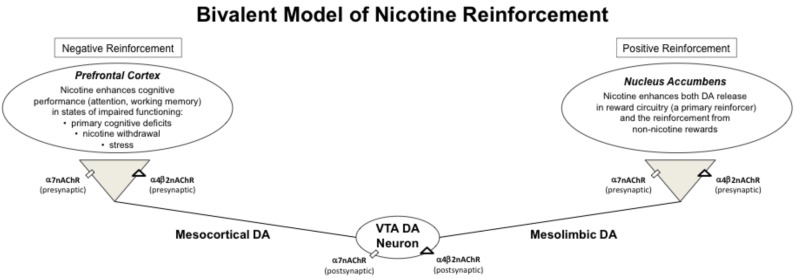
Cigarette smoking is the main cause of preventable death in developed countries. While the direct positive behavioral reinforcing effect of nicotine has historically been considered the primary mechanism driving the development of TUD, accumulating contemporary research suggests that the cognitive-enhancing effects of nicotine may also significantly contribute to the initiation and maintenance of TUD, especially in individuals with pre-existing cognitive deficits.
We provide a selective overview of recent advances in understanding nicotine's effects on cognitive function, a discussion of the role of cognitive function in vulnerability to TUD, followed by an overview of the neurobiological mechanisms underlying the cognitive effects of nicotine.
Preclinical models and human studies have demonstrated that nicotine has cognitiveenhancing effects. Attention, working memory, fine motor skills and episodic memory functions are particularly sensitive to nicotine's effects. Recent studies have demonstrated that the α4, β2, and α7 subunits of the nicotinic acetylcholine receptor (nAChR) participate in the cognitive-enhancing effects of nicotine. Imaging studies have been instrumental in identifying brain regions where nicotine is active, and research on the dynamics of large-scale networks after activation by, or withdrawal from, nicotine hold promise for improved understanding of the complex actions of nicotine on human cognition.
Because poor cognitive performance at baseline predicts relapse among smokers who are attempting to quit smoking, studies examining the potential efficacy of cognitive-enhancement as strategy for the treatment of TUD may lead to the development of more efficacious interventions.
吸烟是发达国家可预防死亡的主要原因。虽然尼古丁的直接正向行为强化作用历来被认为是导致 TUD 发展的主要机制,但越来越多的当代研究表明,尼古丁的认知增强作用也可能对 TUD 的发生和维持有重大贡献,尤其是在认知缺陷的个体中。
我们对理解尼古丁对认知功能的影响的最新进展进行了选择性概述,讨论了认知功能在 TUD 易感性中的作用,然后概述了尼古丁对认知影响的神经生物学机制。
临床前模型和人类研究表明,尼古丁具有认知增强作用。注意力、工作记忆、精细运动技能和情景记忆功能对尼古丁的作用特别敏感。最近的研究表明,烟碱型乙酰胆碱受体(nAChR)的α4、β2 和α7 亚基参与了尼古丁的认知增强作用。成像研究对于确定尼古丁作用的大脑区域具有重要意义,而关于激活后或戒断后大规模网络动态的研究有望更好地理解尼古丁对人类认知的复杂作用。
由于基线时认知表现不佳预示着试图戒烟的吸烟者复吸,因此研究认知增强作为治疗 TUD 的策略的潜在效果可能会导致更有效的干预措施的发展。