Shi Mang, Zhang Yong-Zhen, Holmes Edward C
Marie Bashir Institute for Infectious Diseases and Biosecurity, Charles Perkins Centre, School of Life and Environmental Sciences and Sydney Medical School, The University of Sydney, Sydney, Australia; State Key Laboratory for Infectious Disease Prevention and Control, Collaborative Innovation Center for Diagnosis and Treatment of Infectious Diseases, Department of Zoonoses, National Institute for Communicable Disease Control and Prevention, Chinese Center for Disease Control and Prevention, Changping, Beijing, China.
State Key Laboratory for Infectious Disease Prevention and Control, Collaborative Innovation Center for Diagnosis and Treatment of Infectious Diseases, Department of Zoonoses, National Institute for Communicable Disease Control and Prevention, Chinese Center for Disease Control and Prevention, Changping, Beijing, China.
Virus Res. 2018 Jan 2;243:83-90. doi: 10.1016/j.virusres.2017.10.016. Epub 2017 Oct 27.
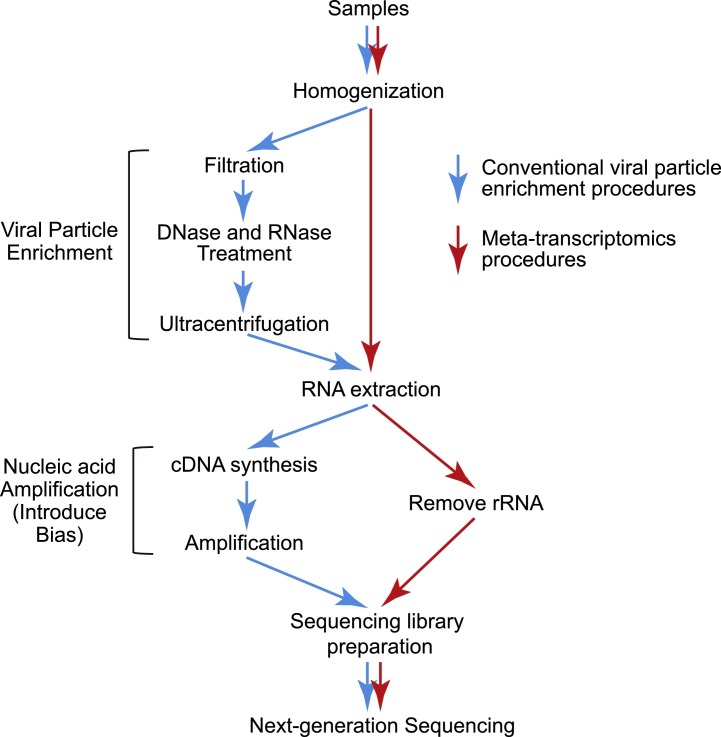
Metagenomics is transforming the study of virus evolution, allowing the full assemblage of virus genomes within a host sample to be determined rapidly and cheaply. The genomic analysis of complete transcriptomes, so-called meta-transcriptomics, is providing a particularly rich source of data on the global diversity of RNA viruses and their evolutionary history. Herein we review some of the insights that meta-transcriptomics has provided on the fundamental patterns and processes of virus evolution, with a focus on the recent discovery of a multitude of novel invertebrate viruses. In particular, meta-transcriptomics shows that the RNA virus world is more fluid than previously realized, with relatively frequent changes in genome length and structure. As well as having a transformative impact on studies of virus evolution, meta-transcriptomics presents major new challenges for virus classification, with the greater sampling of host taxa now filling many of the gaps on virus phylogenies that were previously used to define taxonomic groups. Given that most viruses in the future will likely be characterized using metagenomics approaches, and that we have evidently only sampled a tiny fraction of the total virosphere, we suggest that proposals for virus classification pay careful attention to the wonders unearthed in this new age of virus discovery.
宏基因组学正在改变病毒进化的研究方式,使人们能够快速且低成本地确定宿主样本中病毒基因组的完整组合。对完整转录组的基因组分析,即所谓的宏转录组学,正为RNA病毒的全球多样性及其进化史提供特别丰富的数据来源。在此,我们回顾宏转录组学在病毒进化的基本模式和过程方面所提供的一些见解,重点关注最近发现的大量新型无脊椎动物病毒。特别是,宏转录组学表明RNA病毒世界比以前所认识的更加多变,基因组长度和结构相对频繁地发生变化。宏转录组学不仅对病毒进化研究产生变革性影响,也给病毒分类带来了重大新挑战,因为对宿主类群的更多采样填补了以前用于定义分类群的病毒系统发育中的许多空白。鉴于未来大多数病毒可能会通过宏基因组学方法进行鉴定,而且显然我们只对整个病毒圈的极小一部分进行了采样,我们建议病毒分类的提议应仔细关注这个病毒发现新时代所发掘的奇妙之处。