Department of Pediatrics, Drexel University College of Medicine, St. Christopher's Hospital for Children, Philadelphia, PA 19134, USA.
Department of Pediatrics, Sanford School of Medicine, University of South Dakota, Sanford Children's Hospital, Sioux Falls, SD 57105, USA.
Int J Mol Sci. 2017 Nov 7;18(11):2356. doi: 10.3390/ijms18112356.
Vascular endothelial growth factor (VEGF) stimulates vascular genesis and angiogenesis. Cerebral Hypoxia-Ischemia (HI) leads to the reduction of vasculature in the cerebral cortex of newborn piglets.
The present study tests the hypothesis that post-hypoxia intranasal administration of recombinant human VEGF (rh-VEGF165) for 3 days increases the vascular density in the cerebral cortex of newborn piglets without promoting neovascularization.
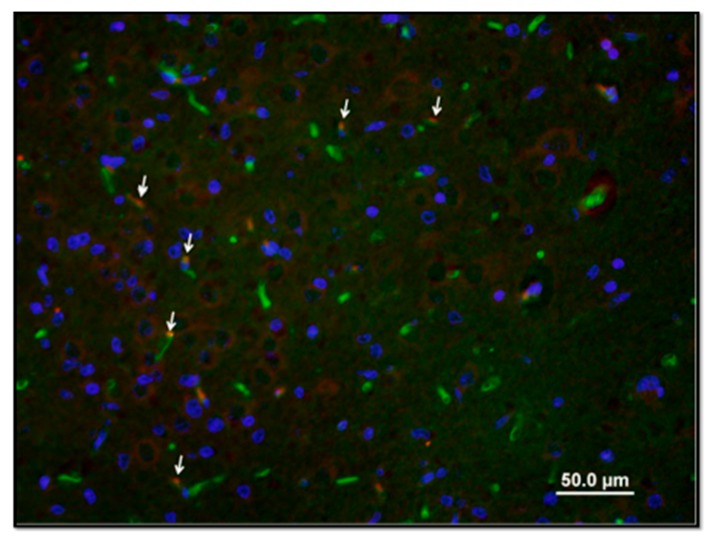
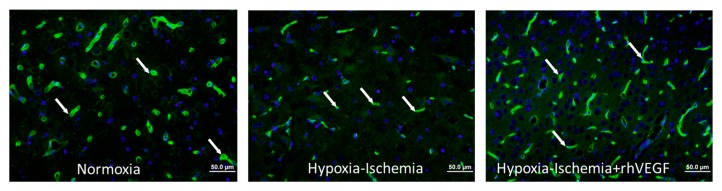
DESIGN/METHODS: Ventilated newborn piglets were divided into three groups ( = 5/group): normoxic (Nx), hypoxic-ischemic (HI), and HI treated with intranasal rh-VEGF165rh-VEGF165 (HI-VEGF). HI piglets were exposed to HI (0.05 FiO2) for 30 min. Recombinant h-VEGF165 (100 ng/kg) was administered 15 min after HI and then once daily for 3 days. The animals were perfused transcardially and coronal brains sections were processed for Isolectin, Hoechst, and ki-67 cell proliferation marker staining. To assess the vascular density, 30-35 fields per animal section were manually counted using image J software.
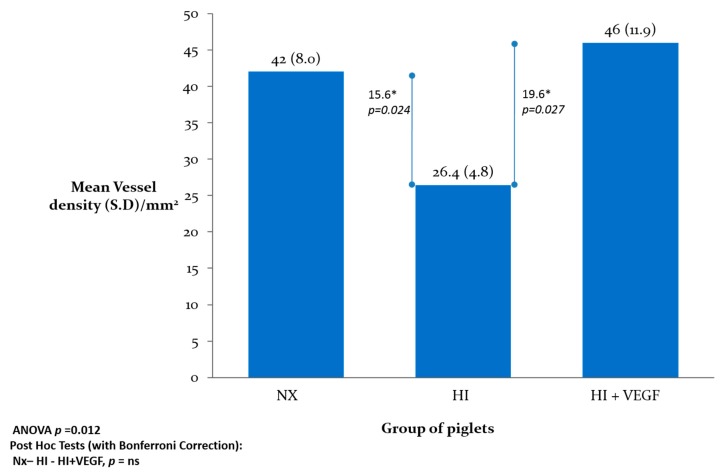
The vascular density (vessels/mm²) was 42.0 ± 8.0 in the Nx group, 26.4 ± 4.8 ( < 0.05 vs. Nx) in the HI group, and 46.0 ± 11.9 ( < 0.05 vs. HI) in the HI-VEGF group. When stained for newly formed vessels, via Ki-67 staining, the vascular density was 5.4 ± 3.6 in the Nx group ( < 0.05 vs. HI), 10.2 ± 2.1 in the HI group, and 10.9 ± 2.9 in the HI-VEGF group ( = 0.72 vs. HI). HI resulted in a decrease in vascular density. Intranasal rh-VEGF165rh-VEGF165 resulted in the attenuation of the HI-induced decrease in vascular density. However, rh-VEGF165 did not result in the formation of new vascularity, as evident by ki-67 staining.
Intranasal rh-VEGF165 may prevent the HI-induced decrease in the vascular density of the brain and could serve as a promising adjuvant therapy for hypoxic-ischemic encephalopathy (HIE).
血管内皮生长因子(VEGF)刺激血管生成和血管生成。脑缺氧缺血(HI)导致新生仔猪大脑皮质血管减少。
本研究假设,在 HI 后连续 3 天经鼻给予重组人 VEGF(rh-VEGF165)可增加新生仔猪大脑皮质的血管密度,而不会促进新生血管形成。
设计/方法:接受通气的新生仔猪分为三组(每组 5 只):常氧(Nx)、缺氧缺血(HI)和 HI 经鼻给予 rh-VEGF165(HI-VEGF)。HI 仔猪暴露于 0.05 FiO2 缺氧 30 分钟。在 HI 后 15 分钟给予 rh-VEGF165(100ng/kg),然后每天一次连续 3 天。动物经心内灌注,冠状脑切片用 Isolectin、Hoechst 和 ki-67 细胞增殖标志物染色。为了评估血管密度,使用 image J 软件手动计数每个动物切片的 30-35 个视野。
Nx 组血管密度(血管/mm²)为 42.0 ± 8.0,HI 组为 26.4 ± 4.8(<0.05 vs. Nx),HI-VEGF 组为 46.0 ± 11.9(<0.05 vs. HI)。通过 Ki-67 染色检测新生血管时,Nx 组血管密度为 5.4 ± 3.6(<0.05 vs. HI),HI 组为 10.2 ± 2.1,HI-VEGF 组为 10.9 ± 2.9(=0.72 vs. HI)。HI 导致血管密度降低。经鼻 rh-VEGF165 导致 HI 诱导的血管密度降低减弱。然而,rh-VEGF165 并没有导致新血管形成,这从 ki-67 染色中可以明显看出。
经鼻 rh-VEGF165 可能预防 HI 引起的脑血管密度降低,并可能作为缺氧缺血性脑病(HIE)有前途的辅助治疗方法。