Bristol Dental School, University of Bristol, Bristol, UK.
Population Health Sciences, University of Dundee, Dundee, UK.
Health Expect. 2018 Apr;21(2):508-517. doi: 10.1111/hex.12645. Epub 2017 Nov 7.
To synthesize experiences of the patient complaints process for patients and health-care professionals to identify facilitators and barriers in the successful implementation of patient complaints processes. This will assist the development of cultural change programmes, enabling complaints managers to incorporate stakeholder perspectives into future care.
Systematic literature search and meta-ethnography, comprising reciprocal syntheses of "patient" and "professional" qualitative studies, combined to form a "line-of-argument" embodying both perspectives.
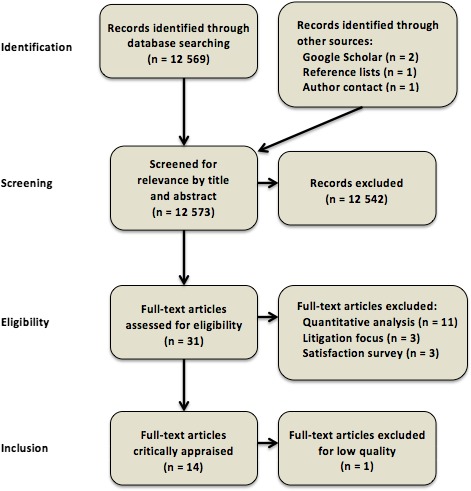
MEDLINE, CINAHL and PsycINFO (database inception to April 2015) were searched to identify international literature in primary and secondary health-care settings, involving qualitative data collection and analysis. Further studies were identified from hand-searching relevant journals, contacting authors, article reference lists and Google Scholar.
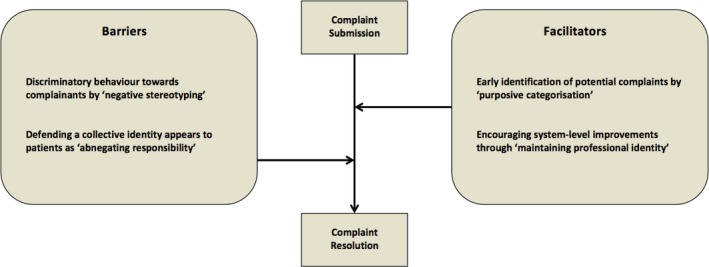
A total of 13 papers, reporting 9 studies from the United Kingdom, Sweden, Australia and New Zealand, were included in the synthesis. Facilitators and barriers to the successful implementation of patient complaints processes were identified across the perspectives of both patients and health-care professionals. Patients sought to individualize the complaints process by targeting specific professionals who engaged in practices that undermined the identity of patients. In contrast, professionals obscured their own individualism through maintaining a collective identity and withholding personal judgement in relation to patient complaints.
Complainants recognized health-care professionals as bearers of individual accountability for unsatisfactory care, in opposition to the stance of collective responsibility endorsed by professionals. Implementation of patient complaints processes must reconcile the need for individualized resolution, whilst striving to improve the future provision of health care through a collaborative approach between patients and professionals.
综合患者和医疗保健专业人员对患者投诉流程的经验,以确定成功实施患者投诉流程的促进因素和障碍。这将有助于制定文化变革计划,使投诉管理人员能够将利益相关者的观点纳入未来的护理工作中。
系统的文献检索和元民族志,包括“患者”和“专业人员”定性研究的相互综合,结合形成一个“论点线”,体现了这两个观点。
MEDLINE、CINAHL 和 PsycINFO(数据库起始日期至 2015 年 4 月),以确定涉及初级和二级医疗保健的国际文献,涉及定性数据的收集和分析。还通过手检相关期刊、联系作者、文章参考文献列表和 Google Scholar 进一步确定了其他研究。
综合分析共纳入了 13 篇论文,其中 9 项研究来自英国、瑞典、澳大利亚和新西兰。从患者和医疗保健专业人员的角度确定了成功实施患者投诉流程的促进因素和障碍。患者试图通过针对特定的专业人员来个性化投诉流程,这些专业人员从事的做法破坏了患者的身份。相比之下,专业人员通过维护集体身份并在与患者投诉相关的问题上不发表个人意见,掩盖了他们自己的个人主义。
投诉人认为医疗保健专业人员对不满意的护理负有个人责任,而专业人员则持集体责任的立场。实施患者投诉流程必须在个性化解决问题的需求与患者和专业人员之间通过协作方法来改善未来医疗保健服务的提供之间取得平衡。