School of Health Sciences (HESAV), HES-SO University of Applied Sciences and Arts Western Switzerland, Lausanne, Switzerland.
Department of Nursing, West Virginia University, Morgantown, WV, USA.
Qual Health Res. 2023 Nov;33(13):1177-1188. doi: 10.1177/10497323231190329. Epub 2023 Sep 5.
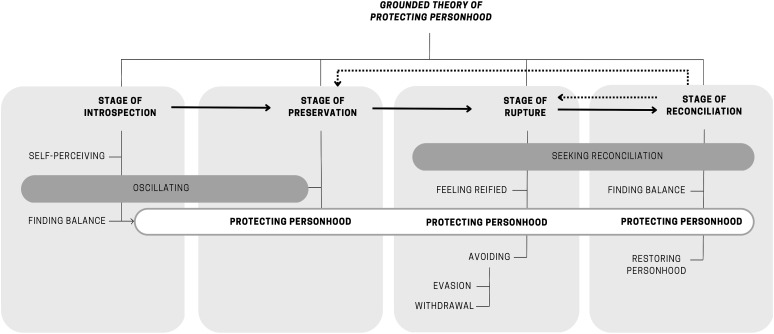
The importance of perceiving and considering patients as healthcare partners has been increasingly promoted. Healthcare systems around the world are now highly interested in patient engagement, participation, collaboration, and partnership. Healthcare professionals are advised that patients, as autonomous beings, should be active in and responsible for a portion of their own care. The study presented here focused on patients' perceptions of interprofessional collaboration. It was conducted using the classic grounded theory methodology. The theory of protecting personhood emerged as the core concept of hospitalized patients, cared for by interprofessional healthcare teams. This theory encapsulates the process hospitalized patients go through to find balance in their sense of self, oscillating between personhood and patienthood in the unfamiliar hospital environment. The process consists of four stages: the stage of introspection, during which hospitalized patients become aware of their self as a person and as a patient; the stage of preservation, when patients find a balance between the sense of personhood and patienthood; the stage of rupture, wherein patients experience an imbalance between their sense of personhood and patienthood; and the stage of reconciliation, in which personhood is restored. The theory of protecting personhood offers insights into a better understanding of hospitalized patients' experiences and strategies, revealing the importance of relationships, and the driving force of empowerment. This study is about patients' perspectives of interprofessional healthcare teams. A grounded theory process allowed the emergence of patients' concerns and expectations, leading to a substantive theory grounded in the patients' data.
越来越多的人认识到并关注将患者视为医疗保健合作伙伴的重要性。全球的医疗体系现在非常关注患者的参与、合作和伙伴关系。建议医疗保健专业人员认识到,作为自主个体,患者应该积极参与并对自身的一部分护理负责。本研究重点关注患者对跨专业协作的看法。它是使用经典扎根理论方法进行的。保护人格的理论是由接受跨专业医疗团队护理的住院患者的核心概念。这一理论涵盖了住院患者在陌生的医院环境中寻找自我平衡的过程,他们在个体性和患者性之间不断摆动。这一过程包括四个阶段:自省阶段,在此期间住院患者开始意识到自己作为个体和患者的身份;保护阶段,患者在个体性和患者性之间找到平衡;破裂阶段,患者体验到个体性和患者性之间的不平衡;和解阶段,人格得到恢复。保护人格的理论深入了解了住院患者的体验和策略,揭示了人际关系的重要性和赋权的驱动力。本研究关注的是患者对跨专业医疗团队的看法。扎根理论的过程使患者的关注点和期望得以显现,从而产生了一种基于患者数据的实质性理论。