von Einem Jobst C, Peter Sylvia, Günther Christine, Volk Hans-Dieter, Grütz Gerald, Salat Christoph, Stoetzer Oliver, Nelson Peter J, Michl Marlies, Modest Dominik P, Holch Julian W, Angele Martin, Bruns Christiane, Niess Hanno, Heinemann Volker
Department of Medical Oncology and Comprehensive Cancer Center, University Hospital Grosshadern, LMU, Munich, Germany.
Apceth GmbH & Co. KG, Munich, Germany.
Oncotarget. 2017 Sep 16;8(46):80156-80166. doi: 10.18632/oncotarget.20964. eCollection 2017 Oct 6.
This phase I, first in human, first in class clinical study aimed at evaluating the safety, tolerability and efficacy of treatment with genetically modified mesenchymal stromal cells (MSC) in combination with ganciclovir (GCV). MSC_apceth_101 are genetically modified autologous MSCs used as vehicles for a cell-based gene therapy in patients with advanced gastrointestinal adenocarcinoma.
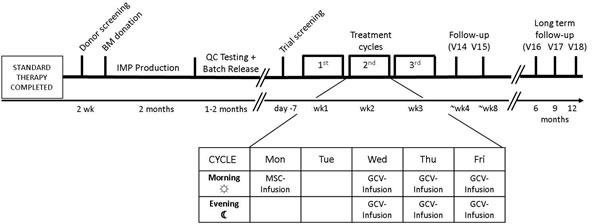
The study design consisted of a dose-escalation 3 + 3 design. All patients ( = 6) were treated with up to three applications of MSC_apceth_101, followed by GCV infusions given on three consecutive days starting 48 hours after injection of MSC_apceth_101. Three of six patients received a total dose of 1.5 × 10 cells/kg. Two patients received three doses of 1 × 10 cells/kg, while one patient received only two doses of 1 × 10 cells/kg due to a SADR.
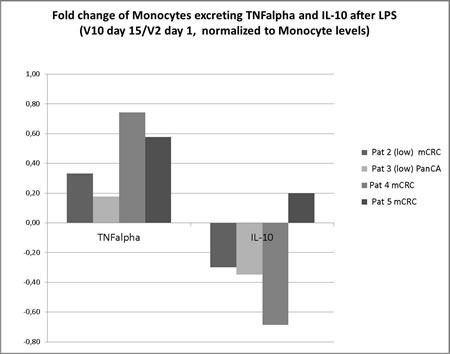
Six patients received MSC_apceth_101. No IMP-related serious adverse events occurred. Adverse-events related to IMP-injection were increased creatinine, cough, fever, and night sweat. TNF, IL-6, IL-8, IL-10 and sE-Selectin, showed that repeated application is immunologically safe, but induces a switch of the functional properties of monocytes to an inflammatory phenotype. Treatment induced stable disease in 4/6 patients, and progressive disease in 2/6 patients.
Treatment with MSC_apceth_101 in combination with GCV demonstrated acceptable safety and tolerability in patients with advanced gastrointestinal adenocarcinoma.
本I期临床研究是首例人体、首例同类临床研究,旨在评估基因改造的间充质基质细胞(MSC)联合更昔洛韦(GCV)治疗的安全性、耐受性和疗效。MSC_apceth_101是基因改造的自体MSC,用作晚期胃肠道腺癌患者基于细胞的基因治疗载体。
研究设计采用剂量递增的3+3设计。所有患者(n=6)接受多达三次的MSC_apceth_101治疗,随后在注射MSC_apceth_101后48小时开始连续三天进行GCV输注。6名患者中有3名接受了1.5×10⁶细胞/kg的总剂量。2名患者接受了三次1×10⁶细胞/kg的剂量,而1名患者因严重不良药物反应仅接受了两次1×10⁶细胞/kg的剂量。
6名患者接受了MSC_apceth_101治疗。未发生与研究用药物相关的严重不良事件。与研究用药物注射相关的不良事件有肌酐升高、咳嗽、发热和盗汗。肿瘤坏死因子、白细胞介素-6、白细胞介素-8、白细胞介素-10和可溶性E选择素表明,重复应用在免疫上是安全的,但会诱导单核细胞的功能特性转变为炎症表型。治疗使4/6的患者病情稳定,2/6的患者病情进展。
MSC_apceth_101联合GCV治疗在晚期胃肠道腺癌患者中显示出可接受的安全性和耐受性。