National Health Commission (NHC) Key Laboratory of Pulmonary Immune-Related Diseases, Guizhou Provincial People's Hospital, Guiyang, China.
Clinical Cancer Center, National Cancer Center/National Clinical Research Center for Cancer/Cancer Hospital, Chinese Academy of Medical Sciences and Peking Union Medical College, Beijing, China.
Front Immunol. 2022 Jul 18;13:896685. doi: 10.3389/fimmu.2022.896685. eCollection 2022.
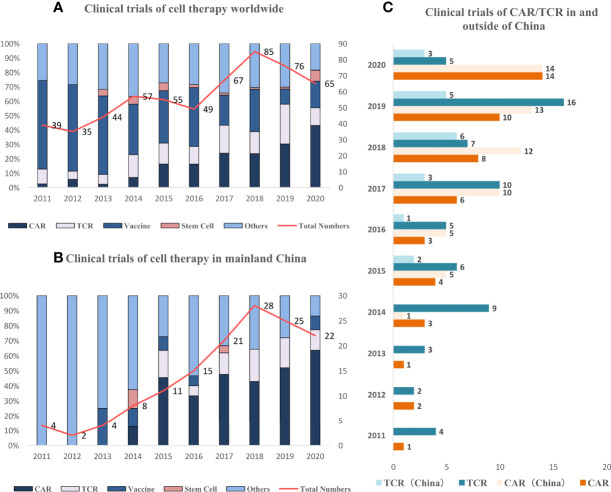
Cell therapy is a distinguished targeted immunotherapy with great potential to treat solid tumors in the new era of cancer treatment. Cell therapy products include genetically engineered cell products and non-genetically engineered cell products. Several recent cell therapies, especially chimeric antigen receptor (CAR)-T cell therapies, have been approved as novel treatment strategies for cancer. Many clinical trials on cell therapies, in the form of cell therapy alone or in combination with other treatments, in solid tumors, have been conducted or ongoing. However, there are still challenges since adverse events and the limited efficacy of cell therapies have also been observed. Here, we concisely summarize the clinical milestones of the conducted and ongoing clinical trials of cell therapy, introduce the evolution of CARs, discuss the challenges and limitations of these therapeutic modalities taking CAR-T as the main focus, and analyze the disparities in the regulatory policies in different countries.
细胞治疗是一种卓越的靶向免疫疗法,具有很大的潜力,可在癌症治疗的新时代治疗实体瘤。细胞治疗产品包括基因工程细胞产品和非基因工程细胞产品。一些最近的细胞疗法,特别是嵌合抗原受体 (CAR)-T 细胞疗法,已被批准为癌症的新型治疗策略。许多细胞疗法的临床试验,无论是单独使用细胞疗法还是与其他治疗方法联合使用,都在实体瘤中进行或正在进行中。然而,仍然存在挑战,因为细胞疗法也观察到了不良反应和有限的疗效。在这里,我们简要总结了已进行和正在进行的细胞治疗临床试验的临床里程碑,介绍了 CAR 的演变,讨论了以 CAR-T 为重点的这些治疗方式的挑战和局限性,并分析了不同国家监管政策的差异。