Clinical Trial Service Unit and Epidemiological Studies Unit, Nuffield Department of Population Health, University of Oxford, Oxford, England.
Medical Research Council Population Health Research Unit, Nuffield Department of Population Health, University of Oxford, Oxford, England.
JAMA Cardiol. 2017 Dec 1;2(12):1349-1358. doi: 10.1001/jamacardio.2017.4069.
In China, the patterns and levels of physical activity differed from those in high-income countries. Substantial uncertainty remains about the relevance, both qualitatively and quantitatively, of domain-specific physical activity for cardiovascular disease (CVD) subtypes in Chinese adults.
To assess the shape and strength of the associations of total, occupational, and nonoccupational physical activity with CVD subtypes in Chinese men and women.
DESIGN, SETTING, AND PARTICIPANTS: This population-based prospective cohort study in 10 (5 urban, 5 rural) areas across China included 487 334 adults who were aged 30 to 79 (mean 51) years with no prior CVD history when enrolled from June 2004 to July 2008.
Self-reported total, occupational, and nonoccupational physical activity, quantified as metabolic equivalent of task hours per day (MET-h/d) based on the type, frequency, and duration of specific activities.
Major vascular events (n = 36 184) and their components, including major coronary events (n = 5082), ischemic stroke (n = 25 647), intracerebral hemorrhage (n = 5252), and CVD death (n = 8437). Cox regression yielded adjusted hazard ratios for each disease that was associated with physical activity.
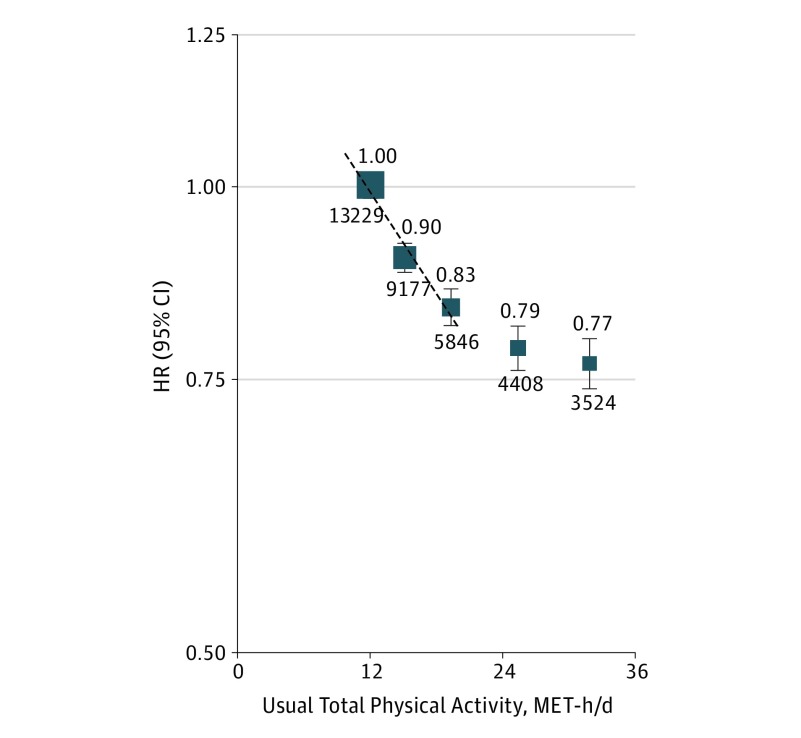
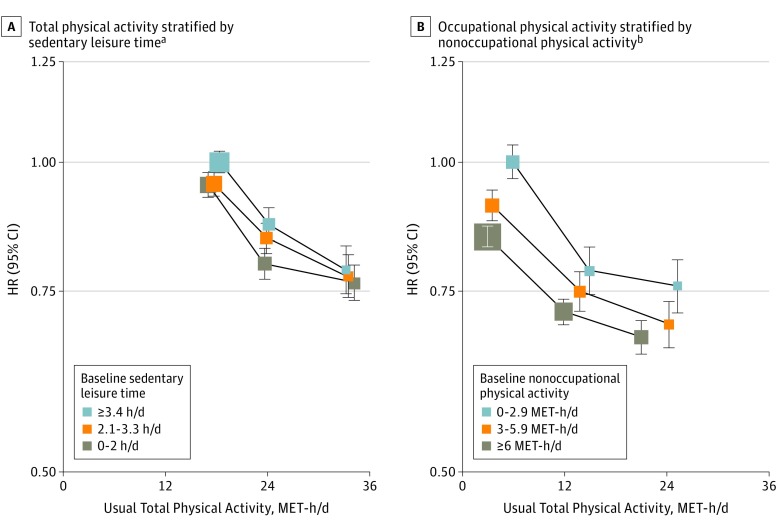
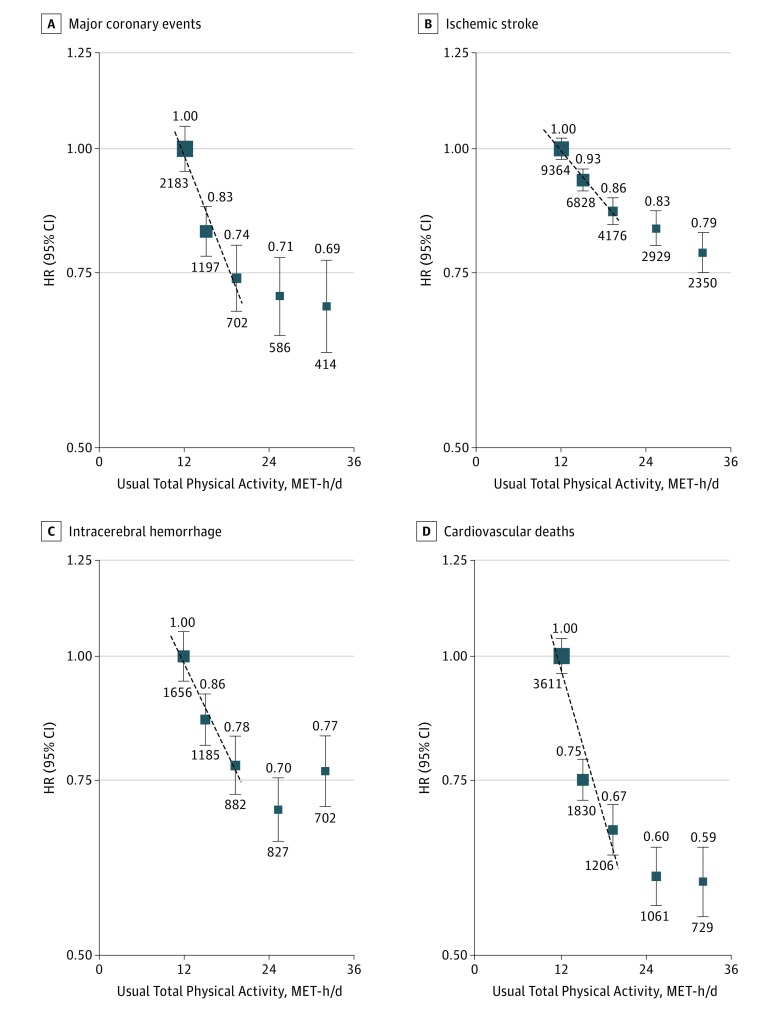
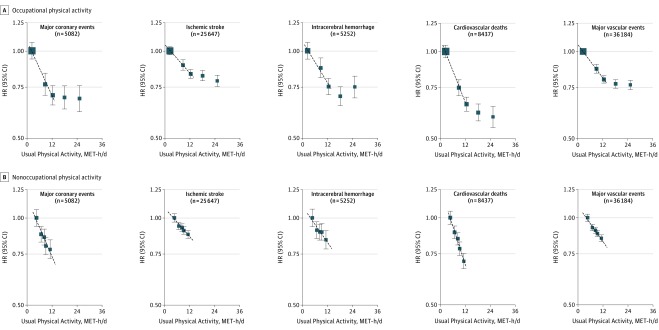
Of the 487 334 study participants, 287 527 (59%) were women and the mean (SD) age was 51 (10.5) years. The overall mean (SD) total physical activity was 21.5 (12.8) MET-h/d, mainly from occupational activity, especially among men (75% vs 50% in women). Total physical activity was inversely associated with the risk of major vascular events, with the adjusted hazard ratio that compared the top vs bottom quintiles of physical activity being 0.77 (95% CI, 0.74-0.80). Throughout the range of total physical activity studied, the association with CVD with each 4 MET-h/d higher usual total physical activity (approximately 1 hour of brisk walking per day) associated with a 6% (95% CI, 5%-7%) lower risk of major vascular events, and a 9%, 5%, 6%, and 12% lower risk of major coronary events, ischemic stroke, intracerebral hemorrhage, and CVD death, respectively. The strength of the associations was similar and independent of each other for occupational and nonoccupational physical activity. However, for occupational physical activity, the associations with CVD subtypes were greatly attenuated above 20 MET-h/d, especially for intracerebral hemorrhage. The associations of total physical activity with major vascular events were similar among men and women and across different levels of sedentary leisure time but were much weaker among individuals with high blood pressure.
Among Chinese adults, higher occupational or nonoccupational physical activity was associated with significantly lower risks of major CVD.
在中国,体力活动的模式和水平与高收入国家不同。对于中国成年人的心血管疾病(CVD)亚型,特定领域的体力活动在定性和定量方面的相关性仍存在很大的不确定性。
评估总体力活动、职业体力活动和非职业体力活动与中国男女 CVD 亚型之间的关联的形态和强度。
设计、地点和参与者:这项基于人群的前瞻性队列研究在中国 10 个(5 个城市,5 个农村)地区进行,纳入了 487334 名年龄在 30 至 79 岁(平均 51 岁)、无既往 CVD 病史的成年人,他们于 2004 年 6 月至 2008 年 7 月期间参加研究。
自我报告的总体力活动、职业体力活动和非职业体力活动,根据特定活动的类型、频率和持续时间,以代谢当量任务小时/天(MET-h/d)来量化。
主要血管事件(n=36184)及其组成部分,包括主要冠状动脉事件(n=5082)、缺血性卒中(n=25647)、颅内出血(n=5252)和 CVD 死亡(n=8437)。Cox 回归分析得出了与体力活动相关的每种疾病的调整后风险比。
在 487334 名研究参与者中,287527 名(59%)为女性,平均(SD)年龄为 51(10.5)岁。总体平均(SD)总体力活动为 21.5(12.8)MET-h/d,主要来自职业活动,尤其是男性(75%比女性的 50%)。总体力活动与主要血管事件的风险呈负相关,体力活动最高五分位组与最低五分位组相比,调整后的风险比为 0.77(95%CI,0.74-0.80)。在研究的总体力活动范围内,与 CVD 相关的是,与通常每天进行 4MET-h/d 更高的总体力活动(约 1 小时快走)相关的风险降低 6%(95%CI,5%-7%),主要冠状动脉事件、缺血性卒中、颅内出血和 CVD 死亡的风险分别降低 9%、5%、6%和 12%。职业和非职业体力活动的关联强度相似且相互独立。然而,对于职业体力活动,当体力活动超过 20MET-h/d 时,与 CVD 亚型的关联会大大减弱,尤其是颅内出血。总体力活动与主要血管事件之间的关联在男性和女性以及不同水平的久坐休闲时间中相似,但在高血压患者中要弱得多。
在中国成年人中,较高的职业或非职业体力活动与显著较低的主要 CVD 风险相关。