Department of Occupational and Environmental Health, School of Public Health, Tongji Medical College, Huazhong University of Science and Technology, Wuhan, China.
Key Laboratory of Environment and Health in Ministry of Education &Ministry of Environmental Protection, and State Key Laboratory of Environmental Health (Incubating), School of Public Health, Tongji Medical College, Huazhong University of Science and Technology, Wuhan, China.
Sci Rep. 2017 Jan 4;7:39939. doi: 10.1038/srep39939.
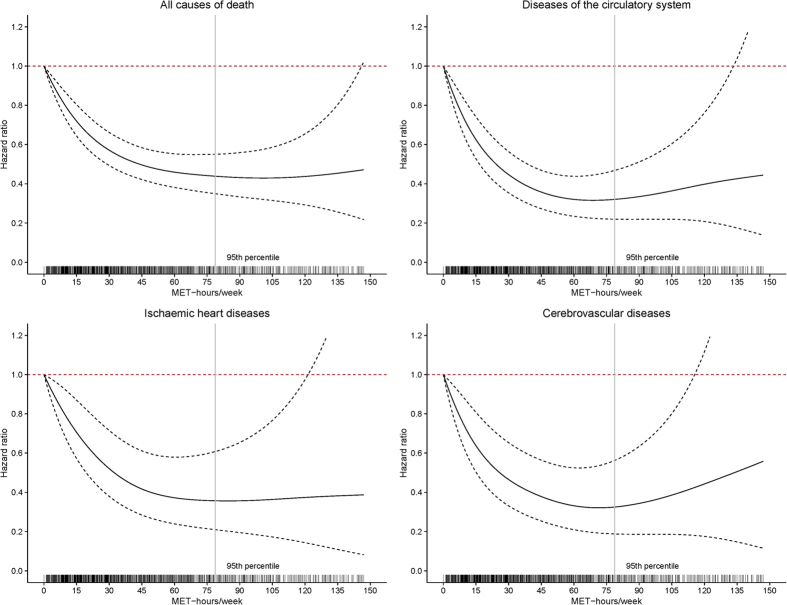
Association between physical activity and mortality has rarely been investigated among the Chinese population. Furthermore, the most appropriate amount of physical activity for longevity benefits remains unclear. We used data from the Dongfeng-Tongji cohort, including 24,606 middle-aged and older retired adults in 2008 and followed to 2013, to quantify linear and non-linear dose-response relationships between regular physical activity and mortality risks by Cox proportional hazards model. Compared with participants who did not engage in regular physical activity, those performing regular physical activity had significantly 46%, 56%, and 49% decreased risks of mortality from all causes, circulatory, and respiratory diseases, respectively. Each one-SD increase in regular physical activity was associated with 32% decrease of respiratory disease mortality. There were significant nonlinear dose-response associations between regular physical activity and mortality from all causes and circulatory diseases. Mortality risks decreased monotonically with increased regular physical activity amount, and appeared to reach a threshold at around 100 MET-hours/week. More mortality benefits were found among non-smokers than that among current and former smokers. Our results suggest that middle-aged and older Chinese adults can achieve mortality benefits from regular physical activity at the WHO recommended minimum, and the benefit threshold appears at approximately 100 MET hours/week.
在中国人群中,体力活动与死亡率之间的关系很少被研究。此外,最适宜的体力活动量以获得长寿益处仍不清楚。我们使用了来自东风-同济队列的数据,该队列包括 2008 年的 24606 名中老年退休人员,并随访至 2013 年,通过 Cox 比例风险模型定量分析了规律体力活动与死亡率风险之间的线性和非线性剂量反应关系。与不进行规律体力活动的参与者相比,进行规律体力活动的参与者死于各种原因、循环系统和呼吸系统疾病的风险分别显著降低了 46%、56%和 49%。规律体力活动每增加一个标准差,与呼吸系统疾病死亡率降低 32%相关。规律体力活动与各种原因和循环系统疾病死亡率之间存在显著的非线性剂量反应关系。死亡率随着规律体力活动量的增加而单调下降,并且似乎在每周约 100MET 小时处达到一个阈值。在不吸烟者中发现的死亡率降低益处大于当前和曾经吸烟者。我们的结果表明,中年和老年中国成年人可以从世界卫生组织推荐的最低水平的规律体力活动中获得死亡率降低益处,并且益处阈值出现在每周约 100MET 小时左右。