Department of Intelligent Interaction Technology, Graduate School of Systems and Information Engineering, University of Tsukuba, 1-1-1, Tennodai, Tsukuba-shi, Ibaraki 305-8573, Japan.
Rhythm-based Brain Information Processing Unit, RIKEN BSI-TOYOTA Collaboration Center, 2-1, Hirosawa, Wako-shi, Saitama, 351-0198, Japan.
Sci Rep. 2017 Nov 8;7(1):15034. doi: 10.1038/s41598-017-14508-4.
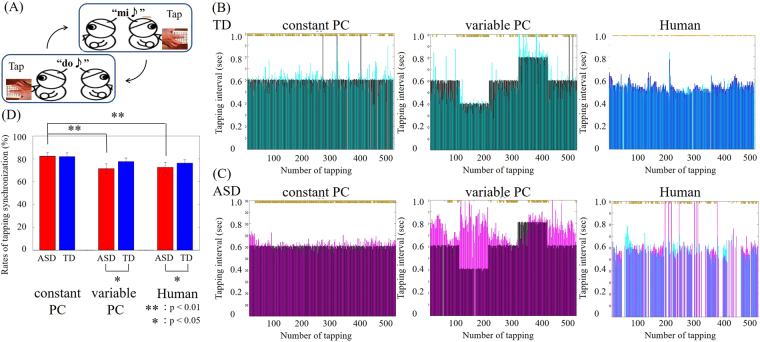
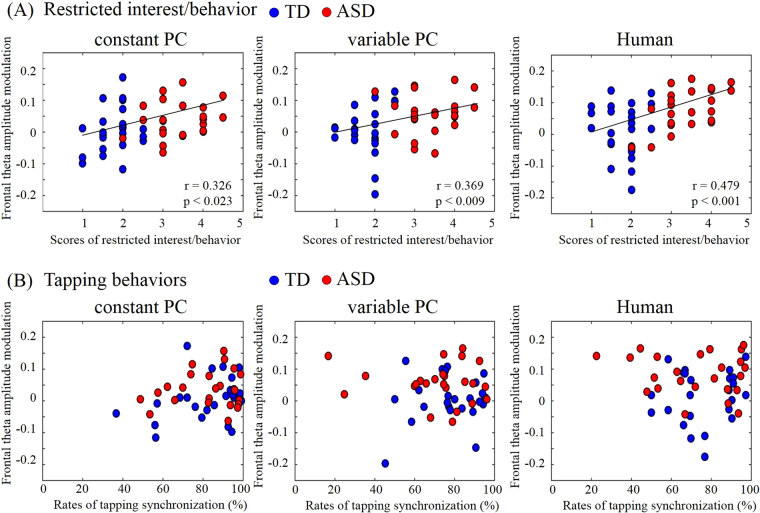
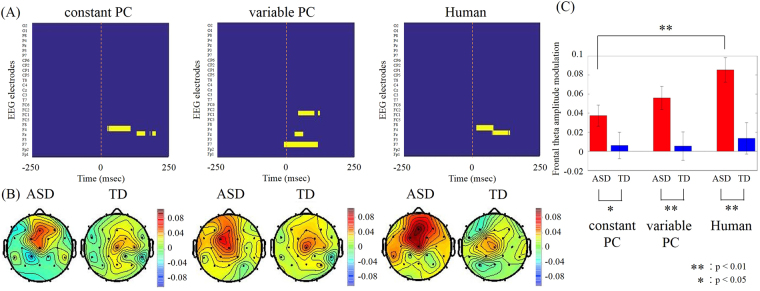
Autism is characterized by two primary characteristics: deficits in social interaction and repetitive behavioral patterns. Because interpersonal communication is extremely complicated, its underlying brain mechanisms remain unclear. Here we showed that both characteristics can be explained by a unifying underlying mechanism related to difficulties with irregularities. To address the issues, we measured electroencephalographm during a cooperative tapping task, which required participants to tap a key alternately and synchronously with constant rhythmic a PC program, a variable rhythmic PC program, or a human partner. We found that people with autism had great difficulty synchronizing tapping behavior with others, and exhibited greater than normal theta-wave (6 Hz) activity in the frontal cortex during the task, especially when their partner behaved somewhat irregularly (i.e. a variable rhythmic PC program or a human partner). Importantly, the higher theta-wave activity was related to the severity of autism, not the performance on the task. This indicates that people with autism need to use intense cognition when trying to adapt to irregular behavior and can easily become overtaxed. Difficulty adapting to irregular behavior in others is likely related to their own tendencies for repetitive and regular behaviors. Thus, while the two characteristics of autism have been comprehended separately, our unifying theory makes understanding the condition and developing therapeutic strategies more tractable.
社交互动障碍和重复行为模式。由于人际沟通极其复杂,其潜在的大脑机制仍不清楚。在这里,我们表明这两个特征可以用一个统一的潜在机制来解释,该机制与不规则性有关。为了解决这些问题,我们在合作敲击任务中测量了脑电图,该任务要求参与者与 PC 程序、可变节奏 PC 程序或人类伙伴交替并同步敲击一个键。我们发现自闭症患者很难与他人同步敲击行为,并且在任务期间额叶的θ波(6 Hz)活动明显增加,尤其是当他们的伙伴表现出一定程度的不规则性(即可变节奏 PC 程序或人类伙伴)时。重要的是,较高的θ波活动与自闭症的严重程度有关,而与任务表现无关。这表明自闭症患者在试图适应不规则行为时需要使用强烈的认知能力,并且很容易过度劳累。难以适应他人的不规则行为可能与他们自己的重复和规律行为倾向有关。因此,虽然自闭症的两个特征已分别被理解,但我们的统一理论使得对该疾病的理解和治疗策略的制定更具可操作性。