Cell Biology and Biophysics Unit, European Molecular Biology Laboratory, Heidelberg, Germany.
FEBS Lett. 2018 Feb;592(4):475-488. doi: 10.1002/1873-3468.12905. Epub 2017 Nov 22.
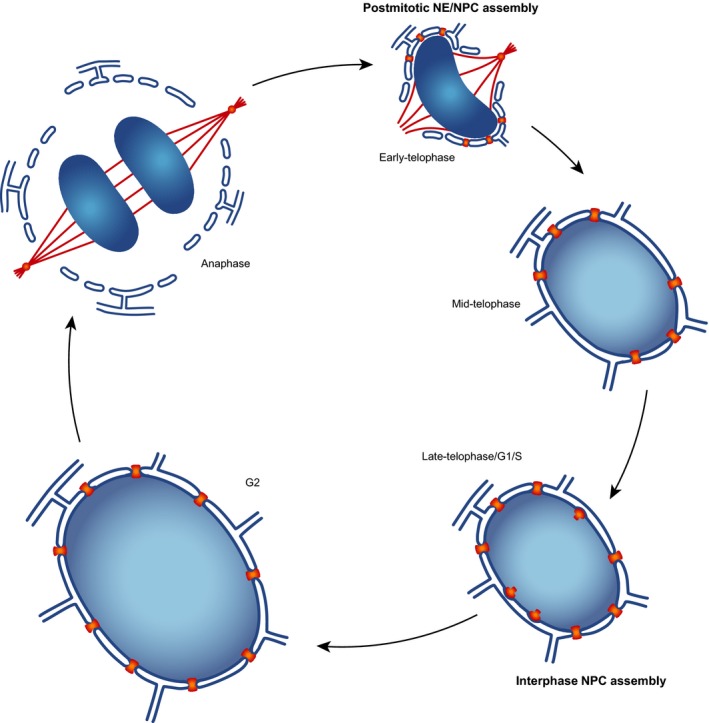
The nuclear pore complex (NPC) mediates all macromolecular transport across the nuclear envelope. In higher eukaryotes that have an open mitosis, NPCs assemble at two points in the cell cycle: during nuclear assembly in late mitosis and during nuclear growth in interphase. How the NPC, the largest nonpolymeric protein complex in eukaryotic cells, self-assembles inside cells remained unclear. Recent studies have started to uncover the assembly process, and evidence has been accumulating that postmitotic and interphase NPC assembly use fundamentally different mechanisms; the duration, structural intermediates, and regulation by molecular players are different and different types of membrane deformation are involved. In this Review, we summarize the current understanding of these two modes of NPC assembly and discuss the structural and regulatory steps that might drive the assembly processes. We furthermore integrate understanding of NPC assembly with the mechanisms for rapid nuclear growth in embryos and, finally, speculate on the evolutionary origin of the NPC implied by the presence of two distinct assembly mechanisms.
核孔复合体(NPC)介导核膜上所有大分子的运输。在具有开放有丝分裂的高等真核生物中,NPC 在细胞周期的两个时间点组装:在末期的核组装期间和在间期的核生长期间。NPC 是真核细胞中最大的非聚合蛋白复合物,其在细胞内如何自我组装仍然不清楚。最近的研究已经开始揭示组装过程,并且越来越多的证据表明有丝分裂后和间期 NPC 组装使用根本不同的机制;持续时间、结构中间体以及分子参与者的调节不同,并且涉及不同类型的膜变形。在这篇综述中,我们总结了目前对这两种 NPC 组装方式的理解,并讨论了可能驱动组装过程的结构和调节步骤。我们进一步将 NPC 组装的理解与胚胎中快速核生长的机制相结合,最后推测由两种不同组装机制存在所暗示的 NPC 的进化起源。