
P-糖蛋白在 Cyathostomins 的伊维菌素耐药性中发挥作用。
P-glycoproteins play a role in ivermectin resistance in cyathostomins.
机构信息
Institute of Infection and Global Health, University of Liverpool, Liverpool Science Park IC2, Brownlow Hill, Liverpool, United Kingdom.
Institute of Infection and Global Health, University of Liverpool, Liverpool Science Park IC2, Brownlow Hill, Liverpool, United Kingdom.
出版信息
Int J Parasitol Drugs Drug Resist. 2017 Dec;7(3):388-398. doi: 10.1016/j.ijpddr.2017.10.006. Epub 2017 Oct 25.
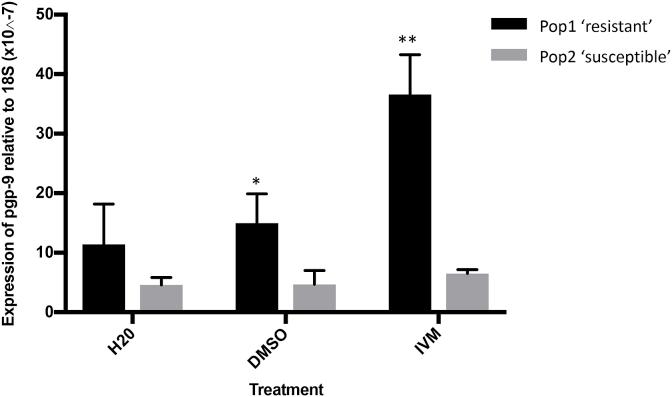
Anthelmintic resistance is a global problem that threatens sustainable control of the equine gastrointestinal cyathostomins (Phylum Nematoda; Superfamily Strongyloidea). Of the three novel anthelmintic classes that have reached the veterinary market in the last decade, none are currently licenced in horses, hence current control regimens focus on prolonging the useful lifespan of licenced anthelmintics. This approach would be facilitated by knowledge of the resistance mechanisms to the most widely used anthelmintics, the macrocyclic lactones (ML). There are no data regarding resistance mechanisms to MLs in cyathostomins, although in other parasitic nematodes, the ABC transporters, P-glycoproteins (P-gps), have been implicated in playing an important role. Here, we tested the hypothesis that P-gps are, at least in part, responsible for reduced sensitivity to the ML ivermectin (IVM) in cyathostomins; first, by measuring transcript levels of pgp-9 in IVM resistant versus IVM sensitive third stage larvae (L3) pre-and post-IVM exposure in vitro. We then tested the effect of a range of P-gp inhibitors on the effect of IVM against the same populations of L3 using the in vitro larval development test (LDT) and larval migration inhibition test (LMIT). We demonstrated that, not only was pgp-9 transcription significantly increased in IVM resistant compared to IVM sensitive L3 after anthelmintic exposure (p < 0.001), but inhibition of P-gp activity significantly increased sensitivity of the larvae to IVM in vitro, an effect only observed in the IVM resistant larvae in the LMIT. These data strongly implicate a role for P-gps in IVM resistance in cyathostomins. Importantly, this raises the possibility that P-gp inhibitor-IVM combination treatments might be used in vivo to increase the effectiveness of IVM against cyathostomins in Equidae.
抗蠕虫药物耐药性是一个全球性问题,威胁着马属动物胃肠道圆线虫(Nematoda 门;Strongyloidea 超科)的可持续控制。在过去十年中进入兽医市场的三种新型抗蠕虫药物类别中,目前没有一种在马中获得许可,因此目前的控制方案侧重于延长许可的抗蠕虫药物的使用寿命。如果了解最广泛使用的抗蠕虫药物——大环内酯类(ML)的耐药机制,这将很有帮助。虽然在其他寄生线虫中,ABC 转运蛋白、P-糖蛋白(P-gps)已被认为在发挥重要作用,但关于 ML 在圆线虫中的耐药机制尚无数据。在这里,我们通过测量体外暴露于伊维菌素(IVM)前后 IVM 抗性和 IVM 敏感的第三期幼虫(L3)中 pgp-9 的转录水平,首先检验了 P-gps 至少部分负责降低圆线虫对 ML 伊维菌素(IVM)敏感性的假设。然后,我们使用体外幼虫发育试验(LDT)和幼虫迁移抑制试验(LMIT)测试了一系列 P-gp 抑制剂对相同 L3 种群中 IVM 作用的影响。我们证明,不仅在抗药性幼虫中,而且在暴露于驱虫药后,IVM 抗性 L3 中的 pgp-9 转录显著高于 IVM 敏感 L3(p<0.001),而且 P-gp 活性抑制显著增加了幼虫对 IVM 的体外敏感性,仅在 LMIT 中观察到 IVM 抗性幼虫中存在这种作用。这些数据强烈表明 P-gps 在圆线虫中 IVM 耐药性中起作用。重要的是,这提出了一种可能性,即 P-gp 抑制剂-IVM 联合治疗可能在体内用于提高 IVM 对马属动物圆线虫的有效性。


 Zotero 插件