Quintana Theresa A, Brewer Matthew T, Chelladurai Jeba R Jesudoss
Department of Diagnostic Medicine and Pathobiology, College of Veterinary Medicine, Kansas State University, Manhattan, KS.
Department of Pathobiology, College of Veterinary Medicine, Auburn University, Auburn, AL.
bioRxiv. 2024 Dec 20:2024.12.20.629602. doi: 10.1101/2024.12.20.629602.
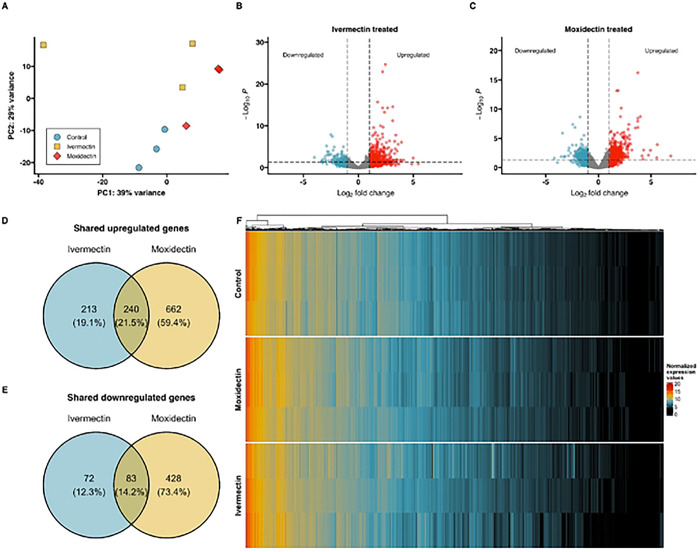
, the causative agent of zoonotic toxocariasis in humans, is a parasitic roundworm of canids with a complex lifecycle. While macrocyclic lactones (MLs) are successful at treating adult infections when used at FDA-approved doses in dogs, they fail to kill somatic third-stage larvae. In this study, we profiled the transcriptome of third-stage larvae derived from larvated eggs and treated with 10 μM of the MLs - ivermectin and moxidectin with Illumina sequencing. We analyzed transcriptional changes in comparison with untreated control larvae. In ivermectin-treated larvae, we identified 608 differentially expressed genes (DEGs), of which 453 were upregulated and 155 were downregulated. In moxidectin-treated larvae, we identified 1,413 DEGs, of which 902 were upregulated and 511 were downregulated. Notably, many DEGs were involved in critical biological processes and pathways including transcriptional regulation, energy metabolism, neuronal structure and function, physiological processes such as reproduction, excretory/secretory molecule production, host-parasite response mechanisms, and parasite elimination. We also assessed the expression of known ML targets and transporters, including glutamate-gated chloride channels (GluCls), and ATP-binding cassette (ABC) transporters, subfamily B, with a particular focus on P-glycoproteins (P-gps). We present gene names for previously uncharacterized GluCl genes using phylogenetic analysis of nematode orthologs to provide uniform gene nomenclature. Our study revealed that the expression of and six ABCB genes, particularly four P-gps, were significantly altered in response to ML treatment. Compared to controls, , , and were downregulated in ivermectin-treated larvae, while , , , and were downregulated in moxidectin-treated larvae. Conversely, and were upregulated in moxidectin-treated larvae. These findings suggest that MLs broadly impact transcriptional regulation in larvae.
犬弓首线虫是人类兽源性弓首线虫病的病原体,是一种具有复杂生命周期的犬科寄生蛔虫。虽然大环内酯类药物(MLs)以美国食品药品监督管理局(FDA)批准的剂量用于犬类时,在治疗成虫感染方面很成功,但它们无法杀死体细胞第三期幼虫。在本研究中,我们对源自含幼虫卵并经10 μM的MLs(伊维菌素和莫西菌素)处理的第三期幼虫的转录组进行了测序分析。我们分析了与未处理的对照幼虫相比的转录变化。在伊维菌素处理的幼虫中,我们鉴定出608个差异表达基因(DEGs),其中453个上调,155个下调。在莫西菌素处理的幼虫中,我们鉴定出1413个DEGs,其中902个上调,511个下调。值得注意的是,许多DEGs参与了关键的生物学过程和途径,包括转录调控、能量代谢、神经元结构和功能、诸如繁殖、排泄/分泌分子产生、宿主 - 寄生虫反应机制以及寄生虫清除等生理过程。我们还评估了已知的ML靶点和转运蛋白的表达,包括谷氨酸门控氯离子通道(GluCls)和ATP结合盒(ABC)转运蛋白B亚家族,特别关注P - 糖蛋白(P - gps)。我们通过对线虫直系同源物的系统发育分析,为以前未表征的GluCl基因提供基因名称,以提供统一的基因命名法。我们的研究表明,ML处理后,犬弓首线虫的一个基因和六个ABCB基因,特别是四个P - gps的表达发生了显著变化。与对照组相比,伊维菌素处理的幼虫中,某基因、某基因和某基因下调,而莫西菌素处理的幼虫中,某基因、某基因、某基因和某基因下调。相反,莫西菌素处理的幼虫中某基因和某基因上调。这些发现表明,MLs广泛影响犬弓首线虫幼虫的转录调控。