Graduate School of Life Science, Hokkaido University, Sapporo, 060-0810, Japan.
Department of Biological Sciences, Faculty of Science, Hokkaido University, Sapporo, 060-0810, Japan.
Sci Rep. 2017 Nov 9;7(1):15158. doi: 10.1038/s41598-017-15276-x.
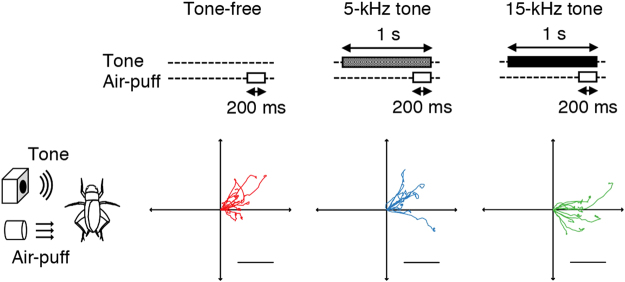
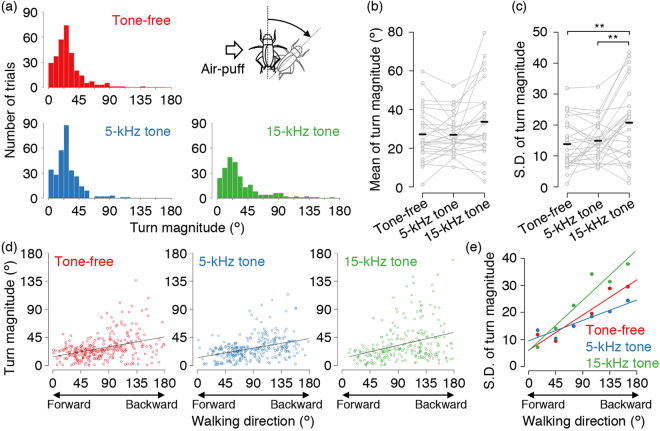
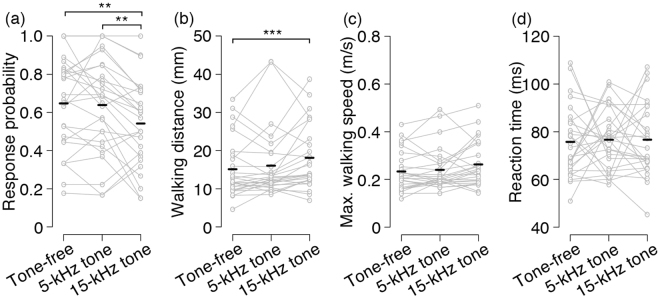
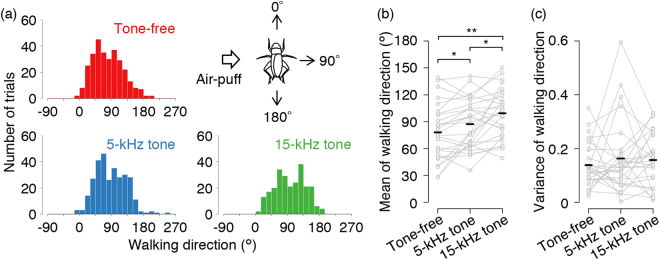
Acoustic signals trigger various behaviours in insects such as courtship or escape from predators. However, it remains unknown whether insects utilize acoustic signals to recognize environmental contexts. The cricket is a prominent model insect for neuroethological studies on acoustic behaviour because female crickets exhibit positive phonotaxis in response to male calling songs, and flying crickets display avoidance behaviour for high-frequency sounds such as echolocation call of bats. The carrier frequency of these sounds is a major factor in determining whether they initiate these acoustic behaviours. Here, we examined the impacts of different frequencies of tone sounds on cercal-mediated escape behaviour, using a 5-kHz tone corresponding to the calling song and a 15-kHz tone serving as a trigger of avoidance behaviours. Neither frequency elicited a response in the standing cricket by itself, but they had different impacts on walking responses to airflow stimuli. While the 15-kHz tone reduced response probability, extended moving distance, and enhanced turn-angle variability, the 5-kHz tone had no effect. Although both frequencies of tones facilitated walking backward, the 15-kHz tone had a larger effect than the 5-kHz tone. These frequency dependencies of behavioural modulation suggest that crickets can recognize acoustic contexts and alter their escape strategy accordingly.
声学信号会引发昆虫的各种行为,如求偶或逃避捕食者。然而,目前尚不清楚昆虫是否利用声学信号来识别环境背景。蟋蟀是研究声学行为的神经生态学的重要模式昆虫,因为雌性蟋蟀会对雄性求爱歌曲产生积极的声向性,而飞行的蟋蟀会对蝙蝠的回声定位叫声等高频声音表现出回避行为。这些声音的载波频率是决定它们是否引发这些声学行为的主要因素。在这里,我们使用与求爱歌曲对应的 5 kHz 调声音和作为回避行为触发的 15 kHz 调声音,研究了不同频率的音调声音对尾须介导的逃避行为的影响。单独的这两种频率都不会引起静止蟋蟀的反应,但它们对气流刺激的行走反应有不同的影响。虽然 15 kHz 的调声音降低了反应的可能性,延长了移动距离,并增加了转弯角度的可变性,但 5 kHz 的调声音没有影响。虽然两种频率的调声音都促进了向后行走,但 15 kHz 的调声音比 5 kHz 的调声音的效果更大。这些行为调制的频率依赖性表明,蟋蟀可以识别声学环境,并相应地改变它们的逃避策略。