Tsurukiri Junya, Ohta Shoichi, Hoshiai Akira, Sano Hidefumi, Okumura Eitaro, Tsubouchi Nobuhiko, Konishi Hiroyuki, Yukioka Tetsuo
Emergency and Critical Care Medicine Tokyo Medical University Hachioji Medical Center Tokyo Japan.
Emergency and Disaster Medicine Tokyo Medical University Tokyo Japan.
Acute Med Surg. 2017 Mar 6;4(2):145-151. doi: 10.1002/ams2.264. eCollection 2017 Apr.
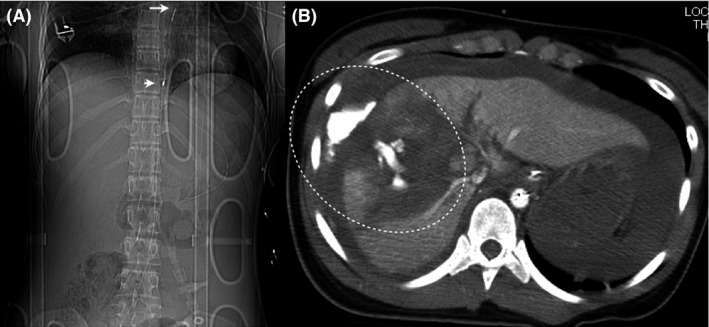
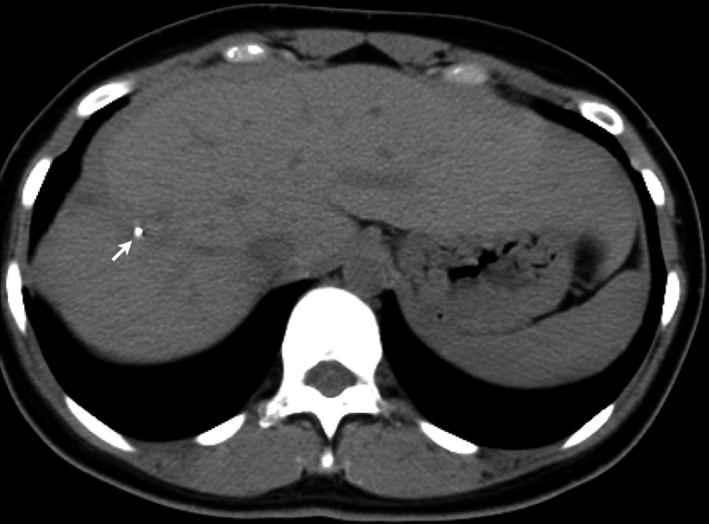
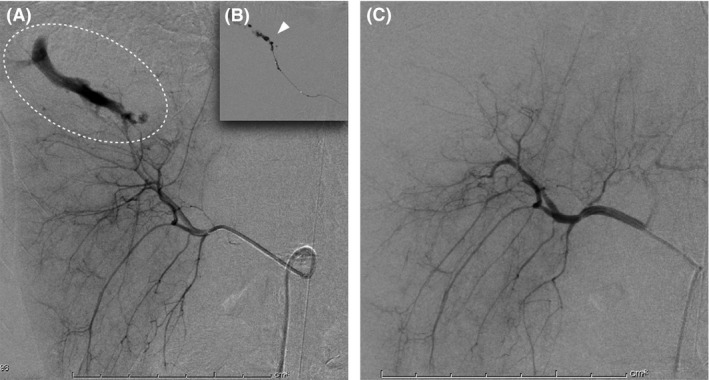
Trauma patients with uncontrolled hemorrhage encountering coagulopathy are often associated with poor outcome. Recently, the concept of damage control interventional radiology, which focuses on "speedy stoppage of bleeding" by interventional radiology among trauma patients with hemodynamic instability and acute traumatic coagulopathy, was proposed as an alternative to damage control surgery. N-butyl cyanoacrylate (NBCA) has been used as a liquid embolic agent in various non-traumatic situations, where it has been shown to have a high technical success rate and low recurrent bleeding rate, especially in patients with coagulopathy. In this case, we treated a young patient with hemodynamic instability caused by a high-grade hepatic injury, who underwent arterial embolization (AE) using NBCA assisted with resuscitative endovascular balloon occlusion of the aorta and achieved successful hemostasis. A review of published works using PUBMED was carried out, and 10 published reports involving 23 trauma patients who underwent AE using NBCA were identified. Among them, only four reports involving five trauma patients with torso visceral injuries were identified. Three of five patients who were hemodynamically unstable underwent AE using NBCA, resulting in the stabilization of hemodynamics. We concluded that AE with resuscitative endovascular balloon occlusion of the aorta as a damage control interventional radiology procedure might be acceptable for the hemodynamically unstable hepatic injury, and NBCA could be one of the effective hemostatic agents for this purpose, in cases of trauma-induced coagulopathy.
合并凝血功能障碍且出血无法控制的创伤患者往往预后不良。最近,提出了损伤控制介入放射学的概念,其通过介入放射学对血流动力学不稳定和急性创伤性凝血功能障碍的创伤患者进行“快速止血”,作为损伤控制手术的替代方法。氰基丙烯酸正丁酯(NBCA)已在各种非创伤情况下用作液体栓塞剂,已证明其技术成功率高且再出血率低,尤其是在凝血功能障碍患者中。在此病例中,我们治疗了一名因严重肝损伤导致血流动力学不稳定的年轻患者,该患者在复苏性血管内主动脉球囊阻断辅助下使用NBCA进行了动脉栓塞(AE),并成功止血。我们使用PUBMED对已发表的文献进行了回顾,共识别出10篇已发表的报告,涉及23例使用NBCA进行AE的创伤患者。其中,仅识别出4篇报告,涉及5例躯干内脏损伤的创伤患者。5例血流动力学不稳定的患者中有3例使用NBCA进行了AE,血流动力学得以稳定。我们得出结论,作为一种损伤控制介入放射学程序,复苏性血管内主动脉球囊阻断辅助下的AE对于血流动力学不稳定的肝损伤可能是可行的,并且在创伤性凝血功能障碍的情况下,NBCA可能是用于此目的的有效止血剂之一。