Liu Xiaoping
Davis Heart and Lung Research Institute, Department of Internal Medicine, The Ohio State University College of Medicine, 420 West 12th Avenue, Columbus, OH 43210, USA.
Biochem Biophys Rep. 2015 Oct 1;4:228-233. doi: 10.1016/j.bbrep.2015.09.020. eCollection 2015 Dec.
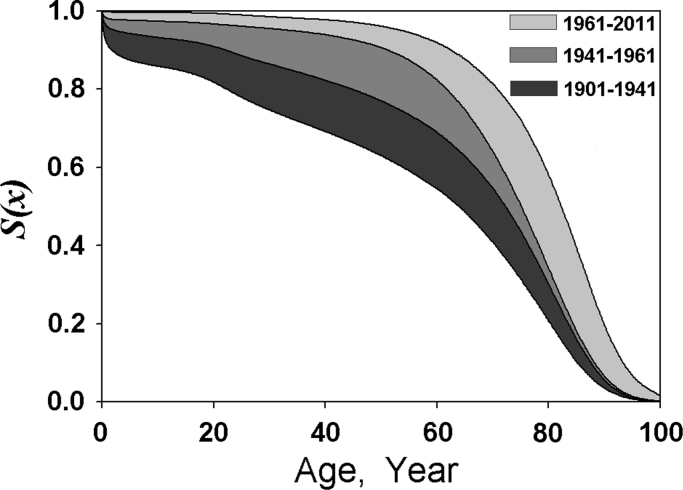
The Gompertz law of mortality quantitatively describes the mortality rate of humans and almost all multicellular animals. However, its underlying kinetic mechanism is unclear. The Gompertz law cannot explain the mortality plateau at advanced ages and cannot give an explicit relationship between temperature and mortality. In this study a reaction kinetics model with a time dependent rate coefficient is proposed to describe the survival and senescence processes. A temperature-dependent mortality function was derived. The new mortality function becomes the Gompertz mortality function with the same relationship of parameters prescribed by the Strehler-Mildvan correlation when age is smaller than a characteristic value , and reaches the mortality plateau when age is greater than . A closed-form analytical expression for describing the relationship of average lifespan with temperature and other equations are derived from the new mortality function. The derived equations can be used to estimate the limit of average lifespan, predict the maximal longevity, calculate the temperature coefficient of lifespan, and explain the tendency of the survival curve. This prediction is consistent with the most recently reported mortality trajectories for single-year birth cohorts. This study suggests that the senescence process results from the imbalance between damaging energy and protecting energy for the critical chemical substance in the body. The rate of senescence of the organism increases while the protecting energy decreases. The mortality plateau is reached when the protecting energy decreases to its minimal levels. The decreasing rate of the protecting energy is temperature-dependent. This study is exploring the connection between the biochemical mechanism and demography.
冈珀茨死亡率定律定量描述了人类以及几乎所有多细胞动物的死亡率。然而,其潜在的动力学机制尚不清楚。冈珀茨定律无法解释高龄时的死亡率平稳期,也无法给出温度与死亡率之间的明确关系。在本研究中,提出了一个具有时间依赖性速率系数的反应动力学模型来描述生存和衰老过程。推导了一个温度依赖性死亡率函数。当年龄小于一个特征值时,新的死亡率函数成为具有由斯特勒 - 米尔德万相关性规定的相同参数关系的冈珀茨死亡率函数,而当年龄大于该特征值时达到死亡率平稳期。从新的死亡率函数推导出了一个用于描述平均寿命与温度关系的闭式解析表达式以及其他方程。所推导的方程可用于估计平均寿命的极限、预测最大寿命、计算寿命的温度系数以及解释生存曲线的趋势。这一预测与最近报道的单年出生队列的死亡率轨迹一致。本研究表明,衰老过程是由于体内关键化学物质的破坏能量与保护能量之间的失衡所致。随着保护能量的减少,生物体的衰老速率增加。当保护能量降至最低水平时达到死亡率平稳期。保护能量的下降速率是温度依赖性的。本研究正在探索生化机制与人口统计学之间的联系。