Department of Emergency, Tongji Hospital, Huazhong University of Science and Technology, Wuhan, China.
Selzman Institute for Kidney Health, Section of Nephrology, Department of Medicine, Baylor College of Medicine, Houston, Texas.
J Am Soc Nephrol. 2018 Feb;29(2):505-517. doi: 10.1681/ASN.2017030290. Epub 2017 Nov 10.
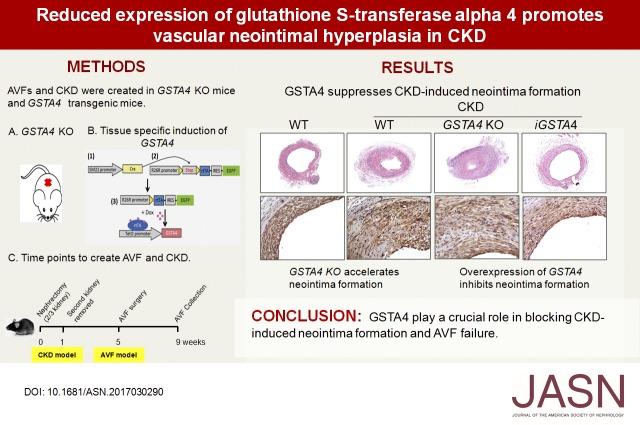
Neointima formation is the leading cause of arteriovenous fistula (AVF) failure. We have shown that CKD accelerates this process by transforming the vascular smooth muscle cells (SMCs) lining the AVF from a contractile to the synthetic phenotype. However, the underlying mechanisms affecting this transformation are not clear. Previous studies have shown that the -class glutathione transferase isozymes have an important role in regulating 4-hydroxynonenal (4-HNE)-mediated proliferative signaling of cells. Here, using both the loss- and gain-of-function approaches, we investigated the role of glutathione S-transferase 4 (GSTA4) in modulating cellular 4-HNE levels for the transformation and proliferation of SMCs. Compared with non-CKD controls, mice with CKD had downregulated expression of GSTA4 at the mRNA and protein levels, with concomitant increase in 4-HNE in arteries and veins. This effect was associated with upregulated phosphorylation of MAPK signaling pathway proteins in proliferating SMCs. Overexpressing GSTA4 blocked 4-HNE-induced SMC proliferation. Additionally, inhibitors of MAPK signaling inhibited the 4-HNE-induced responses. Compared with wild-type mice, mice lacking exhibited increased CKD-induced neointima formation in AVF. Transient expression of an activated form of GSTA4, achieved using a combined Tet-On/Cre induction system in mice, lowered levels of 4-HNE and reduced the proliferation of SMCs. Together, these results demonstrate the critical role of GSTA4 in blocking CKD-induced neointima formation and AVF failure.
新内膜形成是动静脉瘘(AVF)失功的主要原因。我们已经表明,CKD 通过将 AVF 血管平滑肌细胞(SMCs)从收缩表型转变为合成表型来加速这一过程。然而,影响这种转变的潜在机制尚不清楚。先前的研究表明,β 类谷胱甘肽转移酶同工酶在调节 4-羟基壬烯醛(4-HNE)介导的细胞增殖信号中具有重要作用。在这里,我们使用功能丧失和功能获得两种方法,研究了谷胱甘肽 S-转移酶 4(GSTA4)在调节细胞 4-HNE 水平以促进 SMC 转化和增殖中的作用。与非 CKD 对照组相比,CKD 小鼠的 GSTA4 在 mRNA 和蛋白水平的表达下调,同时动脉和静脉中的 4-HNE 增加。这种作用与增殖的 SMC 中 MAPK 信号通路蛋白磷酸化的上调有关。过表达 GSTA4 阻断了 4-HNE 诱导的 SMC 增殖。此外,MAPK 信号通路抑制剂抑制了 4-HNE 诱导的反应。与野生型小鼠相比,缺乏 Gsta4 的小鼠在 AVF 中表现出增加的 CKD 诱导的新生内膜形成。在小鼠中使用 Tet-On/Cre 诱导系统实现的 GSTA4 激活形式的瞬时表达降低了 4-HNE 水平并减少了 SMC 的增殖。综上所述,这些结果表明 GSTA4 在阻断 CKD 诱导的新生内膜形成和 AVF 失功方面起着关键作用。