University of Massachusetts Medical School, 365 Plantation Street, Worcester, MA 01605, USA.
University of Massachusetts Medical School, 365 Plantation Street, Worcester, MA 01605, USA; Center of Alcohol Studies, Rutgers University, 607 Allison Road, Piscataway, NJ 08854, USA.
J Subst Abuse Treat. 2017 Dec;83:1-9. doi: 10.1016/j.jsat.2017.09.014. Epub 2017 Sep 29.
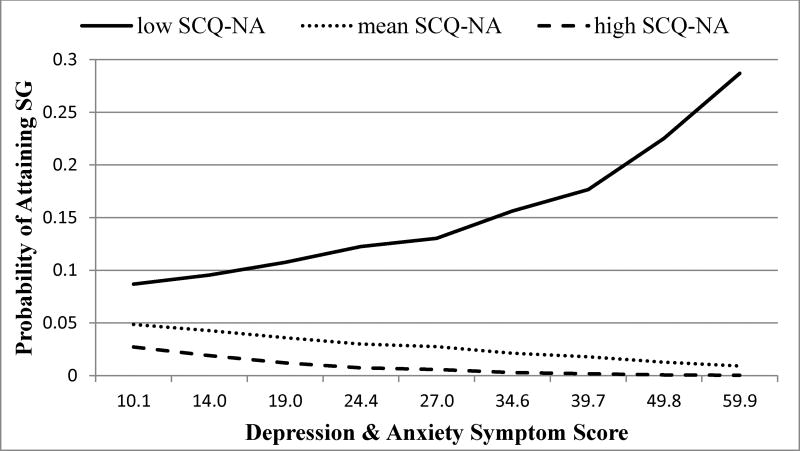
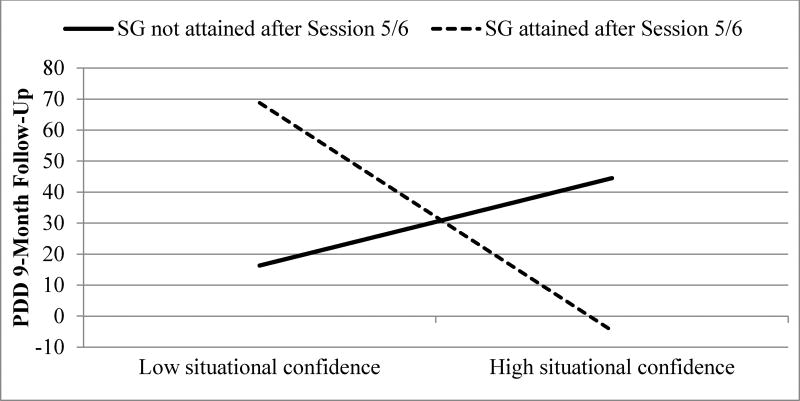
Sudden gains (SGs) are defined as abrupt and significant improvements in mental health symptoms that occur between two psychotherapy sessions. Preliminary evidence suggests that SGs may be an important pattern of symptom reduction in the treatment of alcohol use disorder (AUD) (i.e., a steep between-session reduction in drinking or alcohol craving frequency or intensity) (Drapkin, Epstein, McCrady, & Eddie, 2015). The current study examined SGs within two randomized clinical trials (RCTs) testing female-specific cognitive behavior therapy (CBT) protocol for AUD (n=146). We tested a priori hypotheses about whether women's baseline depression, anxiety, and confidence to be abstinent while in a negative emotional state would predict attainment of SGs after attending sessions that addressed depression, anxiety, and emotion regulation (i.e., sessions five and six of the 12-session protocol). Data were collected at baseline, within treatment, and 15months after baseline. Results showed that women with high levels of depression and/or anxiety and low confidence to be abstinent in a negative emotional state at baseline were more likely to experience a SG (steep decrease in drinking) after sessions five and six (p=0.02). Further, among women with high levels of depression and/or anxiety at baseline, those who experienced both a SG in drinking after session five/six and had higher confidence to remain abstinent in a negative emotional state at the end of treatment reported lower drinking frequency at 9- but not 15-month follow-up [95% CI=(-2.65, -0.86)]. Findings support the value of providing interventions targeting mood and emotion regulation in AUD treatment for women.
突跃式改善(SGs)是指在两次心理治疗之间心理健康症状突然而显著的改善。初步证据表明,SGs 可能是治疗酒精使用障碍(AUD)时症状减轻的一个重要模式(即治疗期间饮酒或酒精渴求频率或强度的急剧降低)(Drapkin、Epstein、McCrady 和 Eddie,2015)。本研究在两项测试女性特定认知行为治疗(CBT)方案治疗 AUD 的随机临床试验(RCT)中检查了 SGs(n=146)。我们测试了关于女性在负面情绪状态下的基线抑郁、焦虑和保持禁欲信心是否会预测在处理抑郁、焦虑和情绪调节的治疗课程后获得 SGs 的先验假设(即 12 节方案的第五和第六节)。数据在基线、治疗期间和基线后 15 个月收集。结果表明,基线时抑郁和/或焦虑程度高且在负面情绪状态下保持禁欲信心低的女性在第五和第六节治疗后更有可能出现 SG(饮酒急剧减少)(p=0.02)。此外,在基线时抑郁和/或焦虑程度高的女性中,那些在第五/六节治疗后既经历了 SG 又在治疗结束时对在负面情绪状态下保持禁欲有更高信心的女性,在 9 个月但不是 15 个月的随访中报告的饮酒频率较低[95%CI=(-2.65,-0.86)]。这些发现支持在 AUD 治疗中为女性提供针对情绪和情绪调节的干预措施的价值。