Lima Viviane D, St-Jean Martin, Rozada Ignacio, Shoveller Jean A, Nosyk Bohdan, Hogg Robert S, Sereda Paul, Barrios Rolando, Montaner Julio S G
British Columbia Centre for Excellence in HIV/AIDS, St. Paul's Hospital, Vancouver, British Columbia, Canada.
Division of AIDS, Department of Medicine, Faculty of Medicine, University of British Columbia, Vancouver, British Columbia, Canada.
J Int AIDS Soc. 2017 Nov;20(3). doi: 10.1002/jia2.25011.
Antiretroviral therapy (ART) scale-up is central to the global strategy to control the HIV/AIDS pandemic. To accelerate efforts towards ending the AIDS epidemic, the Joint United Nations Programme on HIV/AIDS released the 90-90-90 and 95-95-95 targets, which have recently been approved by the United Nations (UN). This study characterizes the province of British Columbia (BC)'s progress towards achieving the UN targets, predicts a trajectory up to 2030 according to each of the individual steps (i.e. %Diagnosed, %On ART and %Virologically Suppressed), and identifies the population sub-groups at higher risk of not achieving these targets.
The analyses were based on linked individual-level datasets of people living with HIV (PLWH) in BC, aged ≥18 months, from 2000 to 2013. Using past trends in HIV prevalence and of each individual UN targets, we forecasted these outcomes until 2030 via generalized additive models. We ran a second set of analyses to assess the associations between individual demographic and behavioural factors and each of the individual steps of the UN targets. Lastly, we performed sensitivity analyses to account for uncertainty associated with prevalence estimates and suppression definitions.
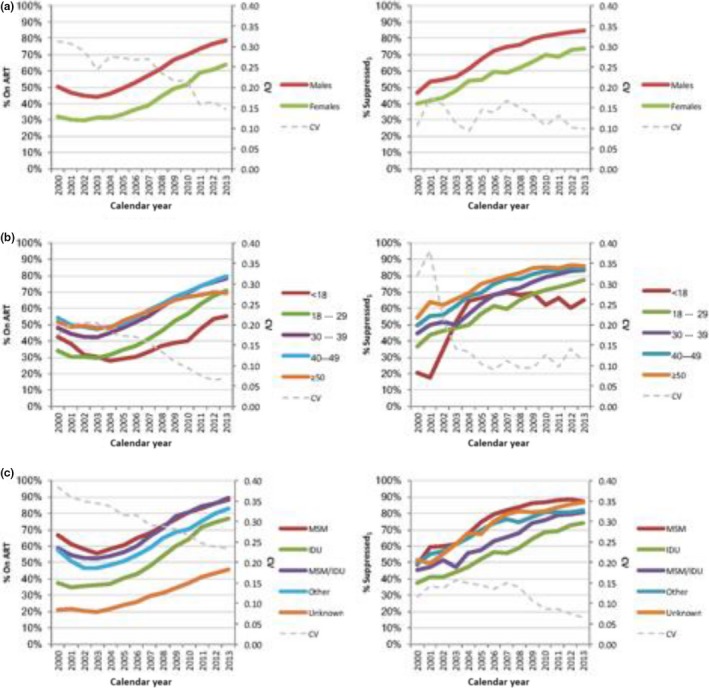
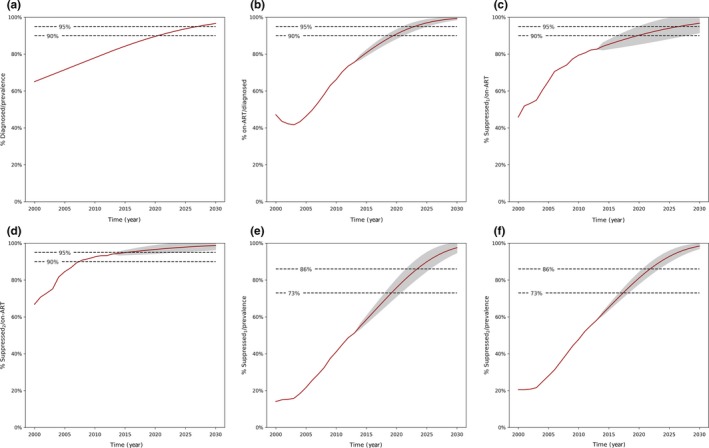
Among the estimated 10666 PLWH in BC in 2013, 82% were diagnosed, 76% of those diagnosed were on ART and 83% of those on ART were virologically suppressed. We identified that females, PLWH aged <30 years and those with unknown risk or who self-identify as having a history of injection drug use were the population subgroups that experienced the most challenge in engaging on ART and achieving viral suppression. Our model projections suggest that BC will achieve 90%-91%-90% and 97%-99%-97% by 2020 and 2030 respectively.
As we approach 2020, BC is rapidly moving towards achieving the UN targets. However, region-specific challenges persist. Identification of remaining regional challenges will be essential to achieving the proposed UN targets and therefore fulfilling the promise to end AIDS as a pandemic by 2030.
扩大抗逆转录病毒疗法(ART)的应用是全球控制艾滋病毒/艾滋病大流行战略的核心。为加快实现终结艾滋病流行的努力,联合国艾滋病毒/艾滋病联合规划署发布了90-90-90和95-95-95目标,这些目标最近已获联合国批准。本研究描述了不列颠哥伦比亚省(BC省)在实现联合国目标方面的进展,根据各个步骤(即诊断率、接受抗逆转录病毒疗法的比例和病毒学抑制率)预测了直至2030年的发展轨迹,并确定了未实现这些目标风险较高的人群亚组。
分析基于2000年至2013年BC省年龄≥18个月的艾滋病毒感染者(PLWH)的个体层面关联数据集。利用艾滋病毒流行率及每个联合国目标的既往趋势,我们通过广义相加模型预测了直至2030年的这些结果。我们进行了第二组分析,以评估个体人口统计学和行为因素与联合国目标的各个步骤之间的关联。最后,我们进行了敏感性分析,以考虑与患病率估计和抑制定义相关的不确定性。
2013年BC省估计的10666名艾滋病毒感染者中,82%已被诊断,其中76%的已诊断者接受了抗逆转录病毒疗法,接受抗逆转录病毒疗法者中有83%实现了病毒学抑制。我们发现,女性、年龄<30岁的艾滋病毒感染者以及风险不明或自称有注射吸毒史的人是在接受抗逆转录病毒疗法和实现病毒抑制方面面临最大挑战的人群亚组。我们的模型预测表明,BC省到2020年和2030年将分别实现90%-91%-90%和97%-99%-97%的目标。
随着我们迈向2020年,BC省正在迅速朝着实现联合国目标迈进。然而,特定区域的挑战依然存在。识别剩余的区域挑战对于实现提议的联合国目标并因此兑现到2030年终结艾滋病大流行的承诺至关重要。