• 文献检索
  • 文档翻译
  • 深度研究
  • 学术资讯
  • Suppr Zotero 插件Zotero 插件
  • 邀请有礼
  • 套餐&价格
  • 历史记录
应用&插件
Suppr Zotero 插件Zotero 插件浏览器插件Mac 客户端Windows 客户端微信小程序
定价
高级版会员购买积分包购买API积分包
服务
文献检索文档翻译深度研究API 文档MCP 服务
关于我们
关于 Suppr公司介绍联系我们用户协议隐私条款
关注我们

Suppr 超能文献

核心技术专利:CN118964589B侵权必究
粤ICP备2023148730 号-1Suppr @ 2026

文献检索

告别复杂PubMed语法,用中文像聊天一样搜索,搜遍4000万医学文献。AI智能推荐,让科研检索更轻松。

立即免费搜索

文件翻译

保留排版,准确专业,支持PDF/Word/PPT等文件格式,支持 12+语言互译。

免费翻译文档

深度研究

AI帮你快速写综述,25分钟生成高质量综述,智能提取关键信息,辅助科研写作。

立即免费体验

通过配体导向建模改进G蛋白偶联受体的虚拟筛选

Improving virtual screening of G protein-coupled receptors via ligand-directed modeling.

作者信息

Coudrat Thomas, Simms John, Christopoulos Arthur, Wootten Denise, Sexton Patrick M

机构信息

Drug Discovery Biology and Department of Pharmacology, Monash Institute of Pharmaceutical Sciences, Monash University, Parkville, Victoria, Australia.

School of Life and Health Sciences, Aston University, Birmingham, United Kingdom.

出版信息

PLoS Comput Biol. 2017 Nov 13;13(11):e1005819. doi: 10.1371/journal.pcbi.1005819. eCollection 2017 Nov.

DOI:10.1371/journal.pcbi.1005819
PMID:29131821
原文链接:https://pmc.ncbi.nlm.nih.gov/articles/PMC5708846/
Abstract

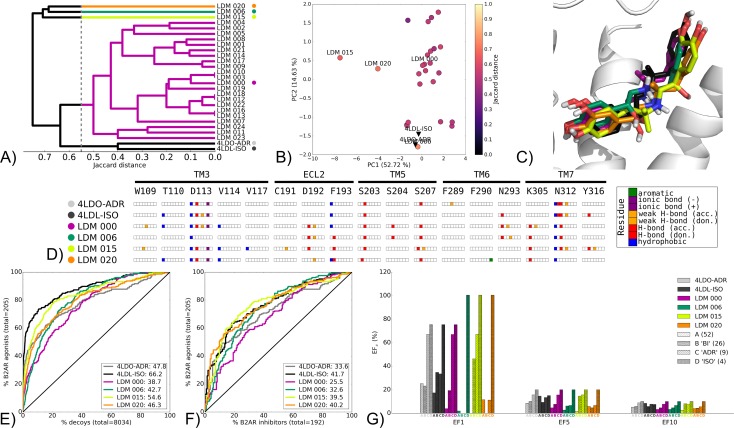
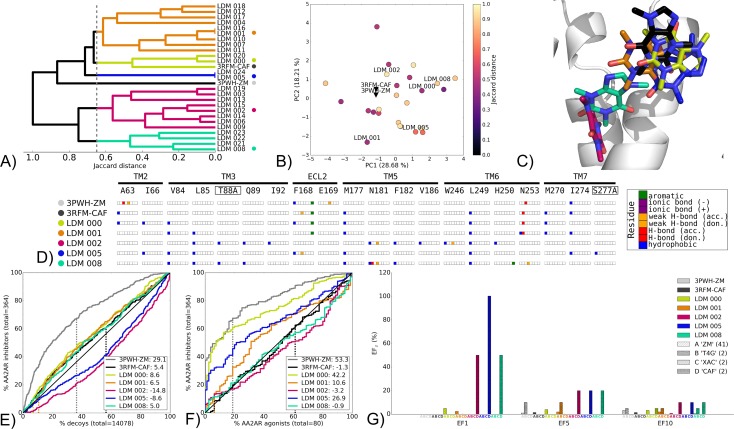
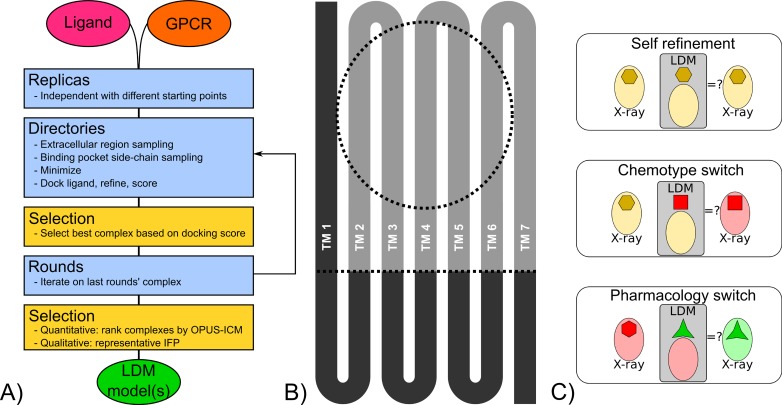
G protein-coupled receptors (GPCRs) play crucial roles in cell physiology and pathophysiology. There is increasing interest in using structural information for virtual screening (VS) of libraries and for structure-based drug design to identify novel agonist or antagonist leads. However, the sparse availability of experimentally determined GPCR/ligand complex structures with diverse ligands impedes the application of structure-based drug design (SBDD) programs directed to identifying new molecules with a select pharmacology. In this study, we apply ligand-directed modeling (LDM) to available GPCR X-ray structures to improve VS performance and selectivity towards molecules of specific pharmacological profile. The described method refines a GPCR binding pocket conformation using a single known ligand for that GPCR. The LDM method is a computationally efficient, iterative workflow consisting of protein sampling and ligand docking. We developed an extensive benchmark comparing LDM-refined binding pockets to GPCR X-ray crystal structures across seven different GPCRs bound to a range of ligands of different chemotypes and pharmacological profiles. LDM-refined models showed improvement in VS performance over origin X-ray crystal structures in 21 out of 24 cases. In all cases, the LDM-refined models had superior performance in enriching for the chemotype of the refinement ligand. This likely contributes to the LDM success in all cases of inhibitor-bound to agonist-bound binding pocket refinement, a key task for GPCR SBDD programs. Indeed, agonist ligands are required for a plethora of GPCRs for therapeutic intervention, however GPCR X-ray structures are mostly restricted to their inactive inhibitor-bound state.

摘要

G蛋白偶联受体(GPCRs)在细胞生理和病理生理过程中发挥着关键作用。利用结构信息进行文库虚拟筛选(VS)以及基于结构的药物设计以识别新型激动剂或拮抗剂先导物的兴趣与日俱增。然而,实验测定的具有多种配体的GPCR/配体复合物结构稀少,这阻碍了旨在识别具有特定药理学特性的新分子的基于结构的药物设计(SBDD)程序的应用。在本研究中,我们将配体导向建模(LDM)应用于现有的GPCR X射线结构,以提高VS性能以及对具有特定药理学特征分子的选择性。所描述的方法使用针对该GPCR的单个已知配体来优化GPCR结合口袋构象。LDM方法是一种计算效率高的迭代工作流程,由蛋白质采样和配体对接组成。我们开展了一项广泛的基准测试,将LDM优化的结合口袋与七种不同GPCR的X射线晶体结构进行比较,这些GPCR与一系列不同化学类型和药理学特征的配体结合。在24个案例中的21个案例中,LDM优化的模型在VS性能方面相较于原始X射线晶体结构有所改善。在所有案例中,LDM优化的模型在富集优化配体的化学类型方面具有卓越性能。这可能是LDM在抑制剂结合到激动剂结合口袋优化的所有案例中取得成功的原因,这是GPCR SBDD程序的一项关键任务。事实上,众多GPCR进行治疗干预都需要激动剂配体,然而GPCR X射线结构大多局限于其无活性的抑制剂结合状态。
https://cdn.ncbi.nlm.nih.gov/pmc/blobs/5834/5708846/d78b0f76d795/pcbi.1005819.g008.jpg
https://cdn.ncbi.nlm.nih.gov/pmc/blobs/5834/5708846/4dd6e878ba78/pcbi.1005819.g001.jpg
https://cdn.ncbi.nlm.nih.gov/pmc/blobs/5834/5708846/1235f73ea980/pcbi.1005819.g002.jpg
https://cdn.ncbi.nlm.nih.gov/pmc/blobs/5834/5708846/36f5e7f5ff39/pcbi.1005819.g003.jpg
https://cdn.ncbi.nlm.nih.gov/pmc/blobs/5834/5708846/baa2b745d993/pcbi.1005819.g004.jpg
https://cdn.ncbi.nlm.nih.gov/pmc/blobs/5834/5708846/e2bedb53188e/pcbi.1005819.g005.jpg
https://cdn.ncbi.nlm.nih.gov/pmc/blobs/5834/5708846/a18b82a73ee4/pcbi.1005819.g006.jpg
https://cdn.ncbi.nlm.nih.gov/pmc/blobs/5834/5708846/fe733f9d4eed/pcbi.1005819.g007.jpg
https://cdn.ncbi.nlm.nih.gov/pmc/blobs/5834/5708846/d78b0f76d795/pcbi.1005819.g008.jpg
https://cdn.ncbi.nlm.nih.gov/pmc/blobs/5834/5708846/4dd6e878ba78/pcbi.1005819.g001.jpg
https://cdn.ncbi.nlm.nih.gov/pmc/blobs/5834/5708846/1235f73ea980/pcbi.1005819.g002.jpg
https://cdn.ncbi.nlm.nih.gov/pmc/blobs/5834/5708846/36f5e7f5ff39/pcbi.1005819.g003.jpg
https://cdn.ncbi.nlm.nih.gov/pmc/blobs/5834/5708846/baa2b745d993/pcbi.1005819.g004.jpg
https://cdn.ncbi.nlm.nih.gov/pmc/blobs/5834/5708846/e2bedb53188e/pcbi.1005819.g005.jpg
https://cdn.ncbi.nlm.nih.gov/pmc/blobs/5834/5708846/a18b82a73ee4/pcbi.1005819.g006.jpg
https://cdn.ncbi.nlm.nih.gov/pmc/blobs/5834/5708846/fe733f9d4eed/pcbi.1005819.g007.jpg
https://cdn.ncbi.nlm.nih.gov/pmc/blobs/5834/5708846/d78b0f76d795/pcbi.1005819.g008.jpg

相似文献

1
Improving virtual screening of G protein-coupled receptors via ligand-directed modeling.通过配体导向建模改进G蛋白偶联受体的虚拟筛选
PLoS Comput Biol. 2017 Nov 13;13(11):e1005819. doi: 10.1371/journal.pcbi.1005819. eCollection 2017 Nov.
2
Efficiency of Homology Modeling Assisted Molecular Docking in G-protein Coupled Receptors.同源建模辅助分子对接在 G 蛋白偶联受体中的效率。
Curr Top Med Chem. 2021;21(4):269-294. doi: 10.2174/1568026620666200908165250.
3
Reliability of Docking-Based Virtual Screening for GPCR Ligands with Homology Modeled Structures: A Case Study of the Angiotensin II Type I Receptor.基于对接的虚拟筛选技术用于 G 蛋白偶联受体配体的可靠性研究:以血管紧张素 II 型 1 型受体为例。
ACS Chem Neurosci. 2019 Jan 16;10(1):677-689. doi: 10.1021/acschemneuro.8b00489. Epub 2018 Oct 17.
4
Structural features embedded in G protein-coupled receptor co-crystal structures are key to their success in virtual screening.嵌入G蛋白偶联受体共晶体结构中的结构特征是其在虚拟筛选中取得成功的关键。
PLoS One. 2017 Apr 5;12(4):e0174719. doi: 10.1371/journal.pone.0174719. eCollection 2017.
5
From heptahelical bundle to hits from the Haystack: structure-based virtual screening for GPCR ligands.从七螺旋束到大海捞针:基于结构的GPCR配体虚拟筛选
Methods Enzymol. 2013;522:279-336. doi: 10.1016/B978-0-12-407865-9.00015-7.
6
Performance of virtual screening against GPCR homology models: Impact of template selection and treatment of binding site plasticity.针对 GPCR 同源模型的虚拟筛选性能:模板选择和结合位点可塑性处理的影响。
PLoS Comput Biol. 2020 Mar 13;16(3):e1007680. doi: 10.1371/journal.pcbi.1007680. eCollection 2020 Mar.
7
Docking and Virtual Screening Strategies for GPCR Drug Discovery.用于GPCR药物发现的对接和虚拟筛选策略
Methods Mol Biol. 2015;1335:251-76. doi: 10.1007/978-1-4939-2914-6_17.
8
GPCR crystal structures: Medicinal chemistry in the pocket.G蛋白偶联受体晶体结构:口袋中的药物化学
Bioorg Med Chem. 2015 Jul 15;23(14):3880-906. doi: 10.1016/j.bmc.2014.12.034. Epub 2014 Dec 24.
9
Synergistic Use of GPCR Modeling and SDM Experiments to Understand Ligand Binding.利用GPCR建模与定点突变实验协同作用理解配体结合
Methods Mol Biol. 2018;1705:335-343. doi: 10.1007/978-1-4939-7465-8_15.
10
Dopamine D3 receptor antagonist reveals a cryptic pocket in aminergic GPCRs.多巴胺 D3 受体拮抗剂揭示了胺能 GPCR 中的一个隐匿口袋。
Sci Rep. 2018 Jan 17;8(1):897. doi: 10.1038/s41598-018-19345-7.

引用本文的文献

1
Combination of Docking-Based and Pharmacophore-Based Virtual Screening Identifies Novel Agonists That Target the Urotensin Receptor.基于对接和基于药效团的虚拟筛选相结合,鉴定靶向尾加压素受体的新型激动剂。
Molecules. 2022 Dec 8;27(24):8692. doi: 10.3390/molecules27248692.
2
Structure-Based Virtual Screening and Biological Evaluation of Peptide Inhibitors for Polo-Box Domain.基于结构的虚拟筛选与 Polo-Box 结构域肽抑制剂的生物学评价
Molecules. 2019 Dec 27;25(1):107. doi: 10.3390/molecules25010107.
3
Expression and purification of recombinant G protein-coupled receptors: A review.

本文引用的文献

1
Predicting Binding Affinities for GPCR Ligands Using Free-Energy Perturbation.使用自由能微扰预测GPCR配体的结合亲和力。
ACS Omega. 2016 Aug 31;1(2):293-304. doi: 10.1021/acsomega.6b00086. Epub 2016 Aug 30.
2
Structural features embedded in G protein-coupled receptor co-crystal structures are key to their success in virtual screening.嵌入G蛋白偶联受体共晶体结构中的结构特征是其在虚拟筛选中取得成功的关键。
PLoS One. 2017 Apr 5;12(4):e0174719. doi: 10.1371/journal.pone.0174719. eCollection 2017.
3
From Homology Models to a Set of Predictive Binding Pockets-a 5-HT Receptor Case Study.
重组G蛋白偶联受体的表达与纯化:综述
Protein Expr Purif. 2020 Mar;167:105524. doi: 10.1016/j.pep.2019.105524. Epub 2019 Oct 31.
4
In Silico Methods for the Discovery of Orthosteric GABA Receptor Compounds.计算机辅助方法发现变构型 GABA 受体化合物。
Molecules. 2019 Mar 7;24(5):935. doi: 10.3390/molecules24050935.
5
Exploring G Protein-Coupled Receptors (GPCRs) Ligand Space via Cheminformatics Approaches: Impact on Rational Drug Design.通过化学信息学方法探索G蛋白偶联受体(GPCRs)配体空间:对合理药物设计的影响。
Front Pharmacol. 2018 Mar 9;9:128. doi: 10.3389/fphar.2018.00128. eCollection 2018.
从同源模型到一组预测性结合口袋——5-羟色胺受体案例研究
J Chem Inf Model. 2017 Feb 27;57(2):311-321. doi: 10.1021/acs.jcim.6b00263. Epub 2017 Jan 18.
4
Ligand Discovery for a Peptide-Binding GPCR by Structure-Based Screening of Fragment- and Lead-Like Chemical Libraries.通过基于结构的片段类和先导物类化学文库筛选发现肽结合G蛋白偶联受体的配体
ACS Chem Biol. 2017 Mar 17;12(3):735-745. doi: 10.1021/acschembio.6b00646. Epub 2017 Jan 24.
5
Relative Binding Free Energy Calculations Applied to Protein Homology Models.应用于蛋白质同源模型的相对结合自由能计算
J Chem Inf Model. 2016 Dec 27;56(12):2388-2400. doi: 10.1021/acs.jcim.6b00362. Epub 2016 Nov 18.
6
Understanding the common themes and diverse roles of the second extracellular loop (ECL2) of the GPCR super-family.了解GPCR超家族第二个细胞外环(ECL2)的共同主题和多样作用。
Mol Cell Endocrinol. 2017 Jul 5;449:3-11. doi: 10.1016/j.mce.2016.11.023. Epub 2016 Nov 27.
7
Interacting with GPCRs: Using Interaction Fingerprints for Virtual Screening.与G蛋白偶联受体相互作用:利用相互作用指纹进行虚拟筛选。
J Chem Inf Model. 2016 Oct 24;56(10):2053-2060. doi: 10.1021/acs.jcim.6b00314. Epub 2016 Sep 27.
8
GPCR Dynamics: Structures in Motion.G 蛋白偶联受体动力学:运动中的结构。
Chem Rev. 2017 Jan 11;117(1):139-155. doi: 10.1021/acs.chemrev.6b00177. Epub 2016 Sep 13.
9
Accelerated structure-based design of chemically diverse allosteric modulators of a muscarinic G protein-coupled receptor.基于结构的毒蕈碱型 G 蛋白偶联受体化学多样变构调节剂的加速设计。
Proc Natl Acad Sci U S A. 2016 Sep 20;113(38):E5675-84. doi: 10.1073/pnas.1612353113. Epub 2016 Sep 6.
10
Structure-based discovery of opioid analgesics with reduced side effects.基于结构的副作用减少的阿片类镇痛药的发现。
Nature. 2016 Sep 8;537(7619):185-190. doi: 10.1038/nature19112. Epub 2016 Aug 17.