Max-Planck-Institut für Kohlenforschung , 45470 Mülheim an der Ruhr, Germany.
J Org Chem. 2017 Dec 15;82(24):13563-13571. doi: 10.1021/acs.joc.7b02794. Epub 2017 Nov 29.
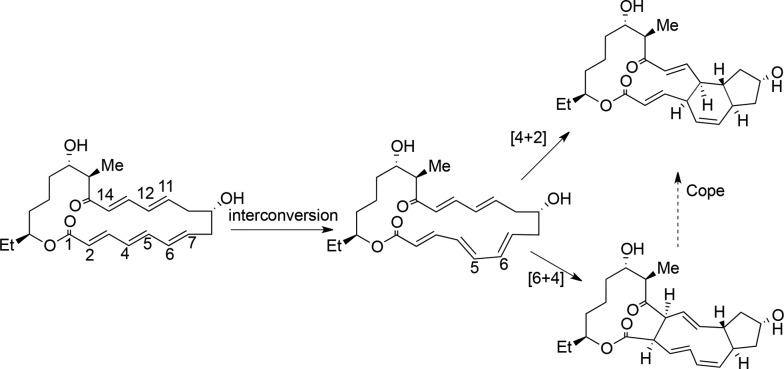
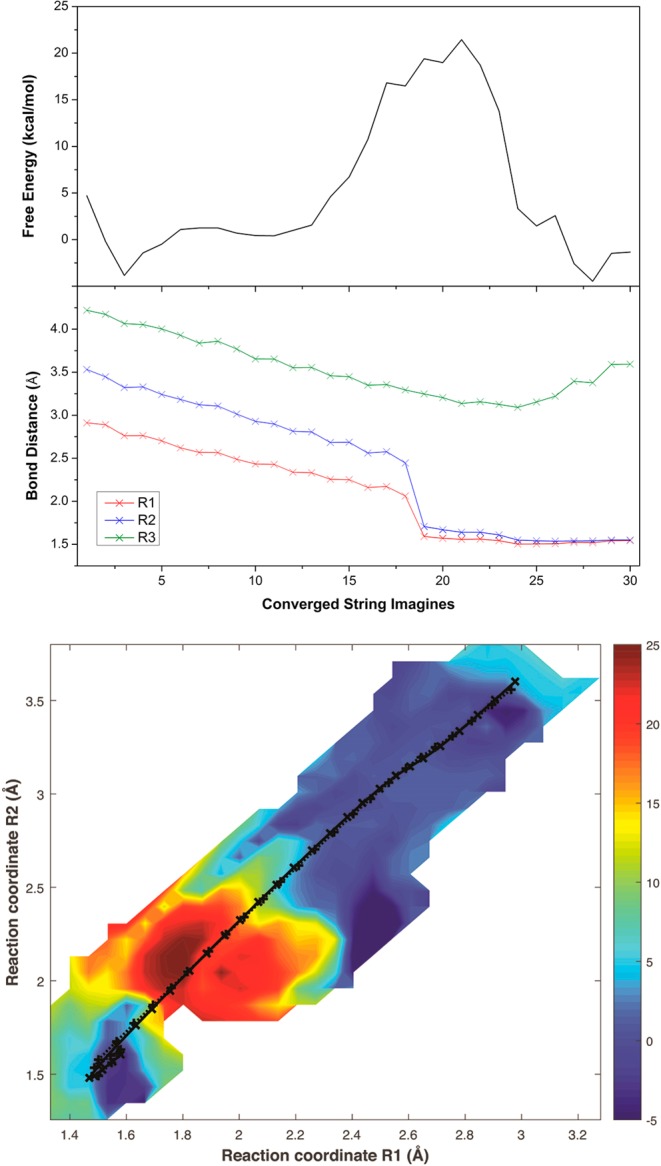
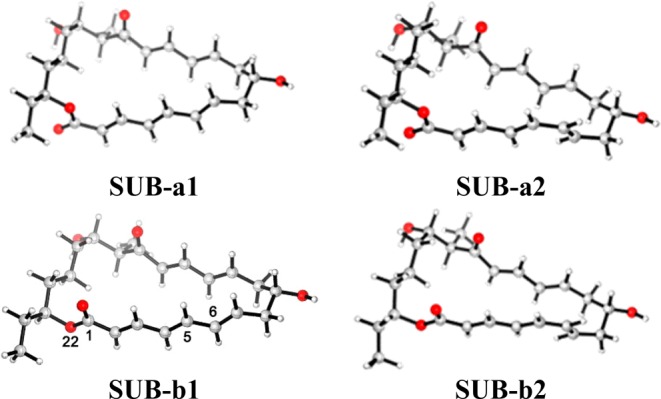
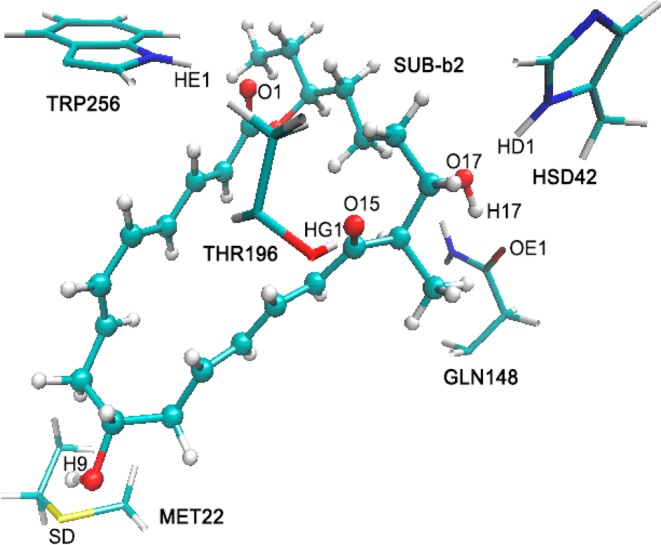
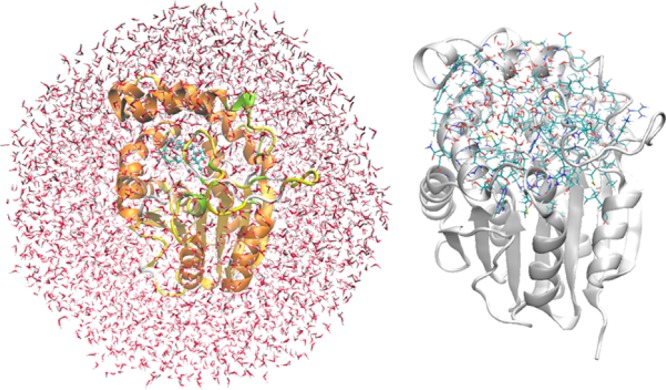
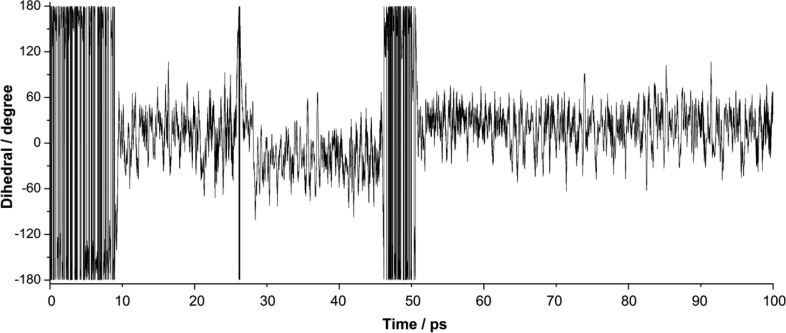
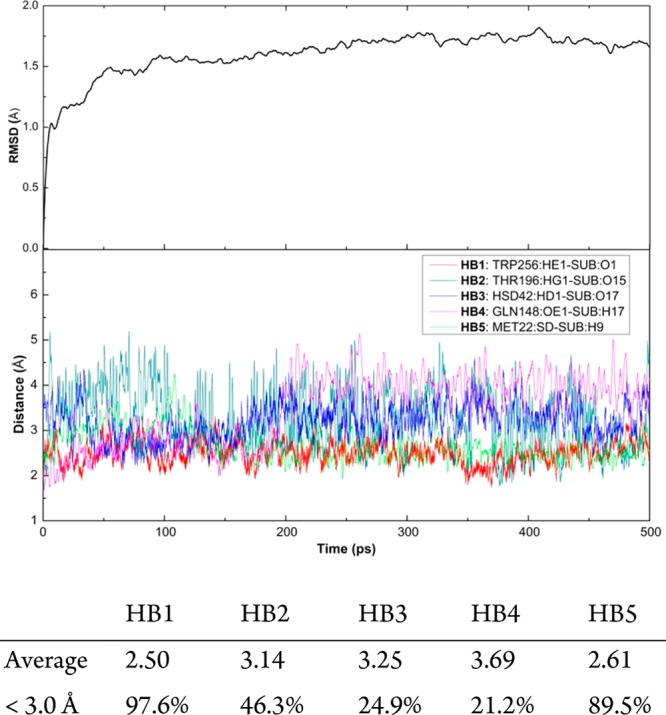
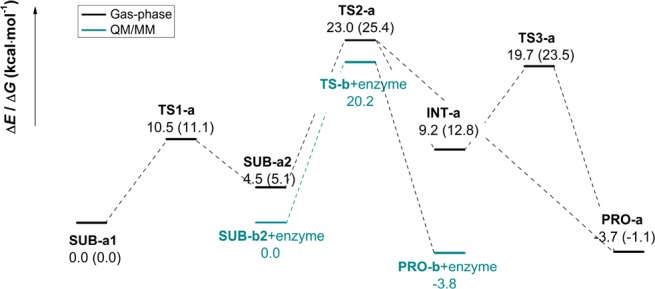
The enzyme SpnF, involved in the biosynthesis of spinosyn A, catalyzes a formal [4+2] cycloaddition of a 22-membered macrolactone, which may proceed as a concerted [4+2] Diels-Alder reaction or a stepwise [6+4] cycloaddition followed by a Cope rearrangement. Quantum mechanics/molecular mechanics (QM/MM) calculations combined with free energy simulations show that the Diels-Alder pathway is favored in the enzyme environment. OM2/CHARMM free energy simulations for the SpnF-catalyzed reaction predict a free energy barrier of 22 kcal/mol for the concerted Diels-Alder process and provide no evidence of a competitive stepwise pathway. Compared with the gas phase, the enzyme lowers the Diels-Alder barrier significantly, consistent with experimental observations. Inspection of the optimized geometries indicates that the enzyme may prearrange the substrate within the active site to accelerate the [4+2] cycloaddition and impede the [6+4] cycloaddition through interactions with active-site residues. Judging from partial charge analysis, we find that the hydrogen bond between the Thr196 residue of SpnF and the substrate C15 carbonyl group contributes to the enhancement of the rate of the Diels-Alder reaction. QM/MM simulations show that the substrate can easily adopt a reactive conformation in the active site of SpnF because interconversion between the C5-C6 s-trans and s-cis conformers is facile. Our QM/MM study suggests that the enzyme SpnF does behave as a Diels-Alderase.
参与 spinosyn A 生物合成的酶 SpnF 催化一个 22 元大环内酯的形式 [4+2] 环加成,该反应可能通过协同 [4+2] Diels-Alder 反应或逐步 [6+4] 环加成 followed by a Cope 重排进行。量子力学/分子力学(QM/MM)计算结合自由能模拟表明,Diels-Alder 途径在酶环境中占优势。OM2/CHARMM 对 SpnF 催化反应的自由能模拟预测协同 Diels-Alder 过程的自由能垒为 22 kcal/mol,并且没有竞争性逐步途径的证据。与气相相比,酶显着降低了 Diels-Alder 垒,这与实验观察结果一致。优化几何形状的检查表明,酶可能在活性位点中预先排列底物,以加速 [4+2] 环加成,并通过与活性位点残基的相互作用阻碍 [6+4] 环加成。从部分电荷分析来看,我们发现 SpnF 的 Thr196 残基与底物 C15 羰基之间的氢键有助于增强 Diels-Alder 反应的速率。QM/MM 模拟表明,由于 C5-C6 s-trans 和 s-cis 构象之间的相互转换很容易,底物可以在 SpnF 的活性位点中容易地采用反应性构象。我们的 QM/MM 研究表明,酶 SpnF 确实表现为 Diels-Alderase。