Álvarez Barreneche María Fernanda, Restrepo Castro Carlos Andrés, Hidrón Botero Alicia, Villa Franco Juan Pablo, Trompa Romero Ivan Mauricio, Restrepo Carvajal Laura, Eusse García Alejandro, Ocampo Mesa Adriana, Echeverri Toro Lina María, Porras Fernández de Castro Glenys Patricia, Ramírez Rivera Jaime Mauricio, Agudelo Restrepo Carlos Andrés
School of Health Sciences, Universidad Pontificia Bolivariana, Carrera 44 # 18-56, Antioquia, Medellín, Colombia.
Division of Infectious Diseases, Department of Internal Medicine, IPS Universitaria Clínica León XIII, Antioquia, Medellín, Colombia.
AIDS Res Ther. 2017 Nov 13;14(1):60. doi: 10.1186/s12981-017-0186-3.
Antiretroviral therapy (ART) has modified the natural history of HIV-infection: the incidence of opportunistic infections (OIs) has decreased and mortality associated to HIV has improved dramatically. The reasons for hospitalization have changed; OIs are no longer the most common reason for admission. This study describes the patient population, admission diagnosis and hospital course of HIV patients in Colombia in the ART era.
Patients admitted with HIV/AIDS at six hospitals in Medellin, Colombia between August 1, 2014 and July 31, 2015 were included. Demographic, laboratory, and clinical data were prospectively collected.
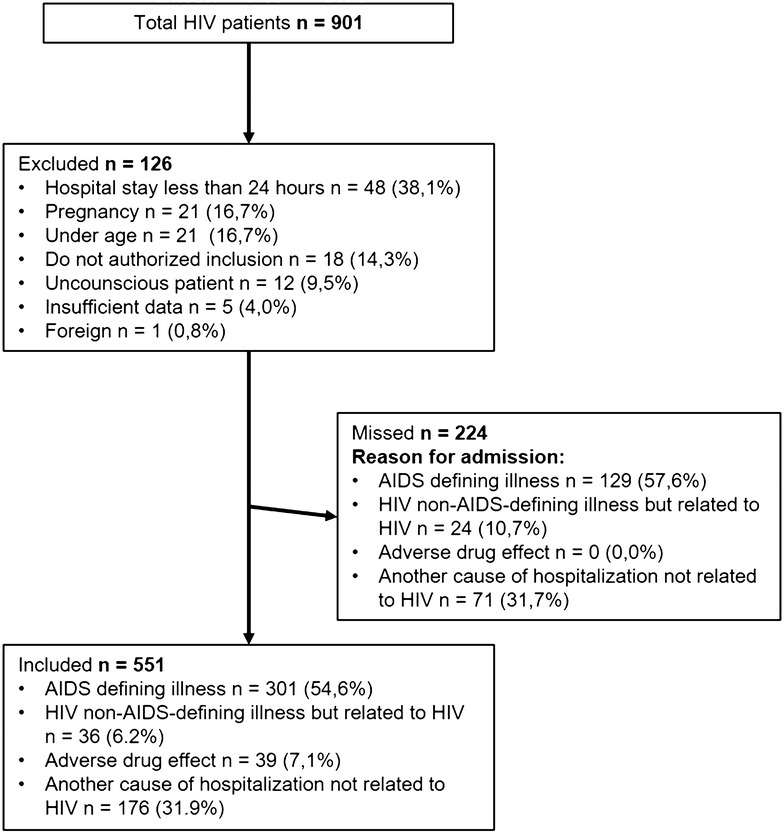
551 HIV-infected patients were admitted: 76.0% were male, the median age was 37 (30-49). A new diagnosis of HIV was made in 22.0% of patients during the index admission. 56.0% of patients of the entire cohort had been diagnosed with HIV for more than 1 year and 68.9% were diagnosed in an advanced stage of the disease. More than 50.0% of patients had CD4 counts less than 200 CD4 cells/μL and viral loads greater than 100,000 copies. The main reasons for hospital admissions were OIs, tuberculosis, esophageal candidiasis and Toxoplasma encephalitis. The median hospital stay was 14 days (IQR 8-23). Admission to the intensive care unit (ICU) was required in 10.3% of patients and 14.3% were readmitted to the hospital; mortality was 5.4%.
Similar to other countries in the developing world, in Colombia, the leading cause of hospitalization among HIV-infected patients remain opportunistic infections. However, in-hospital mortality was low, similar to those described for high-income countries. Strategies to monitor and optimize the adherence and retention in HIV programs are fundamental to maximize the benefit of ART.
抗逆转录病毒疗法(ART)改变了HIV感染的自然史:机会性感染(OIs)的发生率降低,与HIV相关的死亡率显著改善。住院原因发生了变化;机会性感染不再是最常见的入院原因。本研究描述了ART时代哥伦比亚HIV患者的人群、入院诊断和住院过程。
纳入2014年8月1日至2015年7月31日期间在哥伦比亚麦德林的六家医院因HIV/AIDS入院的患者。前瞻性收集人口统计学、实验室和临床数据。
551例HIV感染患者入院:76.0%为男性,中位年龄为37岁(30 - 49岁)。22.0%的患者在本次索引入院期间被新诊断出HIV。整个队列中56.0%的患者被诊断出感染HIV超过1年,68.9%在疾病晚期被诊断。超过50.0%的患者CD4细胞计数低于200个CD4细胞/μL,病毒载量大于100,000拷贝。住院的主要原因是机会性感染、结核病、食管念珠菌病和弓形虫脑炎。中位住院时间为14天(四分位间距8 - 23天)。10.3%的患者需要入住重症监护病房(ICU),14.3%的患者再次入院;死亡率为5.4%。
与发展中世界的其他国家类似,在哥伦比亚,HIV感染患者住院的主要原因仍然是机会性感染。然而,住院死亡率较低,与高收入国家描述的情况相似。监测和优化HIV项目的依从性和留存率的策略对于最大化ART的益处至关重要。