World Health Organization, Expanded Programme on Immunization, Geneva, Switzerland.
World Health Organization, Regional Office for Africa, Brazzaville, People's Republic of Congo.
Vaccine. 2017 Dec 14;35(49 Pt B):6866-6871. doi: 10.1016/j.vaccine.2017.10.025. Epub 2017 Nov 10.
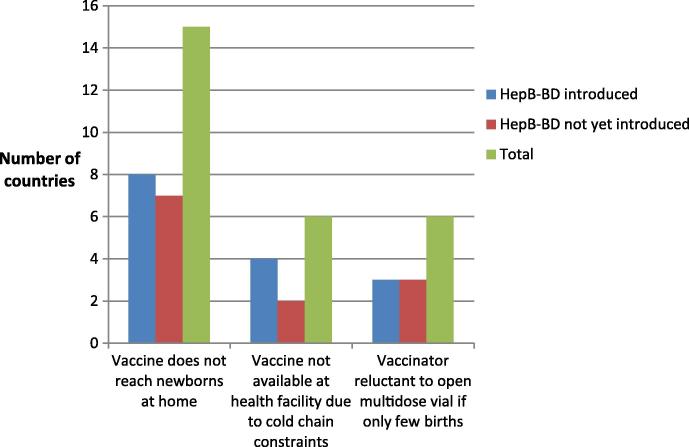
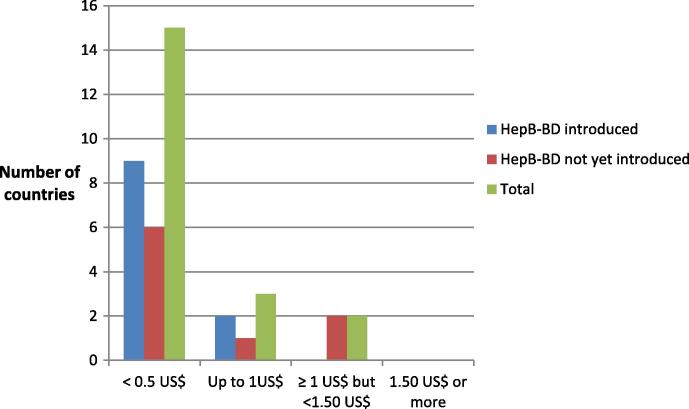
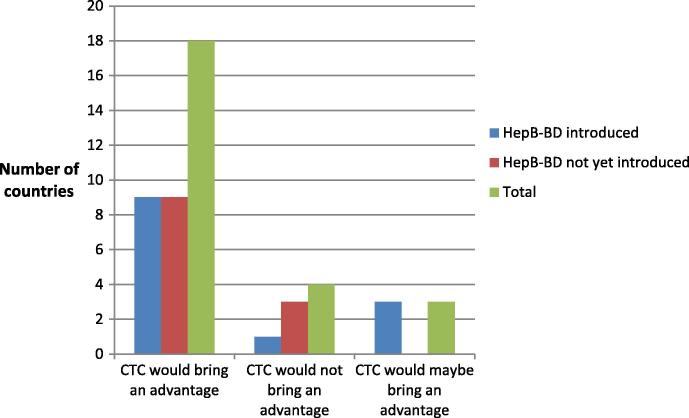
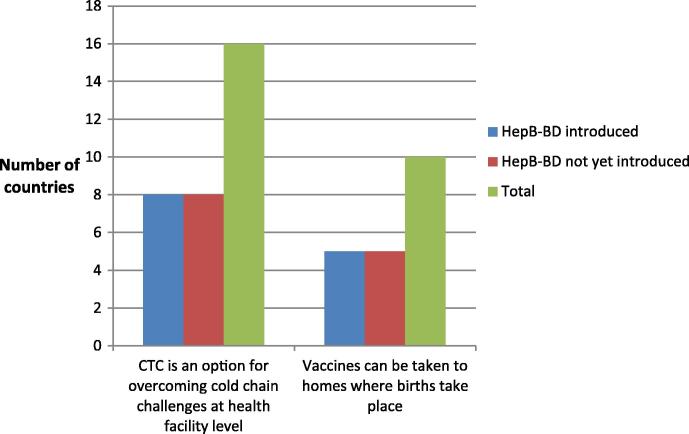
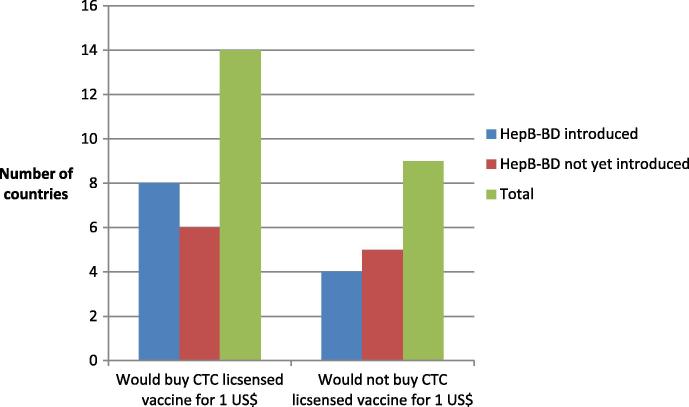
Chronic hepatitis B infection can be prevented by hepatitis B vaccine birth dose (hepB-BD) given within 24 h after birth, followed by two hepatitis B vaccinations within the first year of life. Yet nearly half of World Health Organization (WHO) Member States do not provide a hepB-BD. Barriers are primarily attributed to vaccine storage and transportation, as well as high rates of home births. Delivering the vaccine outside the cold chain could potentially increase coverage. To do this, WHO recommends vaccines be licensed for use in a "controlled temperature chain" (CTC), which requires a given product to tolerate temperature excursions up to at least 40 °C for a minimum of three days. To date, no hepB vaccine is labelled for CTC. To inform dialogue with manufacturers, WHO conducted a survey among countries in the African and Western Pacific Regions (AFR and WPR) to assess demand for a hepatitis B product licensed for use in a CTC. Twenty-five (44%) countries responded, with 8 of 11 (73%) from the WPR and 17 of 46 (37%) from the AFR. Of these responding countries, 5 in AFR and all 8 in WPR have introduced universal hepB-BD. Seventy-two percent indicated that CTC would facilitate the provision of hepB-BD. While no overall difference in responses was detected between countries either providing or not providing hepB-BD, countries that already introduced hepB-BD but had low hepB-BD coverage were particularly interested in CTC. Irrespective of hepB-BD policy, responding countries suggested that a CTC-licenced product would be beneficial, though the price of such a vaccine would influence procurement decisions. This survey was beneficial to inform the CTC agenda. However, countries' lack of experience with HepB-BD as well as with CTC and the fact that countries were commenting on a product that is not yet on the market should be acknowledged.
慢性乙型肝炎感染可以通过在出生后 24 小时内给予乙型肝炎疫苗基础免疫(HBV-BD),并在生命的第一年再接种两次乙型肝炎疫苗来预防。然而,世界卫生组织(WHO)近半数会员国并未提供 HBV-BD。障碍主要归因于疫苗储存和运输,以及高比例的家庭分娩。在冷链之外提供疫苗可能会提高覆盖率。为此,世卫组织建议将疫苗许可用于“控温链”(CTC),这要求特定产品能够耐受至少 40°C 的温度波动至少三天。迄今为止,尚无乙型肝炎疫苗获准用于 CTC。为了与制造商进行对话,世卫组织在非洲和西太平洋地区(AFR 和 WPR)的国家中开展了一项调查,以评估对获准用于 CTC 的乙型肝炎产品的需求。25 个(44%)国家做出了回应,其中 11 个(73%)来自 WPR,46 个(37%)来自 AFR。在做出回应的国家中,5 个 AFR 国家和所有 8 个 WPR 国家都已引入了普遍的 HBV-BD。72%的国家表示 CTC 将有助于提供 HBV-BD。尽管未发现提供或不提供 HBV-BD 的国家之间的反应存在总体差异,但已经引入 HBV-BD 但 HBV-BD 覆盖率较低的国家对 CTC 特别感兴趣。无论 HBV-BD 政策如何,做出回应的国家都表示,CTC 许可的产品将是有益的,尽管这种疫苗的价格将影响采购决策。这项调查有助于推动 CTC 议程。然而,应该认识到各国在 HBV-BD 以及 CTC 方面缺乏经验,并且各国正在对尚未上市的产品发表评论。