Eynard Sonia E, Croiseau Pascal, Laloë Denis, Fritz Sebastien, Calus Mario P L, Restoux Gwendal
Génétique Animale et Biologie Intégrative (GABI), Institut National de la Recherche Agronomique (INRA), AgroParisTech, Université Paris-Saclay, 78350 Jouy en Josas, France
Animal Breeding and Genomics Centre, Wageningen University & Research, 6700 AH Wageningen, The Netherlands.
G3 (Bethesda). 2018 Jan 4;8(1):113-121. doi: 10.1534/g3.117.1117.
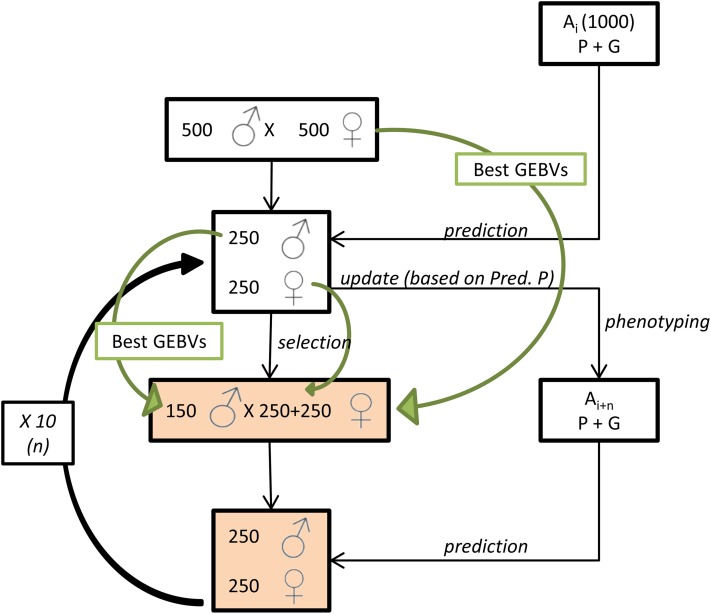
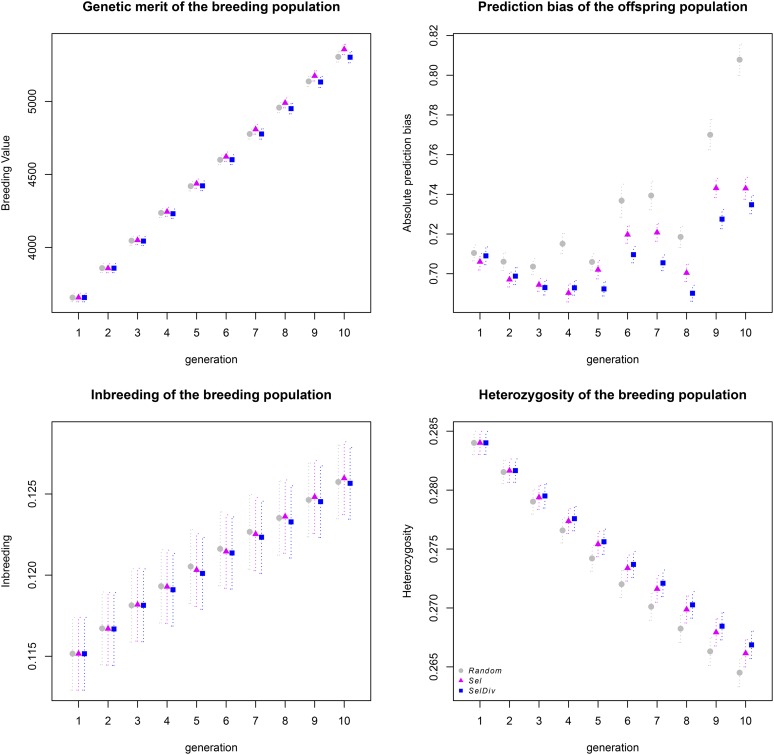
Genomic selection (GS) is commonly used in livestock and increasingly in plant breeding. Relying on phenotypes and genotypes of a reference population, GS allows performance prediction for young individuals having only genotypes. This is expected to achieve fast high genetic gain but with a potential loss of genetic diversity. Existing methods to conserve genetic diversity depend mostly on the choice of the breeding individuals. In this study, we propose a modification of the reference population composition to mitigate diversity loss. Since the high cost of phenotyping is the limiting factor for GS, our findings are of major economic interest. This study aims to answer the following questions: how would decisions on the reference population affect the breeding population, and how to best select individuals to update the reference population and balance maximizing genetic gain and minimizing loss of genetic diversity? We investigated three updating strategies for the reference population: random, truncation, and optimal contribution (OC) strategies. OC maximizes genetic merit for a fixed loss of genetic diversity. A French Montbéliarde dairy cattle population with 50K SNP chip genotypes and simulations over 10 generations were used to compare these different strategies using milk production as the trait of interest. Candidates were selected to update the reference population. Prediction bias and both genetic merit and diversity were measured. Changes in the reference population composition slightly affected the breeding population. Optimal contribution strategy appeared to be an acceptable compromise to maintain both genetic gain and diversity in the reference and the breeding populations.
基因组选择(GS)常用于家畜育种,在植物育种中的应用也日益广泛。GS依靠参考群体的表型和基因型,能够对仅具有基因型的年轻个体的性能进行预测。这有望实现快速的高遗传增益,但可能会导致遗传多样性的损失。现有的保护遗传多样性的方法主要取决于育种个体的选择。在本研究中,我们提出对参考群体组成进行修改,以减轻多样性损失。由于表型分型成本高昂是GS的限制因素,我们的研究结果具有重大的经济意义。本研究旨在回答以下问题:参考群体的决策将如何影响育种群体,以及如何最佳地选择个体来更新参考群体,并在最大化遗传增益和最小化遗传多样性损失之间取得平衡?我们研究了参考群体的三种更新策略:随机策略、截断策略和最优贡献(OC)策略。OC在遗传多样性固定损失的情况下使遗传价值最大化。利用一个拥有50K SNP芯片基因型的法国蒙贝利亚尔奶牛群体,并进行了10代的模拟,以产奶量作为目标性状来比较这些不同策略。选择候选个体来更新参考群体。测量预测偏差以及遗传价值和多样性。参考群体组成的变化对育种群体有轻微影响。最优贡献策略似乎是在参考群体和育种群体中维持遗传增益和多样性的一个可接受的折衷方案。