Hutchinson Sasha G, van Breukelen Gerard, van Schayck Constant P, Essers Brigitte, Hammond S Katharine, Muris Jean W M, Feron Frans J M, Dompeling Edward
Department of Paediatric Pulmonology, Maastricht University Medical Center (MUMC+)/CAPHRI School for Public Health and Primary Care, P.O. Box 616, 6200 MD, Maastricht, The Netherlands.
Department of Methodology and Statistics, MUMC+/CAPHRI, P.O. Box 616, 6200 MD, Maastricht, The Netherlands.
Sci Rep. 2017 Nov 13;7(1):15473. doi: 10.1038/s41598-017-15158-2.
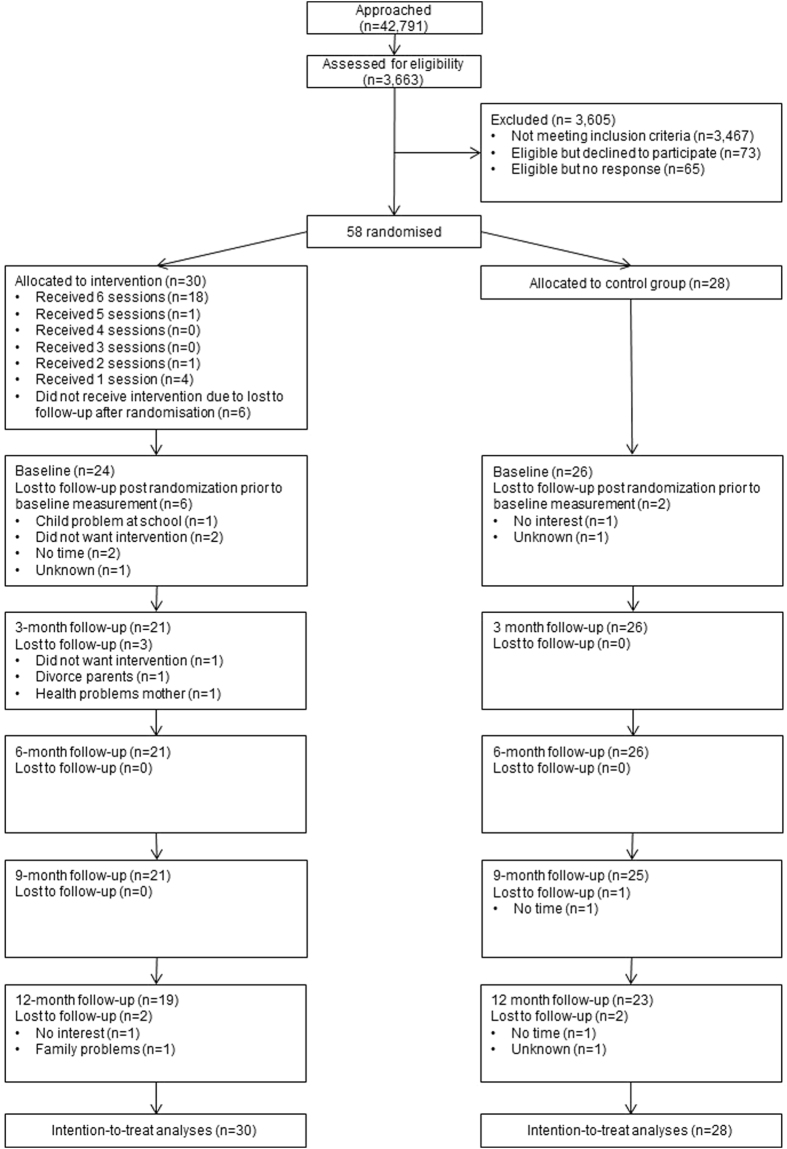
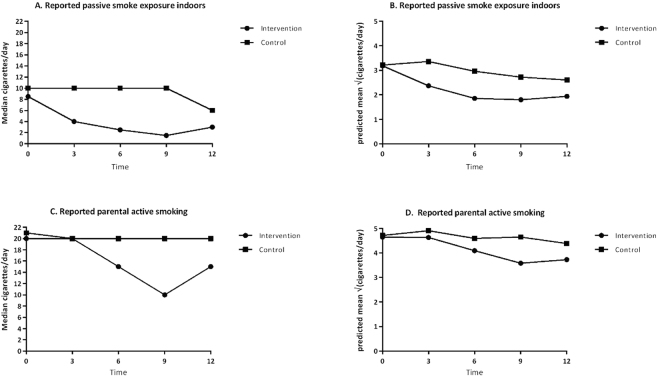
We tested the effectiveness of a program consisting of motivational interviewing (MI) and feedback of urine cotinine to stop passive smoking (PS) in children at risk for asthma. Fifty-eight families with children 0-13 years with a high risk of asthma and PS exposure were randomised in a one-year follow-up study. The intervention group received the intervention program during 6 sessions (1/month) and the control group received measurements (questionnaires, urine cotinine, and lung function) only. The primary outcome measure was the percentage of families stopping PS (parental report verified and unverified with the child's urine cotinine concentration <10 μg/l) in children during the intervention program. The analyses were performed with Mixed Logistic Regression. After 6 months, a significant group difference was observed for the unverified parental report of stopping PS in children: 27% of parents in the intervention group versus 7% in the control group. For the verified parental report, the difference was similar (23% versus 7%) but was not statistically significant. Despite a limited sample size, the results suggest that the intervention program is probably an effective strategy to stop PS in children. A program longer than 6 months might be necessary for a longer lasting intervention effect.
我们测试了一项由动机性访谈(MI)和尿可替宁反馈组成的项目在有哮喘风险的儿童中阻止被动吸烟(PS)的效果。在一项为期一年的随访研究中,将58个有0至13岁儿童且有高哮喘风险和被动吸烟暴露的家庭随机分组。干预组在6次 sessions(每月1次)期间接受干预项目,而对照组仅接受测量(问卷调查、尿可替宁和肺功能)。主要结局指标是在干预项目期间儿童中停止被动吸烟的家庭百分比(父母报告经核实和未经核实且儿童尿可替宁浓度<10μg/l)。分析采用混合逻辑回归进行。6个月后,在儿童停止被动吸烟的未经核实的父母报告方面观察到显著的组间差异:干预组中27%的父母报告,而对照组为7%。对于经核实的父母报告,差异相似(23%对7%)但无统计学意义。尽管样本量有限,但结果表明该干预项目可能是阻止儿童被动吸烟的有效策略。可能需要一个超过6个月的项目以获得更持久的干预效果。