Department of Pharmacology, Drug Discovery & Preclinical Development, ESTEVE, Barcelona, Spain.
Laboratory of Molecular Neuropharmacology and Bioinformatics, Institut de Neurociències and Unitat de Bioestadística, Universitat Autònoma de Barcelona, 08193, Bellaterra, Spain.
Sci Rep. 2017 Nov 13;7(1):15389. doi: 10.1038/s41598-017-15258-z.
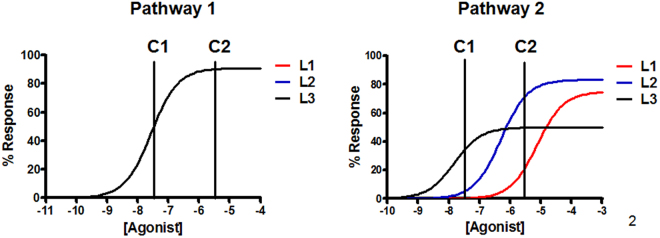
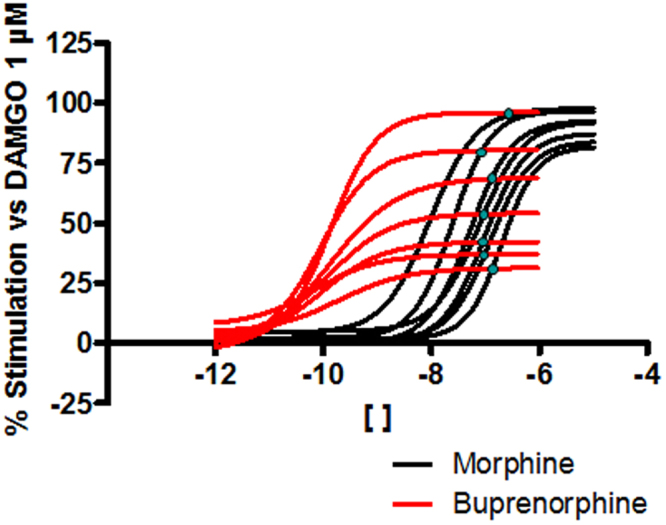
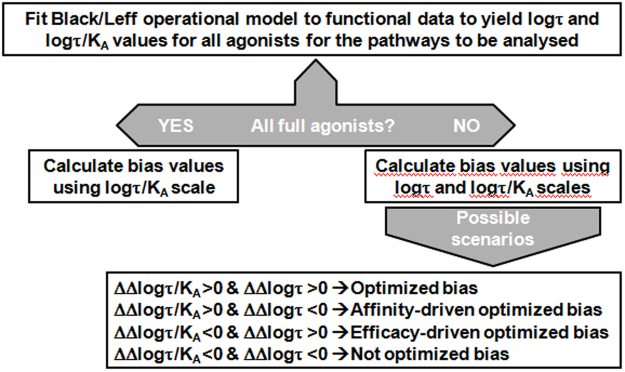
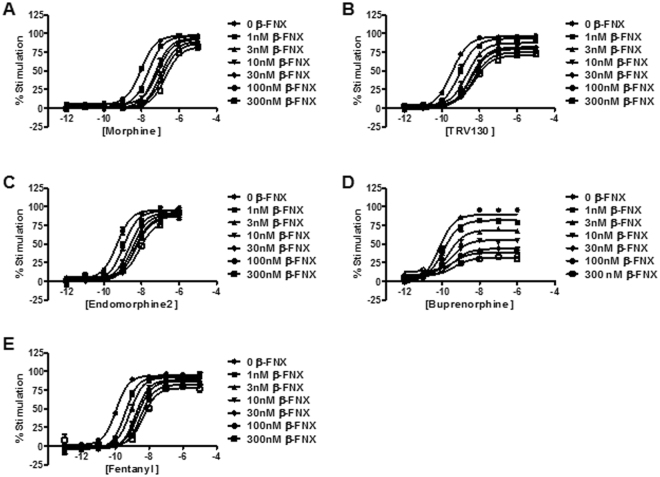
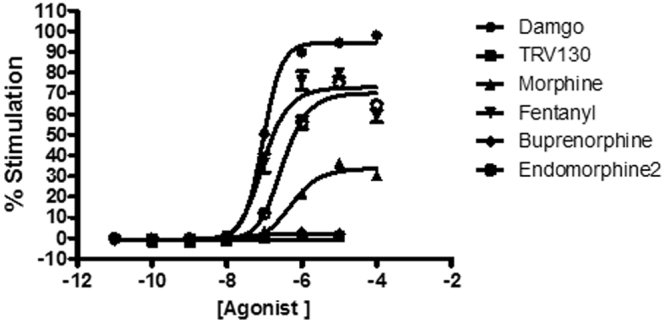
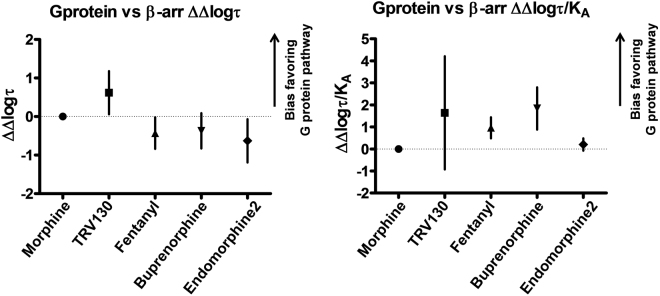
Compelling data in the literature from the recent years leave no doubt about the pluridimensional nature of G protein-coupled receptor function and the fact that some ligands can couple with different efficacies to the multiple pathways that a receptor can signal through, a phenomenon most commonly known as functional selectivity or biased agonism. Nowadays, transduction coefficients (log(τ/K)), based on the Black and Leff operational model of agonism, are widely used to calculate bias. Nevertheless, combining both affinity and efficacy in a single parameter can result in compounds showing a defined calculated bias of one pathway over other though displaying varying experimental bias preferences. In this paper, we present a novel scale (log(τ)), that attempts to give extra substance to different compound profiles in order to better classify compounds and quantify their bias. The efficacy-driven log(τ) scale is not proposed as an alternative to the affinity&efficacy-driven log(τ/K) scale but as a complement in those situations where partial agonism is present. Both theoretical and practical approaches using μ-opioid receptor agonists are presented.
近年来,文献中引人注目的数据无疑表明了 G 蛋白偶联受体功能的多维度性质,以及一些配体可以以不同的效率与受体可以通过的多种途径偶联的事实,这种现象通常被称为功能选择性或偏向激动作用。如今,基于激动作用的 Black 和 Leff 操作模型的转导系数(log(τ/K))被广泛用于计算偏向性。然而,将亲和力和效力结合在一个单一参数中可能会导致化合物在显示一种定义的计算偏向性的同时,表现出不同的实验偏向性偏好。在本文中,我们提出了一种新的尺度(log(τ)),试图为不同的化合物特征提供更多的实质内容,以便更好地对化合物进行分类和量化它们的偏向性。以效力为驱动的 log(τ)尺度并不是作为亲和力和效力驱动的 log(τ/K)尺度的替代品提出的,而是作为在存在部分激动作用的情况下的补充。本文提出了使用μ-阿片受体激动剂的理论和实际方法。