Huber Susanne, Zahourek Patricia, Fieder Martin
Department of Anthropology, University of Vienna, Vienna, Austria.
R Soc Open Sci. 2017 Oct 25;4(10):170544. doi: 10.1098/rsos.170544. eCollection 2017 Oct.
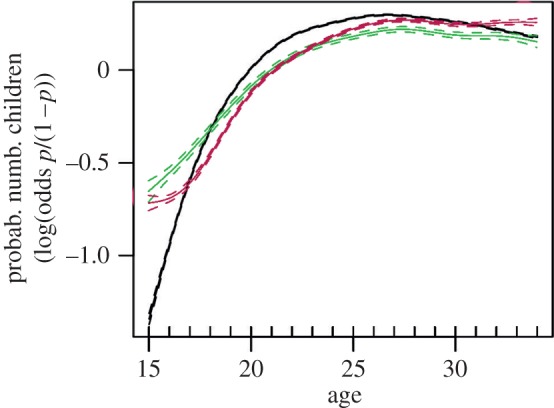
It has been discussed in the literature that the presence of kin, particularly the presence of a women's own mother or her mother in law, may have fertility effects. We aimed to examine the effects of the presence of a woman's own or her husband's mother in the household on a woman's fertility in terms of number of children on a broad basis by analysing census data of over two million married women aged between 15 and 34 years from 14 countries worldwide. We find that with the exception of Iraq, across all countries, the majority of women live only with their spouse in the household. We further find that the presence of any mother in the household is invariably associated with a significantly lower number of children compared to women living only with their spouse. In addition, in most countries, a woman's number of children is lower if she lives with her own mother as compared to her husband's mother in the household. Number of children is nonlinearly associated with woman's age, the presence of any mother being related with an earlier start of childbearing but a shallower increase in number of children. We speculate that the presence of a mother in the household may slow down woman's reproduction, but also discuss alternative explanations.
文献中曾讨论过亲属的存在,尤其是女性自己的母亲或婆婆的存在,可能会对生育产生影响。我们旨在通过分析来自全球14个国家的200多万名年龄在15至34岁之间的已婚女性的人口普查数据,从广义上研究女性自己或其丈夫的母亲在家庭中的存在对女性生育子女数量的影响。我们发现,除伊拉克外,在所有国家,大多数女性在家庭中仅与配偶生活在一起。我们还发现,与仅与配偶生活的女性相比,家庭中有任何一位母亲的情况下,子女数量总是显著减少。此外,在大多数国家,与家庭中与丈夫的母亲生活相比,女性与自己的母亲生活在一起时,生育的子女数量更少。子女数量与女性年龄呈非线性关系,有任何一位母亲的存在与生育开始时间较早相关,但子女数量的增长较平缓。我们推测家庭中有母亲可能会减缓女性的生育速度,但也讨论了其他解释。