Department of Health Promotion and Development, Graduate School of Health Sciences, Hiroshima University, Hiroshima, Japan.
BMC Pregnancy Childbirth. 2012 Jun 14;12:49. doi: 10.1186/1471-2393-12-49.
A husband's support during childbirth is vital to a parturient woman's emotional well-being. Evidence suggests that this type of support enables a woman to feel more in control during labour by reducing maternal anxiety during childbirth. However, in Nepal, where childbearing is considered an essential element of a marital relationship, the husband's role in this process has not been explored. Therefore, we examined whether a woman in Nepal feels more in control during labour when her husband is present, compared to when another woman accompanies her or when she has no support person.
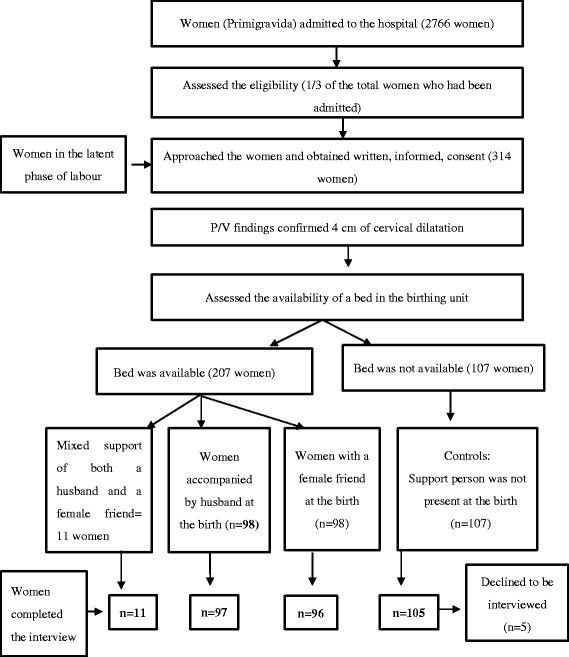
The study participants were low risk primigravida women in the following categories: women who gave birth with their husband present (n = 97), with a female friend present (n = 96), with mixed support (n = 11), and finally, a control group (n = 105). The study was conducted in the public maternity hospital in Kathmandu in 2011. The Labour Agentry Scale (LAS) was used to measure the extent to which women felt in control during labour. The study outcome was compared using an F-test from a one-way analysis of variance, and multiple regression analyses.
The women who gave birth with their husband's support reported higher mean LAS scores (47.92 ± 6.95) than the women who gave birth with a female friend's support (39.91 ± 8.27) and the women in the control group (36.68 ± 8.31). The extent to which the women felt in control during labour was found to be positively associated with having their husband's company during childbirth (β = 0.54; p < 0.001) even after adjusting for background variables. In addition, having a female friend's company during childbirth was related to the women's feeling of being in control during labour (β = 0.19; p < 0.001) but the effect size was smaller than for a husband's company.
The results show that when a woman's husband is present at the birth, she feels more in control during labour. This finding has strong implications for maternity practices in Nepal, where maternity wards rarely encourage a woman to bring her husband to a pregnancy appointment and to be present during childbirth.
丈夫在分娩期间的支持对产妇的情绪健康至关重要。有证据表明,这种支持方式可以通过减少分娩时的产妇焦虑,使女性在分娩过程中感到更能掌控局面。然而,在尼泊尔,分娩被视为婚姻关系的重要组成部分,丈夫在这个过程中的角色尚未得到探索。因此,我们研究了尼泊尔女性在分娩时有丈夫陪伴、有女性朋友陪伴和没有陪伴人员时,哪种情况下会感到更能掌控局面。
研究对象为低危初产妇,分为以下几类:有丈夫陪伴分娩的产妇(n=97)、有女性朋友陪伴分娩的产妇(n=96)、混合陪伴的产妇(n=11)和对照组产妇(n=105)。研究于 2011 年在加德满都的公立医院进行。使用劳动代理量表(LAS)来衡量女性在分娩过程中感到掌控的程度。使用单因素方差分析的 F 检验和多元回归分析比较研究结果。
有丈夫支持的产妇报告的平均 LAS 评分(47.92±6.95)高于有女性朋友支持的产妇(39.91±8.27)和对照组产妇(36.68±8.31)。研究发现,女性在分娩过程中感到掌控的程度与分娩时有丈夫陪伴呈正相关(β=0.54;p<0.001),即使在调整了背景变量后也是如此。此外,分娩时有女性朋友陪伴与女性在分娩过程中感到掌控的程度相关(β=0.19;p<0.001),但影响程度小于丈夫陪伴。
研究结果表明,当女性的丈夫在分娩时在场时,她会在分娩过程中感到更能掌控局面。这一发现对尼泊尔的产妇护理实践具有重要意义,因为尼泊尔的产房很少鼓励女性带丈夫去孕期预约并在分娩时陪伴。