Tang Li, Liu Zichao, Zhang Ruopeng, Su Cunmei, Yang Wenjuan, Yao Youlin, Zhao Shuhua
Department of Reproduction and Genetics, the First Affiliated Hospital of Kunming Medical University, Kunming, Yunnan Province, China.
Key Laboratory of Special Biological Resource Development and Utilization of Universities in Yunnan Province, Department of Life Science and Technology, Kunming University, Kunming, Yunnan Province, China.
PLoS One. 2017 Nov 14;12(11):e0187869. doi: 10.1371/journal.pone.0187869. eCollection 2017.
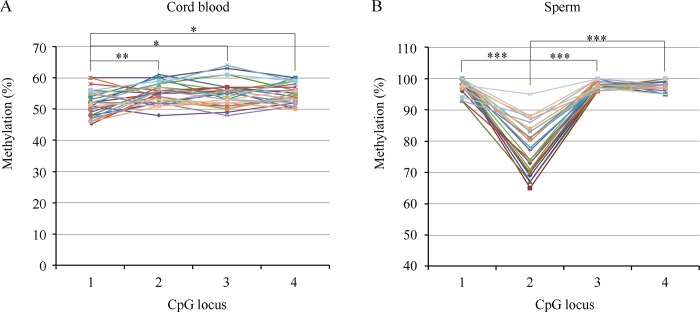
An increase in imprinting disorders in children conceived though assisted reproductive technologies (ARTs) has been the subject of several reports. The transmission of imprinting errors from the sperm of infertile fathers is believed to be a possible reason for the increased occurrence of these disorders. However, whether the imprinting alterations in sperm affect ART outcomes and the imprinting of offspring is unclear. In the current study, we analyzed the methylation of H19, SNRPN and KCNQ1OT1 by pyrosequencing sperm samples from 97 infertile patients and 31 proven fertile males as well as cord blood samples from 13 infantswho were conceived by infertile parents through intracytoplasmic sperm injection (ICSI) and 30 healthy newborns who were conceived naturally. After four cases were excluded owing to the lack of a sequencing signal, the infertile patients were subgrouped into normal (69 cases) and abnormal (24 cases) imprinting groups according to the reference range set by the control group. Between the groups, there were no significant differences in ART outcomes. Significantly different levels of methylation were detected in H19, but none of the imprinted genes were determined to be outside of the methylation reference range set by the values derived from the naturally conceived controls. Three CpG loci were found to be significantly hypomethylated in the maternally imprinted gene KCNQ1OT1 in two patients from the abnormal imprinting group, none of which were caused by sperm imprinting errors. In addition, the paternal H19 gene exhibited discrepant methylation patterns between the sperm controls and the cord blood controls. Our data suggest that increased imprinting errors in the sperm of infertile patients do not have an obvious influence on ART outcomes or the imprinting of offspring.
多项报告都探讨了通过辅助生殖技术(ART)受孕的儿童中印记紊乱现象增加这一问题。不育父亲精子中印记错误的传递被认为是这些疾病发生率增加的一个可能原因。然而,精子中的印记改变是否会影响ART结局以及后代的印记尚不清楚。在本研究中,我们通过焦磷酸测序分析了97例不育患者和31例已证实可育男性的精子样本,以及13例通过胞浆内单精子注射(ICSI)由不育父母受孕的婴儿的脐带血样本和30例自然受孕的健康新生儿的脐带血样本中H19、SNRPN和KCNQ1OT1的甲基化情况。由于缺乏测序信号,排除4例样本后,根据对照组设定的参考范围,将不育患者分为正常印记组(69例)和异常印记组(24例)。两组之间的ART结局没有显著差异。在H19中检测到显著不同的甲基化水平,但没有一个印记基因被确定超出自然受孕对照值设定的甲基化参考范围。在异常印记组的两名患者中,发现母源印记基因KCNQ1OT1的三个CpG位点显著低甲基化,且均不是由精子印记错误引起的。此外,父源H19基因在精子对照和脐带血对照之间表现出不同的甲基化模式。我们的数据表明,不育患者精子中印记错误增加对ART结局或后代印记没有明显影响。