Xu Tingting, Weng Zihua, Pei Chu, Yu Siyuan, Chen Yating, Guo Wenjie, Wang Xingzuo, Luo Peng, Sun Jia
Zhujiang Hospital, Southern Medical University State Key Laboratory of Respiratory Disease, National Clinical Center for Respiratory Diseases, Guangzhou Institute of Respiratory Diseases, First Affiliated Hospital of Guangzhou Medical University, Guangzhou, China.
Medicine (Baltimore). 2017 Nov;96(45):e8289. doi: 10.1097/MD.0000000000008289.
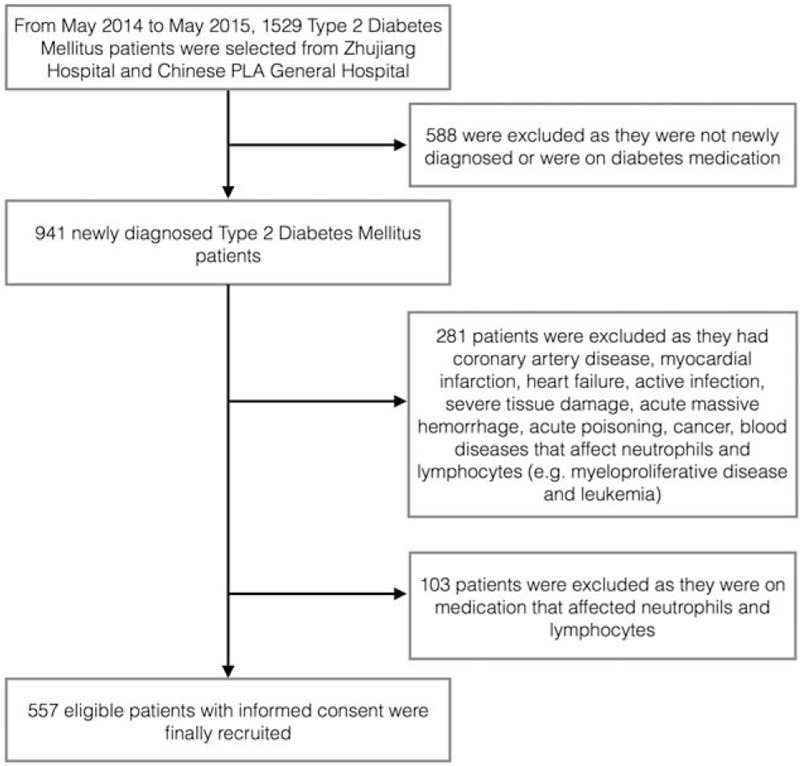
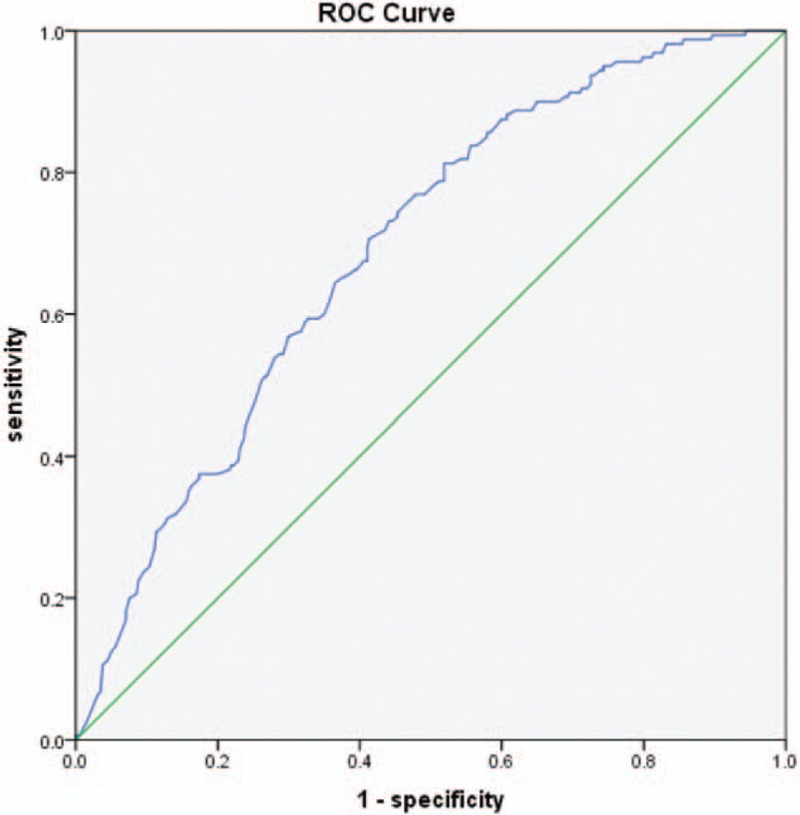
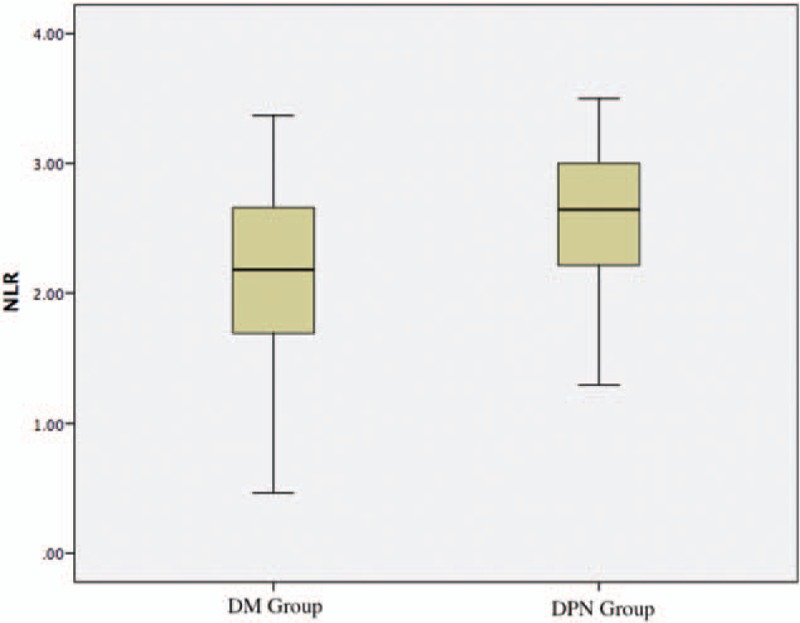
To explore the relationship between neutrophil-to-lymphocyte ratio (NLR) and diabetic peripheral neuropathy (DPN) in type 2 diabetes mellitus.A total of 557 newly diagnosed Type 2 Diabetes Mellitus (T2DM) patients were recruited, including 397 T2DM patients without complication (DM group) as well as 160 T2DM patients complicated with DPN (DPN group). Student t test, Mann-Whitney U test, or χ test was applied to the data of the 2 groups, including the levels of neutrophils and lymphocytes as well as the NLR values of peripheral blood and other biochemistry indexes; Pearson correlation analysis was used to calculate the correlation of NLR and detected factors; risk factors of DPN were estimated via logistic regression analysis and multivariate analysis.The values of triglyceride (TG), neutrophils, fasting insulin, urinary albumin, and 2 hour postglucose in DPN group were significantly higher than those of the DM group, whereas the number of lymphocytes of DPN group was considerably lower than that of the DM group (P < .05 respectively); NLR values were remarkably higher in DPN group compared with those of DM group (2.58 ± 0.50 vs 2.18 ± 0.61, P < .001); logistic regression analysis showed that NLR (P = .002, OR = 4.960, 95% CI = 1.843-13.349) was a risk factor of DPN. Multivariate logistic regression analysis showed that DPN was independently related to NLR (P = .002, OR = 4.960, 95% CI = 1.843-13.349). The ROC curve analysis confirmed that the optimal cut-off point, specificity, and sensitivity in diagnosing DPN by NLR were 2.13%, 48.1%, and 81.3% respectively.Our results showed that NLR is significantly correlated with DPN, which suggested that NLR may be an independent risk factor of DPN.
探讨2型糖尿病患者中性粒细胞与淋巴细胞比值(NLR)与糖尿病周围神经病变(DPN)之间的关系。共纳入557例新诊断的2型糖尿病(T2DM)患者,其中397例无并发症的T2DM患者(DM组)以及160例合并DPN的T2DM患者(DPN组)。对两组数据应用Student t检验、Mann-Whitney U检验或χ检验,包括中性粒细胞和淋巴细胞水平、外周血NLR值以及其他生化指标;采用Pearson相关分析计算NLR与检测因素的相关性;通过逻辑回归分析和多因素分析评估DPN的危险因素。DPN组甘油三酯(TG)、中性粒细胞、空腹胰岛素、尿白蛋白及餐后2小时血糖值均显著高于DM组,而DPN组淋巴细胞数量明显低于DM组(P均<0.05);DPN组NLR值显著高于DM组(2.58±0.50 vs 2.18±0.61,P<0.001);逻辑回归分析显示NLR(P=0.002,OR=4.960,95%CI=1.843-13.349)是DPN的危险因素。多因素逻辑回归分析显示DPN与NLR独立相关(P=0.002,OR=4.960,95%CI=1.843-13.349)。ROC曲线分析证实,NLR诊断DPN的最佳截断点、特异性和敏感性分别为2.13%、48.1%和81.3%。我们的结果表明NLR与DPN显著相关,提示NLR可能是DPN的独立危险因素。