Division of Infection Control and Environmental Health, Norwegian Institute of Public Health, 0456 Oslo, Norway.
Department of Nursing and Health Promotion, Faculty of Health Sciences, Oslo and Akershus University College of Applied Sciences, 0167 Oslo, Norway.
Nutrients. 2017 Nov 13;9(11):1239. doi: 10.3390/nu9111239.
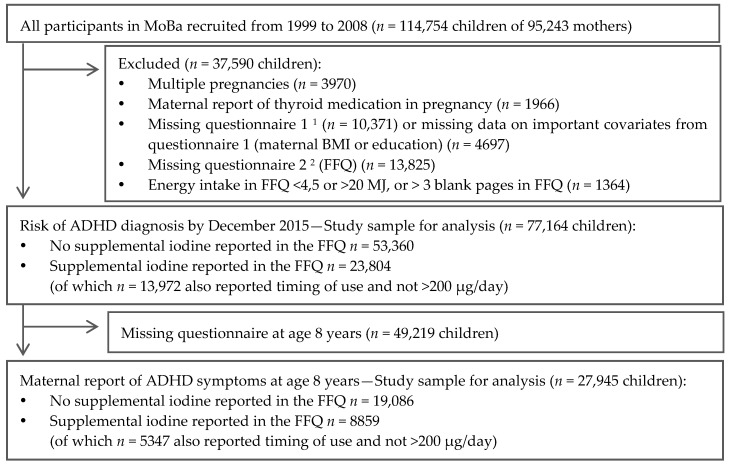
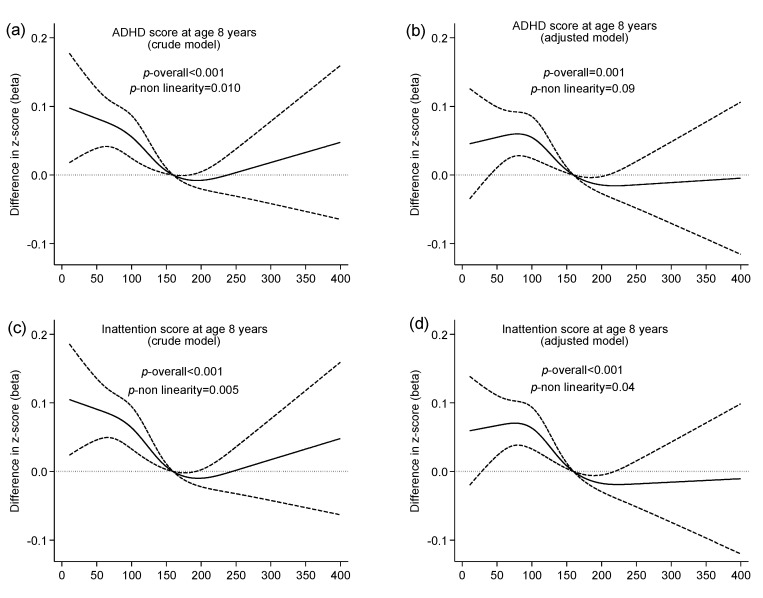
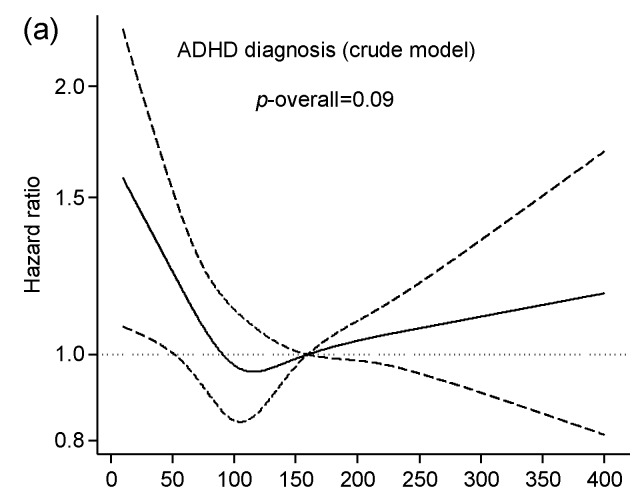
Current knowledge about the relationship between mild to moderately inadequate maternal iodine intake and/or supplemental iodine on child neurodevelopment is sparse. Using information from 77,164 mother-child pairs in the Norwegian Mother and Child Cohort Study, this study explored associations between maternal iodine intake and child attention-deficit/hyperactivity disorder (ADHD) diagnosis, registered in the Norwegian Patient Registry and maternally-reported child ADHD symptoms at eight years of age. Pregnant women reported food and supplement intakes by questionnaire in gestational week 22. In total, 1725 children (2.2%) were diagnosed with ADHD. In non-users of supplemental iodine (53,360 mothers), we found no association between iodine intake from food and risk of child ADHD diagnosis ( = 0.89), while low iodine from food (<200 µg/day) was associated with higher child ADHD symptom scores (adjusted difference in score up to 0.08 standard deviation (SD), < 0.001, = 19,086). In the total sample, we found no evidence of beneficial effects of maternal use of iodine-containing supplements ( = 23,804) on child ADHD diagnosis or symptom score. Initiation of iodine supplement use in gestational weeks 0-12 was associated with an increased risk of child ADHD (both measures). In conclusion, insufficient maternal iodine intake was associated with increased child ADHD symptom scores at eight years of age, but not with ADHD diagnosis. No reduction of risk was associated with maternal iodine supplement use.
目前,关于轻度至中度母体碘摄入不足和/或补充碘对儿童神经发育的影响的知识还很有限。本研究利用挪威母婴队列研究中的 77164 对母婴数据,探讨了母体碘摄入量与儿童注意力缺陷多动障碍(ADHD)诊断之间的关系,ADHD 诊断信息来源于挪威患者登记处,儿童 ADHD 症状则由母亲在 8 岁时报告。孕妇在妊娠第 22 周时通过问卷报告食物和补充剂的摄入量。共有 1725 名儿童(2.2%)被诊断为 ADHD。在未使用补充碘的母亲中(53360 名),我们未发现食物中碘摄入与儿童 ADHD 诊断风险之间存在关联( = 0.89),而低碘食物摄入(<200μg/天)与儿童 ADHD 症状评分较高有关(校正后评分差异高达 0.08 个标准差(SD),<0.001,n=19086)。在总样本中,我们没有发现母体使用含碘补充剂(n=23804)对儿童 ADHD 诊断或症状评分有有益影响的证据。在妊娠 0-12 周开始补充碘与儿童 ADHD 风险增加有关(两种测量方法均如此)。总之,母体碘摄入不足与 8 岁儿童 ADHD 症状评分增加有关,但与 ADHD 诊断无关。母体碘补充使用与风险降低无关。