Prieske Katharina, Prieske Stefan, Joosse Simon A, Trillsch Fabian, Grimm Donata, Burandt Eike, Mahner Sven, Schmalfeldt Barbara, Milde-Langosch Karin, Oliveira-Ferrer Leticia, Woelber Linn
Department of Gynecology and Gynecologic Oncology, University Medical Centre Hamburg-Eppendorf, 20246 Hamburg, Germany.
Department of Tumor Biology, University Medical Centre Hamburg-Eppendorf, 20246 Hamburg, Germany.
Oncotarget. 2017 Sep 15;8(47):83063-83074. doi: 10.18632/oncotarget.20945. eCollection 2017 Oct 10.
Approximately 20-25% of ovarian cancers are attributable to germline or somatic mutations, resulting in defects in the homologous recombination pathway. Inactivation of these genes can also be mediated by epigenetic changes, e.g., hypermethylation of CpG islands in the promoter regions. In such homologous recombination deficient tumors, platinum based chemotherapy is in general effective, however, loss of hypermethylation might lead to refractory disease. The aim of this study was to evaluate the stability of promoter hypermethylation in recurrent disease after platinum based chemotherapy.
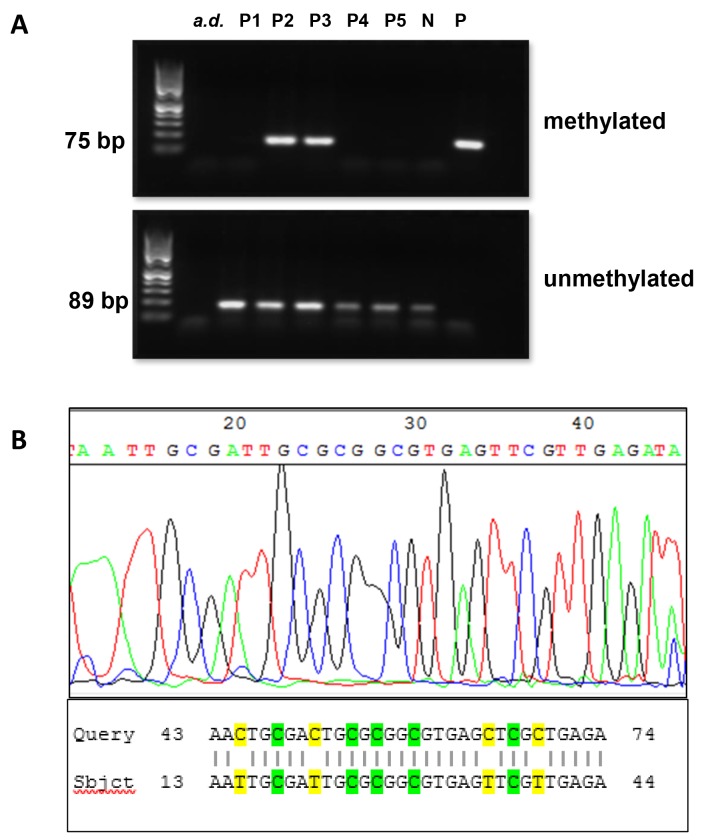
Tumor tissue from 76 patients with primary and 48 patients with platinum-sensitive recurrent high-grade ovarian cancer was collected. In a subgroup of 12 patients, 'paired' tumor tissue from primary and recurrent surgery was available. promoter methylation status was assessed using methylation specific polymerase chain reaction and was verified by Sanger Sequencing.
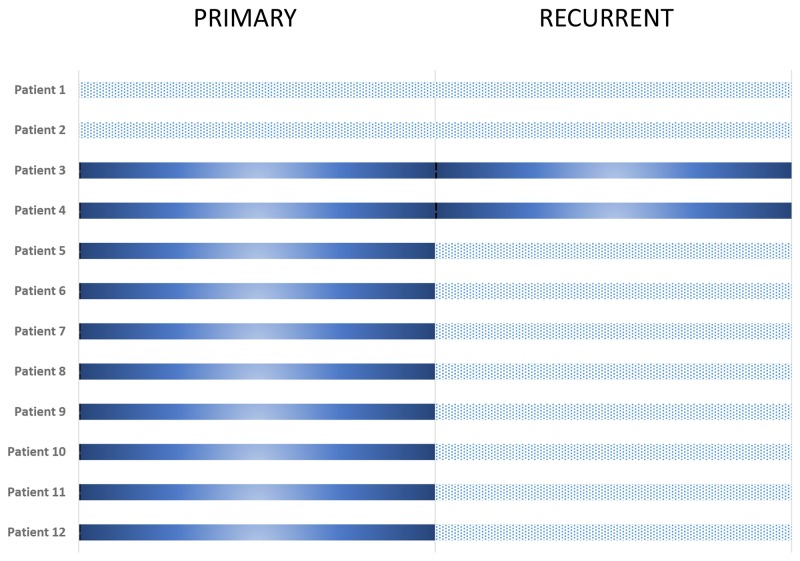
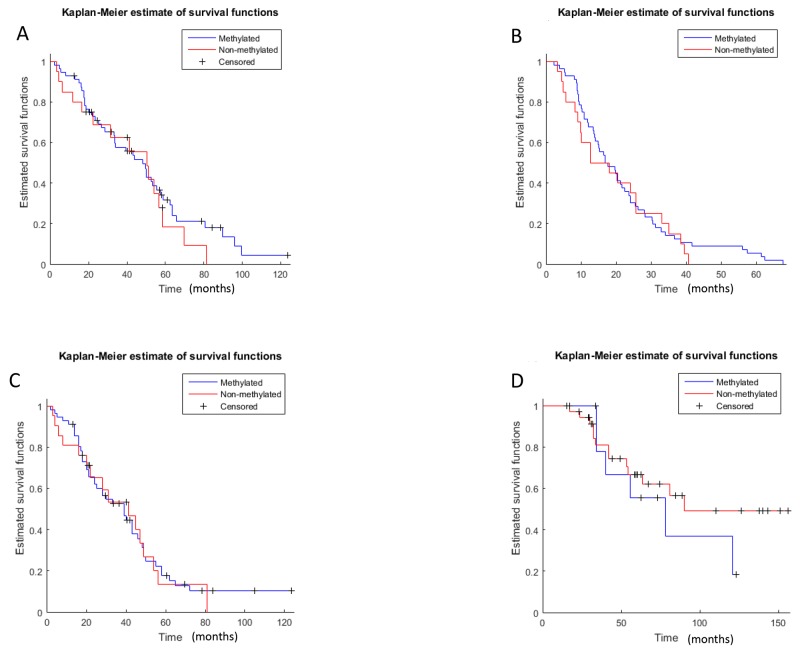
73.7% (56/76) of primary and 20.8% (10/48) of recurrent tumors displayed promoter hypermethylation. promoter methylation status was not associated with progression-free- or overall survival. In the paired subgroup 83.3% (10/12) of the primary vs. 16.7% (2/12) of the recurrent tumors showed hypermethylation. In eight patients loss of hypermethylation was observed, whereas two patients had stable methylation status.
Loss of promoter methylation may be a mechanism to restore function in recurrent disease. However, currently the clinical significance is still unclear and should be evaluated in prospective clinical trials.
约20%-25%的卵巢癌归因于种系或体细胞突变,导致同源重组途径缺陷。这些基因的失活也可由表观遗传变化介导,例如启动子区域CpG岛的高甲基化。在这类同源重组缺陷型肿瘤中,铂类化疗总体有效,然而,高甲基化的缺失可能导致难治性疾病。本研究的目的是评估铂类化疗后复发性疾病中启动子高甲基化的稳定性。
收集76例原发性高级别卵巢癌患者和48例铂敏感复发性高级别卵巢癌患者的肿瘤组织。在12例患者的亚组中,可获得原发性和复发性手术的“配对”肿瘤组织。使用甲基化特异性聚合酶链反应评估启动子甲基化状态,并通过桑格测序进行验证。
73.7%(56/76)的原发性肿瘤和20.8%(10/48)的复发性肿瘤显示启动子高甲基化。启动子甲基化状态与无进展生存期或总生存期无关。在配对亚组中,83.3%(10/12)的原发性肿瘤与16.7%(2/12)的复发性肿瘤显示高甲基化。在8例患者中观察到启动子高甲基化缺失,而2例患者甲基化状态稳定。
启动子甲基化缺失可能是复发性疾病中恢复功能的一种机制。然而,目前其临床意义仍不清楚,应在前瞻性临床试验中进行评估。