Miller Rowan E, Elyashiv Osnat, El-Shakankery Karim H, Ledermann Jonathan A
Department of Medical Oncology, University College London Hospital, London, UK.
Department of Medical Oncology, St Bartholomew's Hospital, London, UK.
Onco Targets Ther. 2022 Oct 4;15:1105-1117. doi: 10.2147/OTT.S272199. eCollection 2022.
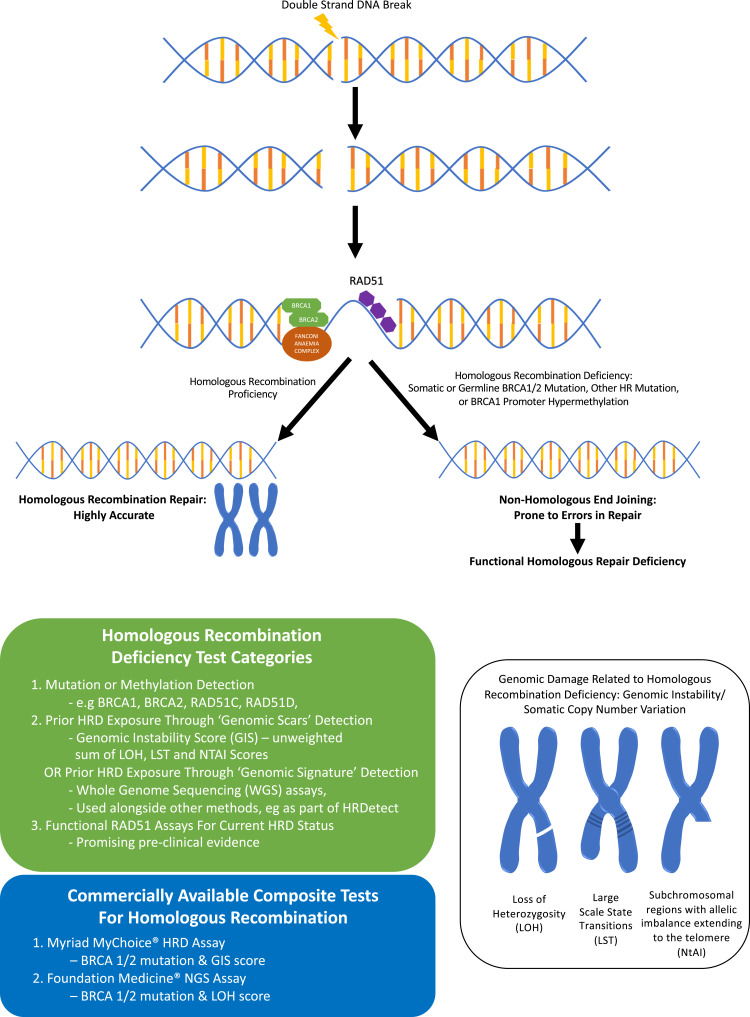
Poly(adenosine diphosphate-ribose) polymerase (PARP) inhibitors have revolutionised the management of patients with high-grade serous and endometrioid ovarian cancer demonstrating significant improvements in progression-free survival. Whilst the greatest benefit is seen with mutant cancers, it is clear that the benefit extends beyond this group. This sensitivity is thought to be due to homologous recombination deficiency (HRD), which is present in up to 50% of the high-grade serous cancers. Several different HRD assays exist, which fall into one of three main categories: homologous recombination repair (HRR)-related gene analysis, genomic "scars" and/or mutational signatures, and real-time HRD functional assessment. We review the emerging data on HRD as a predictive biomarker for PARP inhibitors and discuss the merits and disadvantages of different HRD assays.
聚(腺苷二磷酸核糖)聚合酶(PARP)抑制剂彻底改变了高级别浆液性和子宫内膜样卵巢癌患者的治疗方式,在无进展生存期方面有显著改善。虽然在突变癌症中观察到最大益处,但显然这种益处并不局限于这一组。这种敏感性被认为是由于同源重组缺陷(HRD),高达50%的高级别浆液性癌症存在这种情况。存在几种不同的HRD检测方法,可分为三大类之一:同源重组修复(HRR)相关基因分析、基因组“疤痕”和/或突变特征,以及实时HRD功能评估。我们综述了关于HRD作为PARP抑制剂预测生物标志物的新数据,并讨论了不同HRD检测方法的优缺点。