Liu Tao, Li Jianjun, Huang Shixiong, Li Changqinq, Zhao Zhongyan, Wen Guoqiang, Chen Feng
Department of Neurology, Hainan General Hospital, Haikou 570311, China.
Department of Radiology, Hainan General Hospital, Haikou 570311, China.
Oncotarget. 2017 Jul 17;8(48):84529-84539. doi: 10.18632/oncotarget.19307. eCollection 2017 Oct 13.
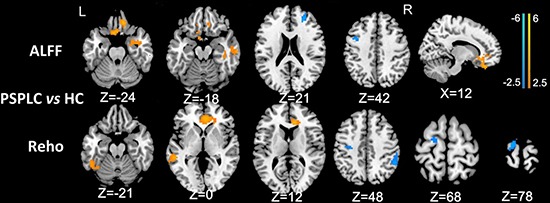
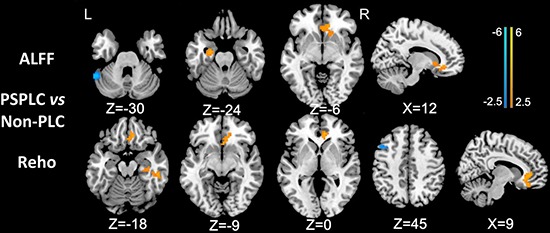
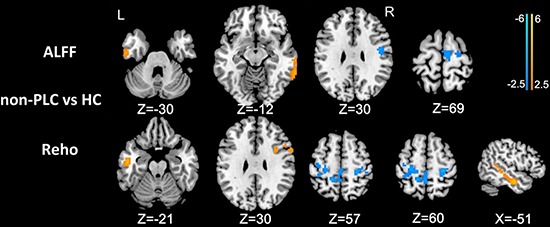
We used resting-state functional magnetic resonance imaging to investigate the global spontaneous neural activity involved in pathological laughing and crying after stroke. Twelve pathological laughing and crying patients with isolated pontine infarction were included, along with 12 age- and gender-matched acute isolated pontine infarction patients without pathological laughing and crying, and 12 age- and gender-matched healthy controls. We examined both the amplitude of low-frequency fluctuation and the regional homogeneity in order to comprehensively evaluate the intrinsic activity in patients with post-stroke pathological laughing and crying. In the post-stroke pathological laughing and crying group, changes in these measures were observed mainly in components of the default mode network (medial prefrontal cortex/anterior cingulate cortex, middle temporal gyrus, inferior temporal gyrus, superior frontal gyrus, middle frontal gyrus and inferior parietal lobule), sensorimotor network (supplementary motor area, precentral gyrus and paracentral lobule), affective network (medial prefrontal cortex/anterior cingulate cortex, parahippocampal gyrus, middle temporal gyrus and inferior temporal gyrus) and cerebellar lobes (cerebellum posterior lobe). We therefore speculate that when disinhibition of the volitional system is lost, increased activation of the emotional system causes pathological laughing and crying.
我们使用静息态功能磁共振成像来研究中风后病理性哭笑所涉及的全脑自发神经活动。纳入了12例患有孤立性脑桥梗死的病理性哭笑患者,以及12例年龄和性别匹配的无病理性哭笑的急性孤立性脑桥梗死患者,还有12例年龄和性别匹配的健康对照。我们检查了低频波动幅度和局部一致性,以便全面评估中风后病理性哭笑患者的内在活动。在中风后病理性哭笑组中,这些指标的变化主要见于默认模式网络(内侧前额叶皮质/前扣带回皮质、颞中回、颞下回、额上回、额中回和顶下小叶)、感觉运动网络(辅助运动区、中央前回和中央旁小叶)、情感网络(内侧前额叶皮质/前扣带回皮质、海马旁回、颞中回和颞下回)以及小脑叶(小脑后叶)的组成部分。因此,我们推测当意志系统的抑制作用丧失时,情感系统的激活增加会导致病理性哭笑。