Department of Molecular Cardiology, Cleveland Clinic, 9500 Euclid Ave, Cleveland, OH 44195, USA.
Matrix Biol. 2019 Jan;75-76:300-313. doi: 10.1016/j.matbio.2017.11.006. Epub 2017 Nov 11.
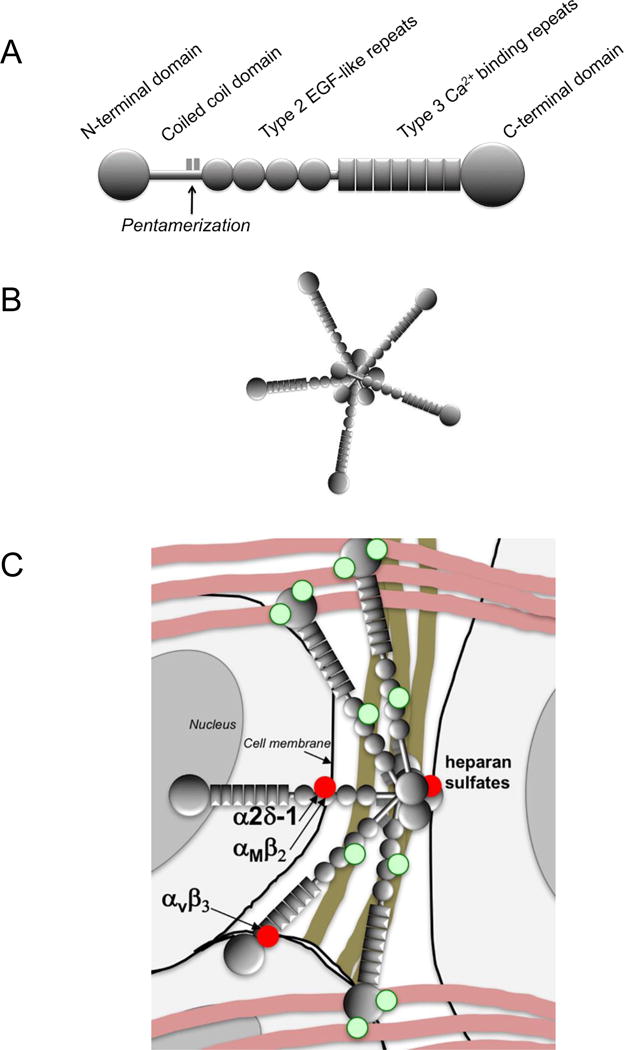
Thrombospondin-4 (TSP-4) belongs to the thrombospondin protein family that consists of five highly homologous members. A number of novel functions have been recently assigned to TSP-4 in cardiovascular and nervous systems, inflammation, cancer, and the motor unit, which have attracted attention to this extracellular matrix (ECM) protein. These newly discovered functions set TSP-4 apart from other thrombospondins. For example, TSP-4 promotes angiogenesis while other TSPs either prevent it or have no effect on new blood vessel growth; TSP-4 reduces fibrosis and collagen production while TSP-1 and TSP-2 promote fibrosis in several organs; unlike other TSPs, TSP-4 appears to have some structural functions in ECM. The current information about TSP-4 functions in different organs and physiological systems suggests that this evolutionary conserved protein is a major regulator of the extracellular matrix (ECM) organization and production and tissue remodeling during the embryonic development and response to injury. In this review article, we summarize the properties and functions of TSP-4 and discuss its role in tissue remodeling.
血栓反应蛋白-4(TSP-4)属于血栓反应蛋白蛋白家族,该家族由五个高度同源的成员组成。最近在心血管和神经系统、炎症、癌症和运动单位中发现了 TSP-4 的许多新功能,这引起了人们对这种细胞外基质(ECM)蛋白的关注。这些新发现的功能使 TSP-4 有别于其他血栓反应蛋白。例如,TSP-4 促进血管生成,而其他 TSP 要么阻止它,要么对新血管生长没有影响;TSP-4 减少纤维化和胶原生成,而 TSP-1 和 TSP-2 在几个器官中促进纤维化;与其他 TSP 不同,TSP-4 似乎在 ECM 中有一些结构功能。目前关于 TSP-4 在不同器官和生理系统中的功能的信息表明,这种进化上保守的蛋白质是胚胎发育过程中细胞外基质(ECM)组织和产生以及组织重塑以及对损伤反应的主要调节剂。在这篇综述文章中,我们总结了 TSP-4 的特性和功能,并讨论了它在组织重塑中的作用。