Seoul National University College of Medicine, Seoul, South Korea.
Ewha Brain Institute, Ewha Womans University, Seoul, South Korea.
Sci Rep. 2017 Nov 14;7(1):15576. doi: 10.1038/s41598-017-15572-6.
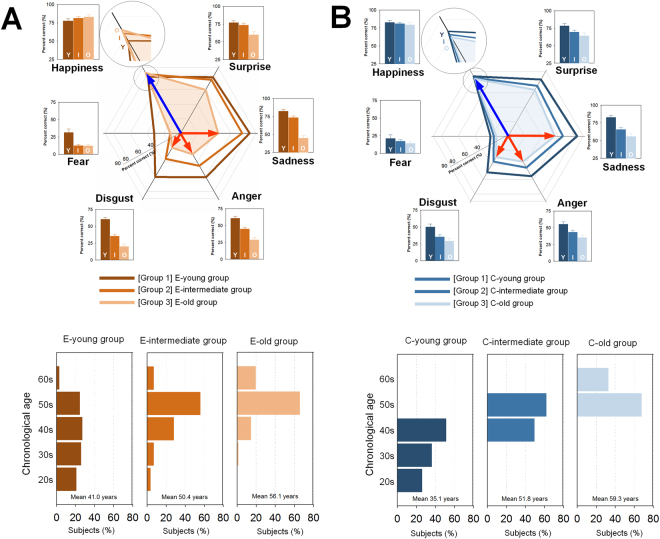
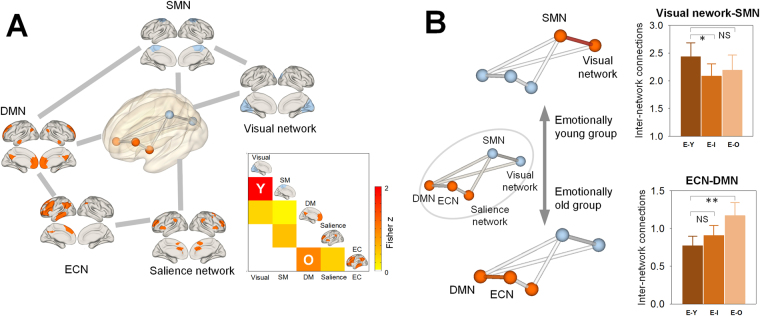
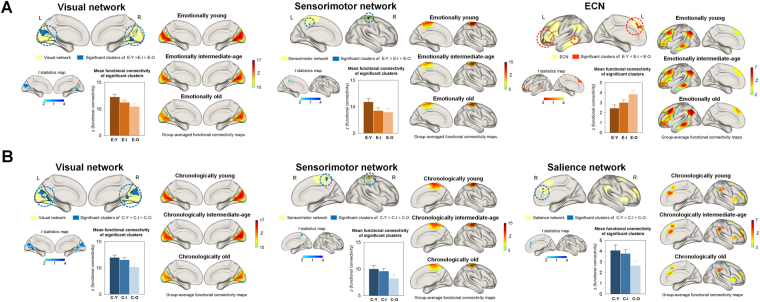
Physical and cognitive functions typically decline with aging while emotional stability is relatively conserved. The current proof-of-concept study is the first to report of the brain mechanisms underlying emotional aging from a brain network perspective. Two hundred eighty-six healthy subjects aged 20-65 were classified into three groups of the emotionally young, intermediate-aged, and old (E-young, E-intermediate, and E-old, respectively) based on the cluster analysis of the emotion recognition task data. As subjects get emotionally older, performance on happiness recognition improved, while that on recognition of negative emotions declined. On the brain network side, there was a significant linear decreasing trend in intra-network functional connectivity of the visual and sensorimotor networks with emotional aging (E-young > E-intermediate > E-old) as well as chronological aging (C-young > C-intermediate > C-old). Intra-network functional connectivity of the executive control network (ECN), however, steadily increased with emotional aging (E-young < E-intermediate < E-old) but not with chronological aging. Furthermore, the inter-network functional connections between the ECN and default mode network were also greater in the E-old group relative to the E-young group. This suggests that the top-down integration of self-referential information during emotional processing becomes stronger as people get emotionally older.
生理和认知功能通常随着年龄的增长而下降,而情绪稳定性则相对保持不变。本概念验证研究首次从脑网络角度报告了情绪老化的大脑机制。基于情绪识别任务数据的聚类分析,将 286 名年龄在 20-65 岁之间的健康受试者分为情绪年轻组、中年组和老年组(E-young、E-intermediate 和 E-old)。随着情绪的老化,受试者在识别快乐的表现上有所提高,而在识别负面情绪的表现上则有所下降。在脑网络方面,随着情绪老化(E-young>E-intermediate>E-old)和年龄增长(C-young>C-intermediate>C-old),视觉和感觉运动网络的内网络功能连接呈现出显著的线性下降趋势。然而,执行控制网络(ECN)的内网络功能连接则随着情绪老化(E-young<E-intermediate<E-old)而稳定增加,而不是随着年龄增长而增加。此外,ECN 和默认模式网络之间的网络间功能连接在老年组中也大于年轻组。这表明,随着人们情绪的老化,自我参照信息的自上而下的整合变得更强。