Malik Bassit, Ojha Utkarsh, Khan Hassan, Begum Farzana, Khan Harun, Malik Qasim
School of Medicine, Imperial College London, London, UK.
Barts and the London School of Medicine and Dentistry, London, UK.
Adv Med Educ Pract. 2017 Nov 6;8:735-743. doi: 10.2147/AMEP.S147212. eCollection 2017.
A teaching curriculum in health policy may be well established in medical school; however, an emphasis on applying taught principles via participation in health policy roles is less defined. We undertook a study to explore medical student participation in health policy roles.
An anonymous online survey via convenience sampling was conducted in the UK.
A total of 112 students from six medical schools participated in the study.
The outcome measures were as follows: medical students' beliefs about their current knowledge of health policy and their desire to learn more; their current, past and future involvement in a health policy role, and perceived barriers to involvement.
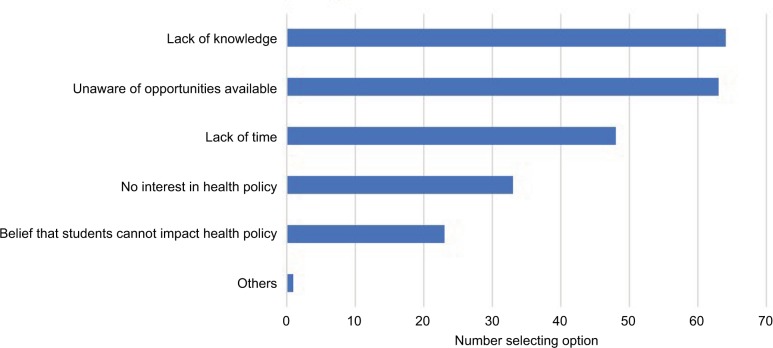
Forty-seven percent of participants reported previous teaching on health policy, with the majority scoring themselves 2 out of 5 for knowledge about the topic (38%). Seventy-seven percent of participants expressed a desire to be taught health policy while 73% agreed with compulsory teaching. Ninety-six percent of participants reported no current or previous activity in a health policy role, with 61% willing to undertake a role in the future. The three main barriers to student involvement were: a lack of knowledge about health policy (57%), an unawareness of opportunities available (56%), and a lack of time (43%).
In addition to already established teaching programs within medical school, implementation of community-based experiences could improve knowledge of health policy, while providing an opportunity for students to gain experience in health policy committee roles.
健康政策教学课程在医学院校可能已得到良好确立;然而,通过参与健康政策相关角色来强调应用所学原则的情况则界定较少。我们开展了一项研究以探索医学生参与健康政策相关角色的情况。
通过便利抽样在英国进行了一项匿名在线调查。
来自六所医学院校的112名学生参与了该研究。
结果指标如下:医学生对自身当前健康政策知识的信念以及他们想要学习更多知识的愿望;他们当前、过去及未来参与健康政策相关角色的情况,以及参与的感知障碍。
47%的参与者报告曾接受过健康政策方面的教学,其中大多数人给自己在该主题知识方面的评分是5分中的2分(38%)。77%的参与者表示希望接受健康政策方面的教学,73%的人同意进行强制性教学。96%的参与者报告目前或过去没有参与过健康政策相关角色的活动,61%的人愿意在未来承担这样的角色。学生参与的三大主要障碍是:缺乏健康政策知识(57%)、不了解可用机会(56%)以及缺乏时间(43%)。
除了医学院校已有的教学项目外,实施基于社区的体验可以提高健康政策知识,同时为学生提供在健康政策委员会角色中获得经验的机会。