Ndakala Frank Ndaks, Oyugi Julius Otieno, Oluka Margaret Ng'wono, Kimani Joshua, Norbert Behrens Georg Martin
University of Nairobi, Institute of Tropical and Infectious Diseases (UNITID), Nairobi, Kenya.
State Department of Science and Technology, Directorate of Research Management and Development (DRMD), Nairobi, Kenya.
Pan Afr Med J. 2017 Sep 5;28:7. doi: 10.11604/pamj.2017.28.7.10885. eCollection 2017.
In many settings, several factors including adverse drug reactions and clinical failure can limit treatment choices for combined antiretroviral therapy (cART). The aim of the study was to describe the incidence of first-line cART changes and associated factors in a cohort of Kenyan sex workers.
This was a retrospective review of medical records collected from 2009 to 2013. The review included records of HIV-infected patients aged ≥ 18 years, who received either stavudine or zidovudine or tenofovir disoproxil fumarate-based regimens. Using systematic random sampling, the study selected 1 500 records and censoring targeted the first incident of a drug change from the first-line cART.
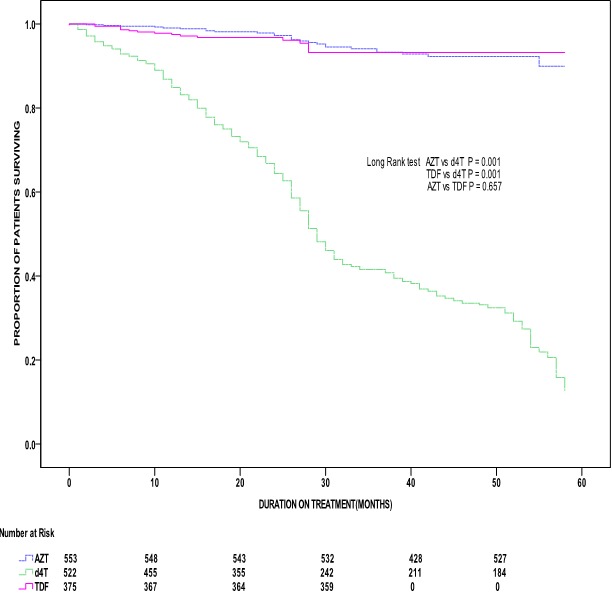
The overall incidence rate of cART changes was 11.1 per 100 person-years within a total follow-up period of 3 427.9 person-years. Out of 380 patients who changed cART, 370 (97%) had a drug substitution and 10 (3%) switched regimens. The most commonly cited reasons for changing cART were adverse drug reactions (76%). Tenofovir disoproxil fumarate had a lower drug change rate (1.9 per 100 person years) compared to stavudine (27 per 100 person years). Using zidovudine as the reference group, stavudine-based regimens were significantly associated with an increased hazard of drug changes (adjusted hazards ratio 10.2; 95% CI: 6.02-17.2).
These findings suggest a moderate incidence of cART changes among sex workers in Nairobi, Kenya. Individuals using stavudine were at a higher risk of experiencing a change in their cART, mostly presenting within 20 months, and primarily due to adverse drug reactions.
在许多情况下,包括药物不良反应和临床治疗失败在内的多种因素会限制联合抗逆转录病毒疗法(cART)的治疗选择。本研究旨在描述肯尼亚一群性工作者中一线cART方案变更的发生率及相关因素。
这是一项对2009年至2013年收集的病历进行的回顾性研究。该回顾纳入了年龄≥18岁、接受基于司他夫定或齐多夫定或替诺福韦酯的治疗方案的HIV感染患者的病历。通过系统随机抽样,该研究选取了1500份病历,并以从一线cART方案首次发生药物变更为截尾目标。
在总计3427.9人年的随访期内,cART方案变更的总体发生率为每100人年11.1次。在380例变更cART方案的患者中,370例(97%)进行了药物替换,10例(3%)更换了治疗方案。cART方案变更最常提及的原因是药物不良反应(76%)。与司他夫定(每100人年27次)相比,替诺福韦酯的药物变更率较低(每100人年1.9次)。以齐多夫定为参照组,基于司他夫定的治疗方案与药物变更风险增加显著相关(调整后的风险比为10.2;95%置信区间:6.02 - 17.2)。
这些研究结果表明,肯尼亚内罗毕的性工作者中cART方案变更的发生率中等。使用司他夫定的个体cART方案变更风险较高,大多在20个月内出现,主要原因是药物不良反应。