Farias Maria Eugenia, Rasuk Maria Cecilia, Gallagher Kimberley L, Contreras Manuel, Kurth Daniel, Fernandez Ana Beatriz, Poiré Daniel, Novoa Fernando, Visscher Pieter T
Laboratorio de Investigaciones Microbiológicas de Lagunas Andinas (LIMLA), Planta Piloto de Procesos Industriales Microbiológicos (PROIMI), CCT-Tucumán, CONICET, Tucumán, Argentina.
Department of Marine Sciences, University of Connecticut, Groton, Connecticut, United States of America.
PLoS One. 2017 Nov 15;12(11):e0186867. doi: 10.1371/journal.pone.0186867. eCollection 2017.
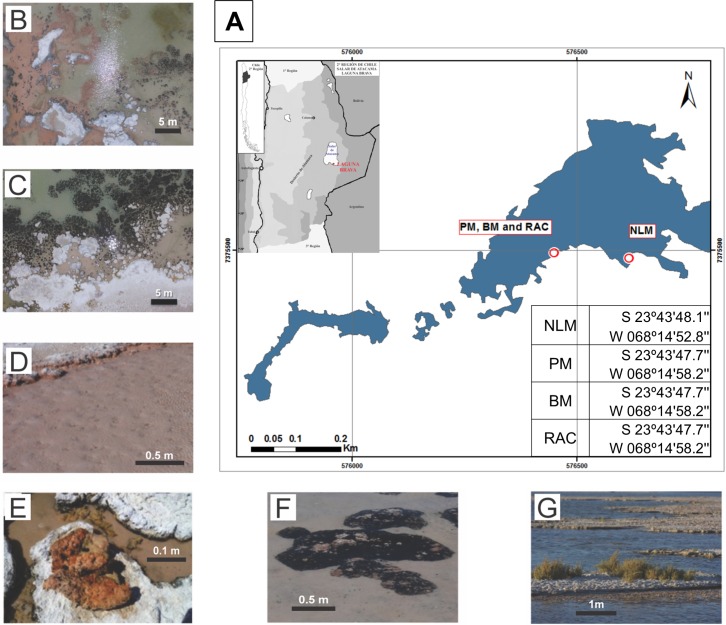
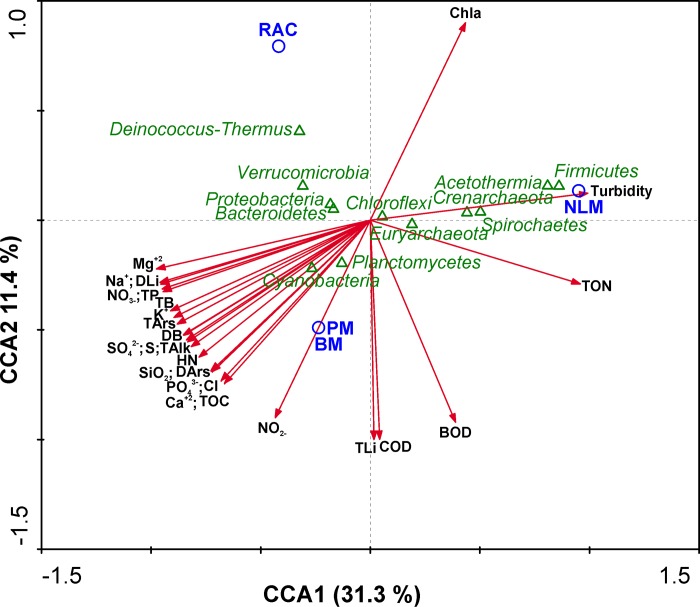
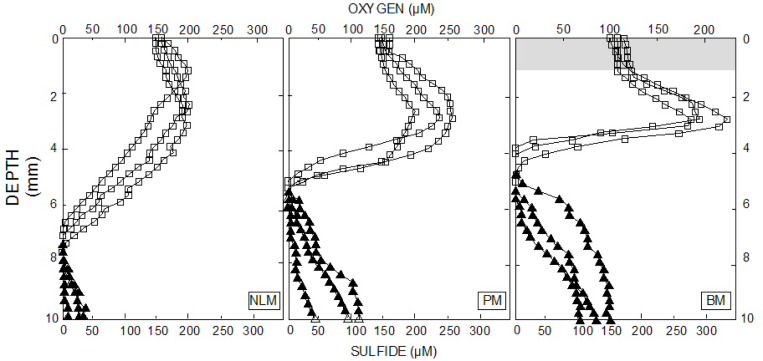
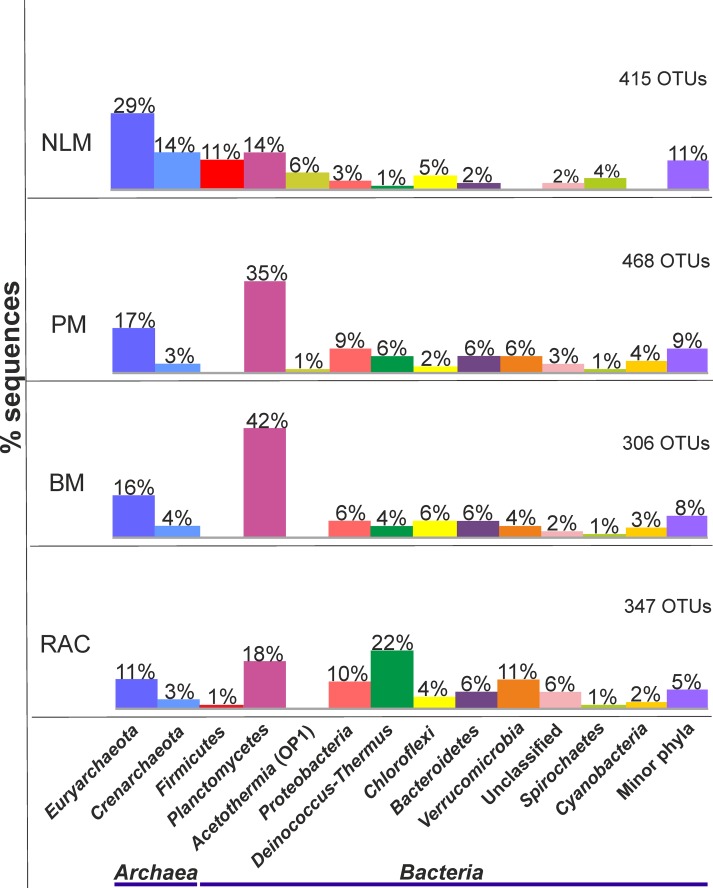
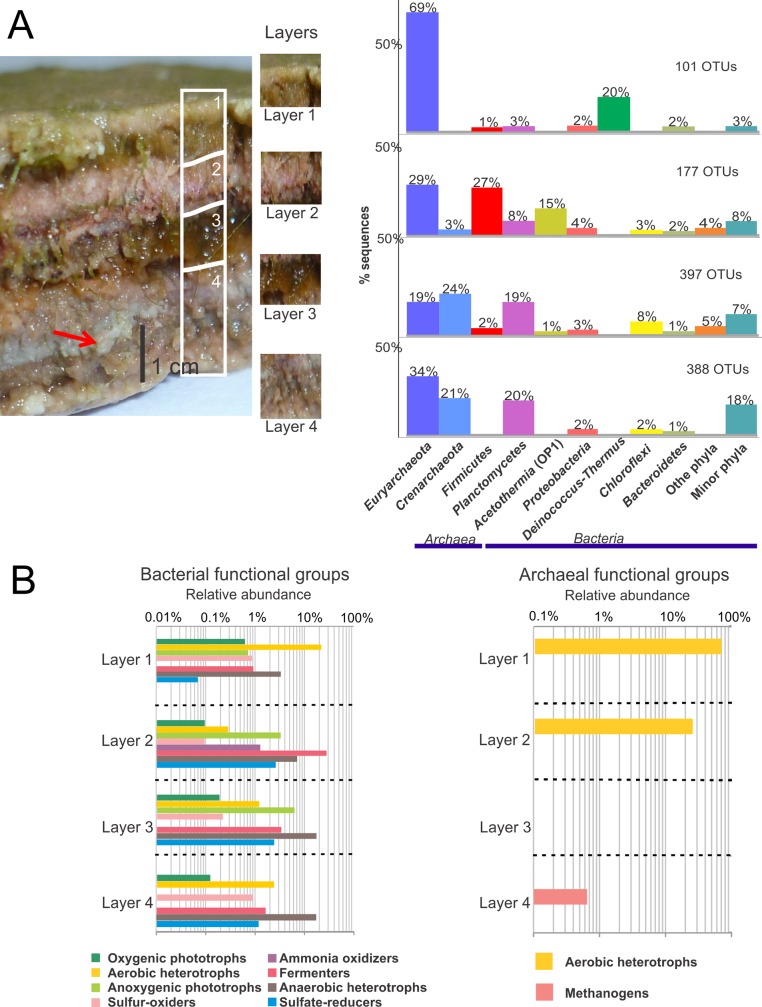
Benthic microbial ecosystems of Laguna La Brava, Salar de Atacama, a high altitude hypersaline lake, were characterized in terms of bacterial and archaeal diversity, biogeochemistry, (including O2 and sulfide depth profiles and mineralogy), and physicochemical characteristics. La Brava is one of several lakes in the Salar de Atacama where microbial communities are growing in extreme conditions, including high salinity, high solar insolation, and high levels of metals such as lithium, arsenic, magnesium, and calcium. Evaporation creates hypersaline conditions in these lakes and mineral precipitation is a characteristic geomicrobiological feature of these benthic ecosystems. In this study, the La Brava non-lithifying microbial mats, microbialites, and rhizome-associated concretions were compared to each other and their diversity was related to their environmental conditions. All the ecosystems revealed an unusual community where Euryarchaeota, Crenarchaeota, Acetothermia, Firmicutes and Planctomycetes were the most abundant groups, and cyanobacteria, typically an important primary producer in microbial mats, were relatively insignificant or absent. This suggests that other microorganisms, and possibly novel pathways unique to this system, are responsible for carbon fixation. Depth profiles of O2 and sulfide showed active production and respiration. The mineralogy composition was calcium carbonate (as aragonite) and increased from mats to microbialites and rhizome-associated concretions. Halite was also present. Further analyses were performed on representative microbial mats and microbialites by layer. Different taxonomic compositions were observed in the upper layers, with Archaea dominating the non-lithifying mat, and Planctomycetes the microbialite. The bottom layers were similar, with Euryarchaeota, Crenarchaeota and Planctomycetes as dominant phyla. Sequences related to Cyanobacteria were very scarce. These systems may contain previously uncharacterized community metabolisms, some of which may be contributing to net mineral precipitation. Further work on these sites might reveal novel organisms and metabolisms of biotechnological interest.
阿塔卡马盐湖拉布拉瓦湖是一个高海拔超盐湖,对其底栖微生物生态系统的细菌和古菌多样性、生物地球化学(包括氧气和硫化物深度剖面以及矿物学)以及物理化学特征进行了表征。拉布拉瓦湖是阿塔卡马盐湖中的几个湖泊之一,在这些湖泊中,微生物群落生长在极端条件下,包括高盐度、高日照以及高含量的锂、砷、镁和钙等金属。蒸发在这些湖泊中形成了高盐环境,矿物沉淀是这些底栖生态系统特有的地球微生物特征。在本研究中,对拉布拉瓦湖的非石化微生物垫、微生物岩和根茎相关结核进行了相互比较,并将它们的多样性与其环境条件相关联。所有生态系统都呈现出一个不寻常的群落,其中广古菌门、泉古菌门、乙酸热菌纲、厚壁菌门和浮霉菌门是最丰富的类群,而蓝细菌通常是微生物垫中的重要初级生产者,在这里相对不显著或不存在。这表明其他微生物以及可能该系统特有的新途径负责碳固定。氧气和硫化物的深度剖面显示有活跃的生产和呼吸作用。矿物组成是碳酸钙(文石),从微生物垫到微生物岩再到根茎相关结核逐渐增加。还存在石盐。对代表性微生物垫和微生物岩按层进行了进一步分析。在上层观察到不同的分类组成,古菌在非石化垫中占主导,而浮霉菌门在微生物岩中占主导。底层相似,广古菌门、泉古菌门和浮霉菌门是优势门类。与蓝细菌相关的序列非常稀少。这些系统可能包含以前未表征的群落代谢,其中一些可能有助于净矿物沉淀。对这些地点的进一步研究可能会揭示具有生物技术意义的新生物体和代谢过程。