Toneatti Diego M, Albarracín Virginia H, Flores Maria R, Polerecky Lubos, Farías María E
Planta Piloto de Procesos Industriales y Microbiológicos, Centro Científico Tecnológico - Consejo Nacional de Investigaciones Científicas y TécnicasSan Miguel de Tucumán, Argentina.
Facultad de Ciencias Naturales e Instituto Miguel Lillo, Universidad Nacional de TucumánSan Miguel de Tucumán, Argentina.
Front Microbiol. 2017 Apr 12;8:646. doi: 10.3389/fmicb.2017.00646. eCollection 2017.
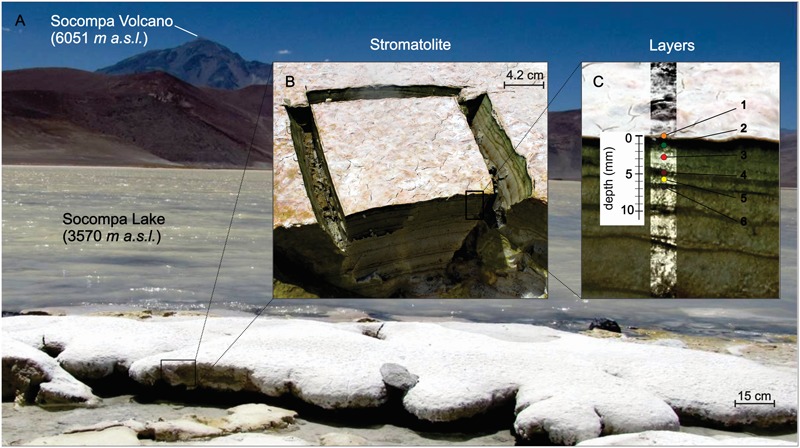
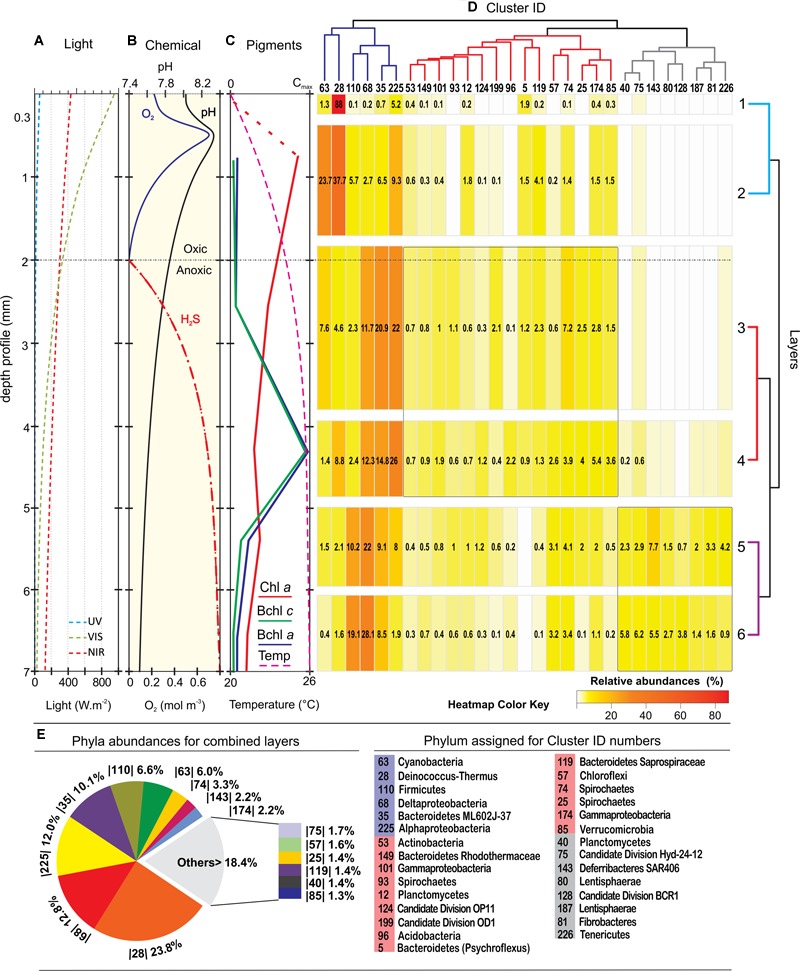
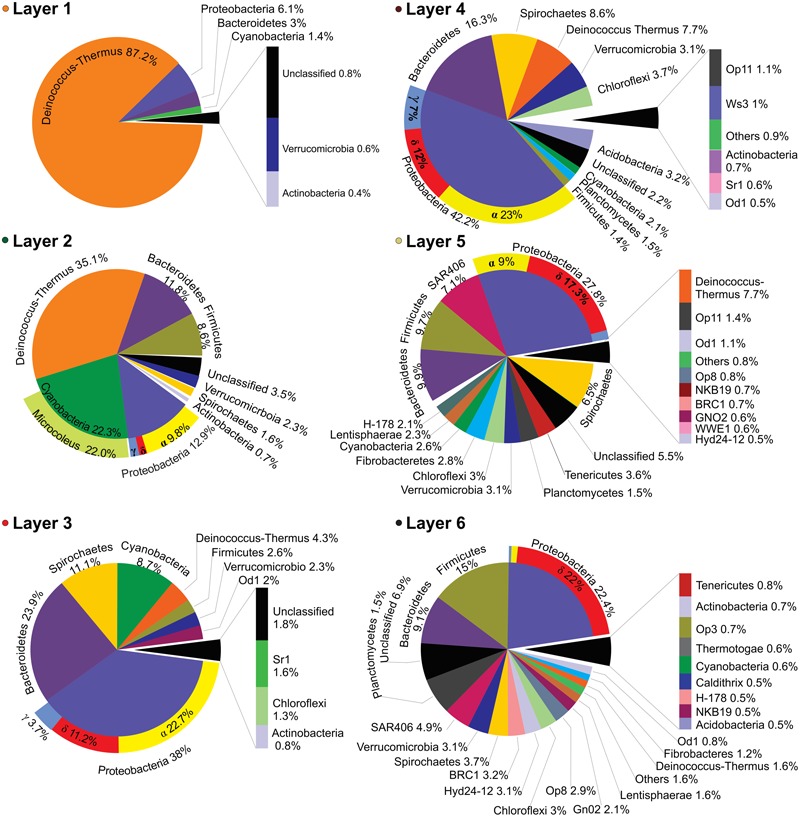
At an altitude of 3,570 m, the volcanic lake Socompa in the Argentinean Andes is presently the highest site where actively forming stromatolite-like structures have been reported. Interestingly, pigment and microsensor analyses performed through the different layers of the stromatolites (50 mm-deep) showed steep vertical gradients of light and oxygen, hydrogen sulfide and pH in the porewater. Given the relatively good characterization of these physico-chemical gradients, the aim of this follow-up work was to specifically address how the bacterial diversity stratified along the top six layers of the stromatolites which seems the most metabolically important and diversified zone of the whole microbial community. We herein discussed how, in only 7 mm, a drastic succession of metabolic adaptations occurred: i.e., microbial communities shift from a UV-high/oxic world to an IR-low/anoxic/high HS environment which force stratification and metabolic specialization of the bacterial community, thus, modulating the chemical faces of the Socompa stromatolites. The oxic zone was dominated by Deinococcus sp. at top surface (0.3 mm), followed by a second layer of Coleofasciculus sp. (0.3 to ∼2 mm). Sequences from anoxygenic phototrophic Alphaproteobacteria, along with an increasing diversity of phyla including Bacteroidetes, Spirochaetes were found at middle layers 3 and 4. Deeper layers (5-7 mm) were mostly occupied by sulfate reducers of Deltaproteobacteria, Bacteroidetes and Firmicutes, next to a high diversity and equitable community of rare, unclassified and candidate phyla. This analysis showed how microbial communities stratified in a physicochemical vertical profile and according to the light source. It also gives an insight of which bacterial metabolic capabilities might operate and produce a microbial cooperative strategy to thrive in one of the most extreme environments on Earth.
在海拔3570米处,阿根廷安第斯山脉的火山湖索孔帕湖是目前已知的有报道称正在形成类似叠层石结构的最高地点。有趣的是,对叠层石不同层(50毫米深)进行的色素和微传感器分析表明,孔隙水中的光、氧气、硫化氢和pH值存在陡峭的垂直梯度。鉴于这些物理化学梯度的特征相对较好,这项后续工作的目的是具体研究细菌多样性如何沿着叠层石的最上面六层分层,这六层似乎是整个微生物群落中代谢最重要、最多样化的区域。我们在此讨论了在仅7毫米的范围内,如何发生了代谢适应的急剧演替:即微生物群落从紫外线高/有氧的环境转变为红外线低/无氧/高硫化氢的环境,这迫使细菌群落分层和代谢特化,从而调节了索孔帕叠层石的化学面貌。有氧区在顶面(0.3毫米)由嗜热栖热放线菌属主导,其次是第二层的束鞘藻属(0.3至约2毫米)。在中间的第3层和第4层发现了无氧光合α-变形菌的序列,以及包括拟杆菌门、螺旋体门在内的门类多样性不断增加的序列。更深的层(5 - 7毫米)主要由δ-变形菌、拟杆菌门和厚壁菌门的硫酸盐还原菌占据,旁边还有高度多样且分布均匀的稀有、未分类和候选门类群落。该分析表明了微生物群落在物理化学垂直剖面中以及根据光源是如何分层的。它还深入了解了哪些细菌代谢能力可能起作用,并产生一种微生物合作策略,以在地球上最极端的环境之一中繁衍生息。