Ivanova Reipold Elena, Easterbrook Philippa, Trianni Alessandra, Panneer Nivedha, Krakower Douglas, Ongarello Stefano, Roberts Teri, Miller Veronica, Denkinger Claudia
FIND, MSF Access Campaign, Geneva, Switzerland.
Global Hepatitis Programme, HIV Department, World Health Organization, Geneva, Switzerland.
BMC Infect Dis. 2017 Nov 1;17(Suppl 1):707. doi: 10.1186/s12879-017-2770-5.
The current low access to virological testing to confirm chronic viraemic HCV infection in low- and middle-income countries (LMIC) is limiting the rollout of hepatitis C (HCV) care. Existing tests are complex, costly and require sophisticated laboratory infrastructure. Diagnostic manufacturers need guidance on the optimal characteristics a virological test needs to have to ensure the greatest impact on HCV diagnosis and treatment in LMIC. Our objective was to develop a target product profile (TPP) for diagnosis of HCV viraemia using a global stakeholder consensus-based approach.
Based on the standardised process established to develop consensus-based TPPs, we followed five key steps. (i) Identifying key potential global stakeholders for consultation and input into the TPP development process. (ii) Informal priority-setting exercise with key experts to identify the needs that should be the highest priority for the TPP development; (iii) Defining the key TPP domains (scope, performance and operational characteristics and price). (iv) Delphi-like process with larger group of key stakeholder to facilitate feedback on the key TPP criteria and consensus building based on pre-defined consensus criteria. (v) A final consensus-gathering meeting for discussions around disputed criteria. A complementary values and preferences survey helped to assess trade-offs between different key characteristics.
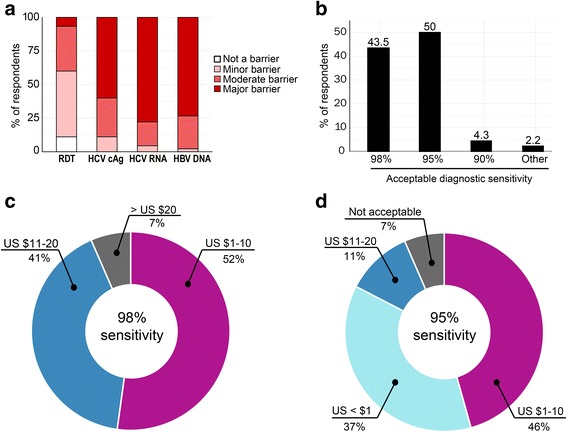
The following key attributes for the TPP for a test to confirm HCV viraemic infection were identified: The scope defined is for both HCV detection as well as confirmation of cure. The timeline of development for tests envisioned in the TPP is 5 years. The test should be developed for use by health-care workers or laboratory technicians with limited training in countries with a medium to high prevalence of HCV (1.5-3.5% and >3.5%) and in high-risk populations in low prevalence settings (<1.5%). A clinical sensitivity at a minimum of 90% is considered sufficient (analytical sensitivity of the equivalent of 3000 IU/ml), particularly if the test increases access to testing through an affordable price, increase ease-of-use and feasibility on capillary blood. Polyvalency would be optimal (i.e. ability to test for HIV and others). The only characteristic that full agreement could not be achieved on was the price for a virological test. Discussants felt that to reach the optimal target price substantial trade-offs had to be made (e.g. in regards to sensitivity and integration).
The TPP and V&P survey results define the need for an easy-to-use, low cost test to increase access to diagnosis and linkage to care in LMIC.
在低收入和中等收入国家(LMIC),目前用于确认慢性病毒血症性丙型肝炎病毒(HCV)感染的病毒学检测可及性较低,这限制了丙型肝炎(HCV)护理服务的推广。现有检测方法复杂、成本高昂,且需要完善的实验室基础设施。诊断产品制造商需要了解病毒学检测应具备哪些最佳特性,才能确保在LMIC对HCV诊断和治疗产生最大影响。我们的目标是采用基于全球利益相关者共识的方法,制定一份用于诊断HCV病毒血症的目标产品简介(TPP)。
基于为制定基于共识的TPP而建立的标准化流程,我们遵循了五个关键步骤。(i)确定关键的潜在全球利益相关者,以便在TPP制定过程中进行咨询并提供意见。(ii)与关键专家进行非正式的优先事项确定活动,以确定TPP制定中应列为最高优先事项的需求;(iii)定义关键的TPP领域(范围、性能和操作特性以及价格)。(iv)与更大规模的关键利益相关者群体进行类似德尔菲法的流程,以促进对关键TPP标准的反馈,并根据预先定义的共识标准建立共识。(v)召开最后一次共识收集会议,讨论有争议的标准。一项补充性的价值观和偏好调查有助于评估不同关键特性之间的权衡。
确定了用于确认HCV病毒血症感染检测的TPP的以下关键属性:所定义的范围涵盖HCV检测以及治愈确认。TPP中设想的检测开发时间为5年。该检测应开发供HCV中等至高流行率(1.5 - 3.5%和>3.5%)国家以及低流行率环境(<1.5%)中高风险人群中接受过有限培训的医护人员或实验室技术人员使用。临床敏感性至少达到90%被认为是足够的(相当于3000 IU/ml的分析敏感性),特别是如果该检测通过可承受的价格增加检测可及性、提高易用性并在毛细血管血检测方面具有可行性。多价性将是最佳的(即能够检测HIV及其他病毒)。唯一未能达成完全一致的特性是病毒学检测的价格。讨论者认为,要达到最佳目标价格,必须进行重大权衡(例如在敏感性和整合方面)。
TPP和价值观与偏好(V&P)调查结果明确了在LMIC需要一种易于使用、低成本的检测方法,以增加诊断可及性并促进与护理的衔接。