Department of Chemical and Biomolecular Engineering, National University of Singapore, 4 Engineering Drive 4, Singapore, 117585, Singapore.
State Key Laboratory of Multiphase Complex Systems, Institute of Process Engineering, Chinese Academy of Sciences, 100190, Beijing, China.
Nat Commun. 2017 Nov 16;8(1):1555. doi: 10.1038/s41467-017-01736-5.
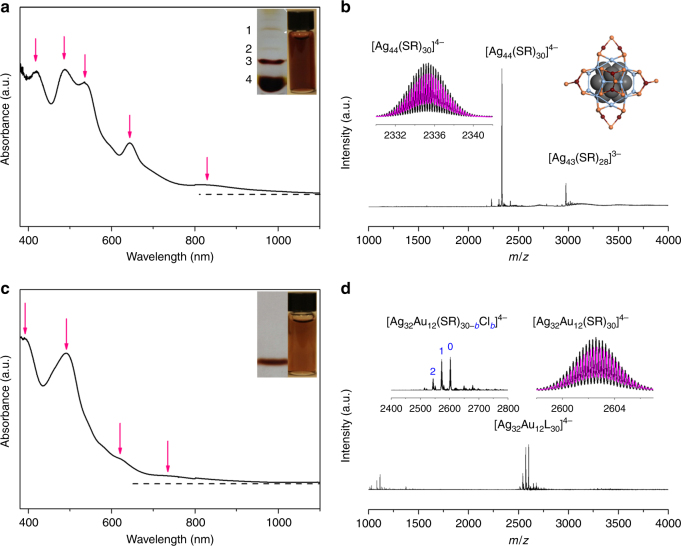
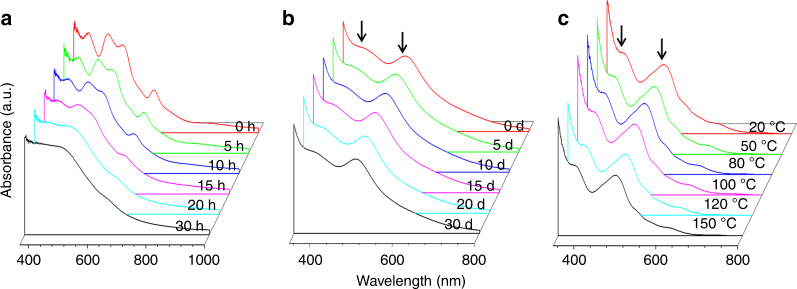
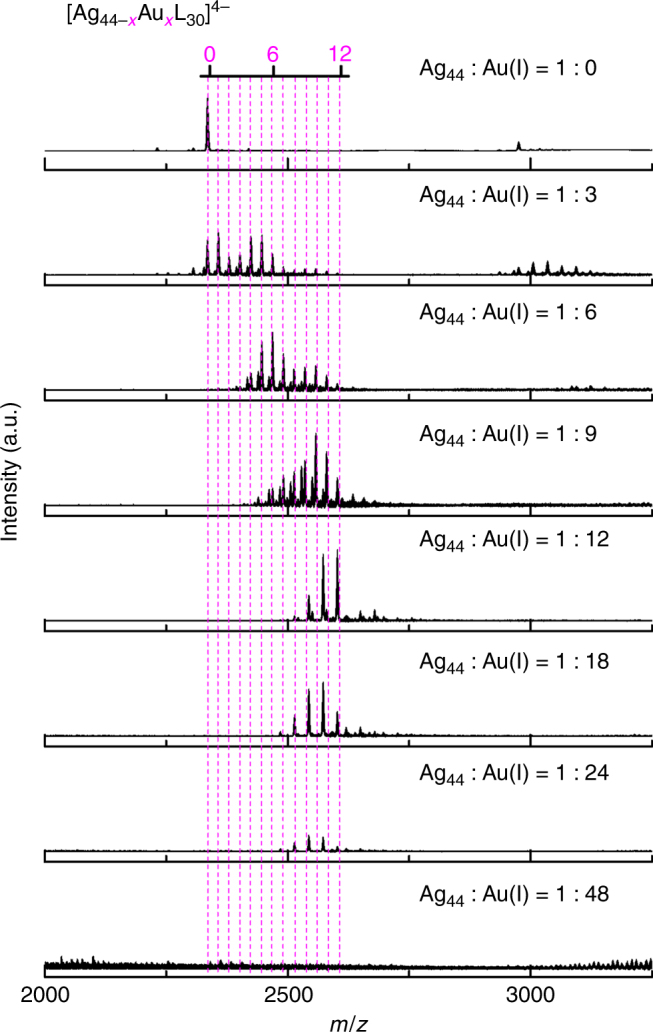
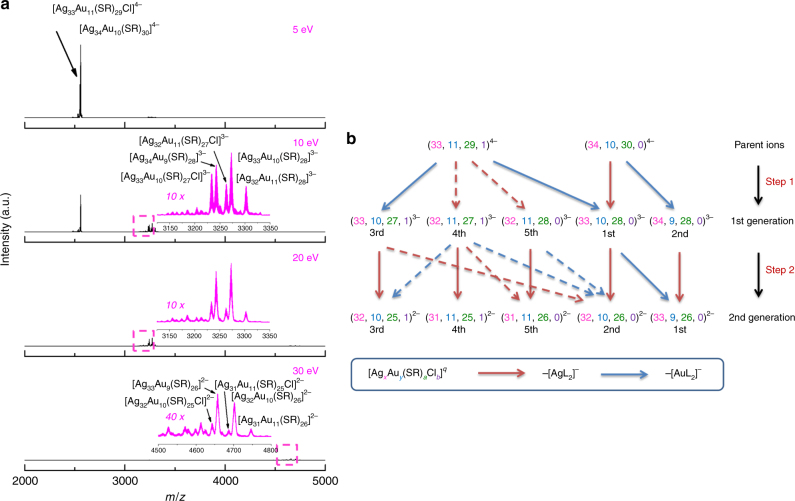
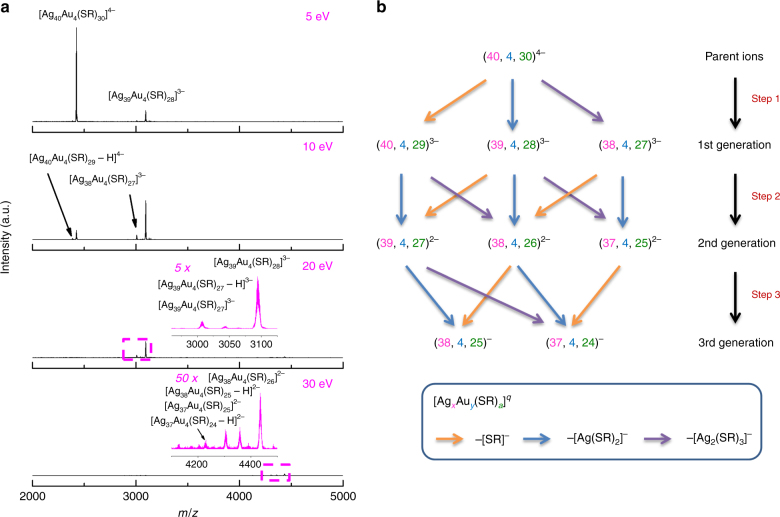
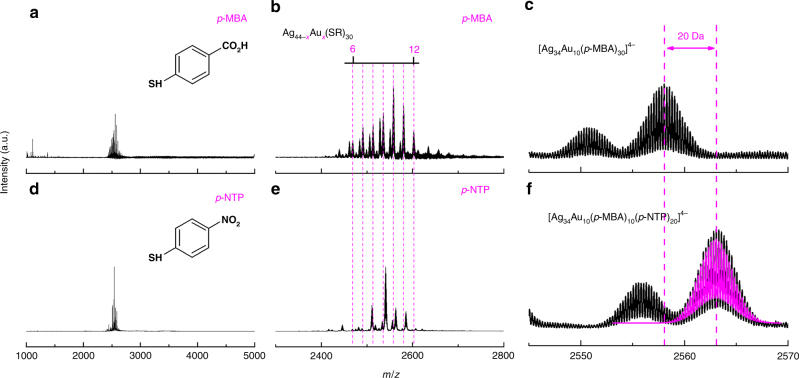
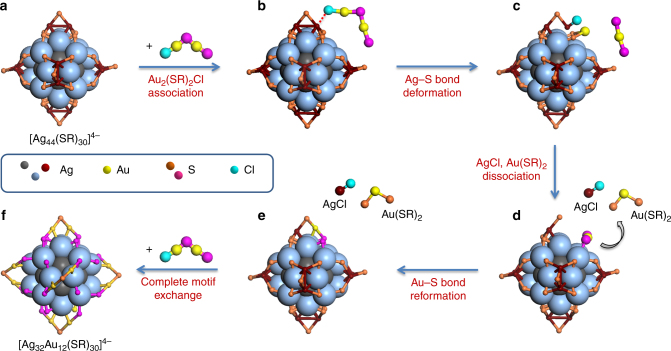
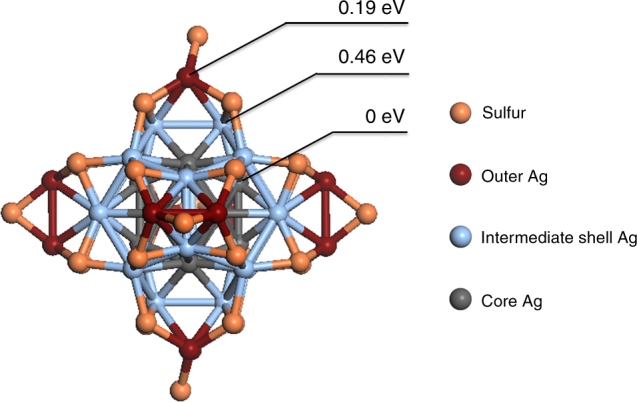
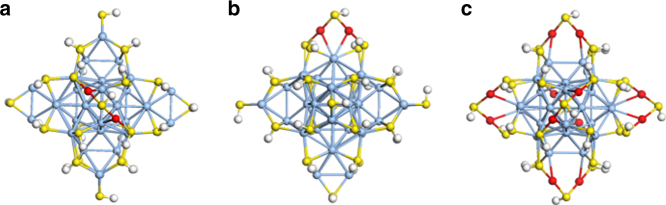
Precise control of alloying sites has long been a challenging pursuit, yet little has been achieved for the atomic-level manipulation of metallic nanomaterials. Here we describe utilization of a surface motif exchange (SME) reaction to selectively replace the surface motifs of parent [Ag(SR)] (SR = thiolate) nanoparticles (NPs), leading to bimetallic NPs with well-defined molecular formula and atomically-controlled alloying sites in protecting shell. A systematic mass (and tandem mass) spectrometry analysis suggests that the SME reaction is an atomically precise displacement of SR-Ag(I)-SR-protecting modules of Ag NPs by the incoming SR-Au(I)-SR modules, giving rise to a core-shell [Ag@Au(SR)]. Theoretical calculation suggests that the thermodynamically less favorable core-shell Ag@Au nanostructure is kinetically stabilized by the intermediate Ag shell, preventing inward diffusion of the surface Au atoms. The delicate SME reaction opens a door to precisely control the alloying sites in the protecting shell of bimetallic NPs with broad utility.
长期以来,对合金化位点的精确控制一直是一个具有挑战性的追求,但在原子级操控金属纳米材料方面几乎没有取得什么进展。在这里,我们描述了利用表面配体交换(SME)反应来选择性地取代母体[Ag(SR)](SR=硫醇)纳米颗粒(NPs)的表面配体,从而得到具有明确分子公式和原子控制合金化位点的保护壳的双金属 NPs。系统的质谱(和串联质谱)分析表明,SME 反应是原子级精确的 Ag NPs 上的 SR-Ag(I)-SR 保护模块被外来的 SR-Au(I)-SR 模块取代,从而形成核壳[Ag@Au(SR)]。理论计算表明,热力学上不太有利的核壳 Ag@Au 纳米结构通过中间的 Ag 壳被动力学稳定,阻止了表面 Au 原子的向内扩散。这种精细的 SME 反应为精确控制双金属 NPs 保护壳中的合金化位点提供了一种途径,具有广泛的应用前景。