Maiti Buddhadev, Schubert Alexander, Sarkar Sunandan, Bhandari Srijana, Wang Kunlun, Li Zhe, Geva Eitan, Twieg Robert J, Dunietz Barry D
Department of Chemistry and Biochemistry , Kent State University , Kent , OH 44242 , USA . Email:
Department of Chemistry , University of Michigan , Ann Arbor , MI 48109 , USA . Email:
Chem Sci. 2017 Oct 1;8(10):6947-6953. doi: 10.1039/c7sc02491f. Epub 2017 Aug 14.
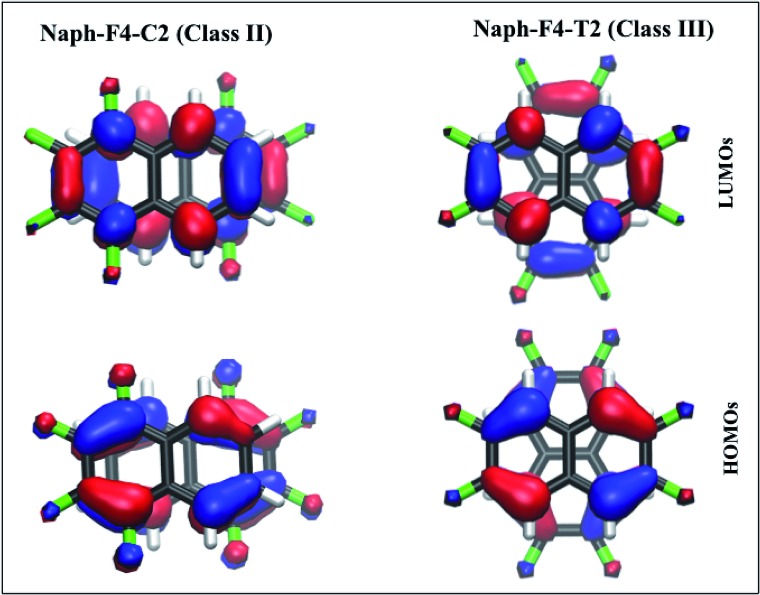
Selective fluorination of organic semiconducting molecules is proposed as a means to achieving enhanced hole mobility. Naphthalene is examined here as a root molecular system with fluorination performed at various sites. Our quantum chemical calculations show that selective fluorination can enhance attractive intermolecular interactions while reducing charge trapping. Those observations suggest a design principle whereby fluorination is utilized for achieving high charge mobilities in the crystalline form. The utility of this design principle is demonstrated through an application to perylene, which is an important building block of organic semiconducting materials. We also show that a quantum mechanical perspective of nuclear degrees of freedom is crucial for a reliable description of charge transport.
有人提出,对有机半导体分子进行选择性氟化是提高空穴迁移率的一种方法。本文以萘为基础分子体系,在不同位置进行氟化。我们的量子化学计算表明,选择性氟化可以增强分子间的吸引力,同时减少电荷俘获。这些观察结果提出了一种设计原则,即利用氟化来实现晶体形式的高电荷迁移率。通过将这种设计原则应用于苝(有机半导体材料的重要组成部分),证明了其效用。我们还表明,核自由度的量子力学观点对于可靠描述电荷传输至关重要。