Emerg Infect Dis. 2017 Dec;23(12):1974-1981. doi: 10.3201/eid2312.171062.
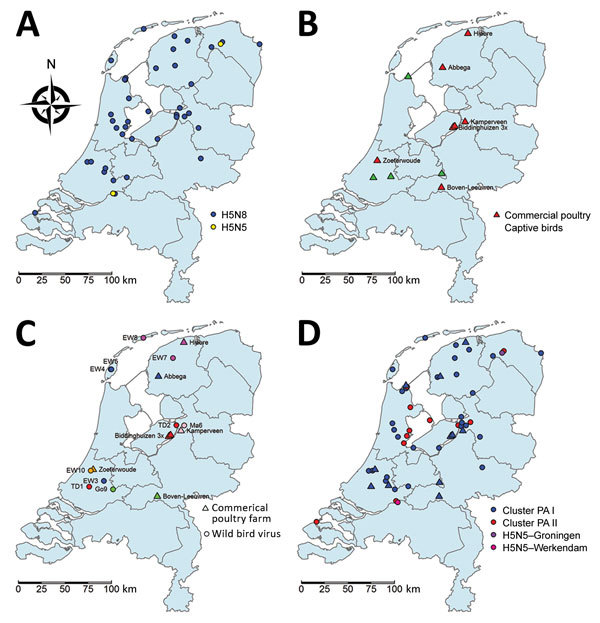
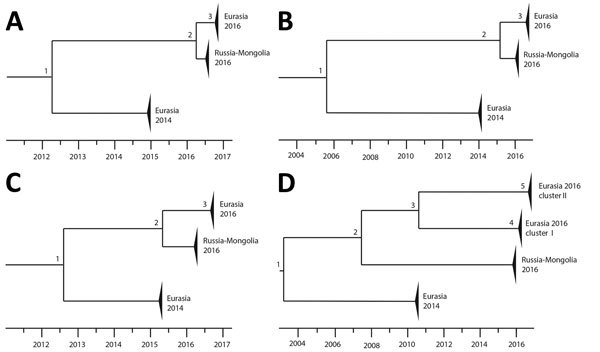
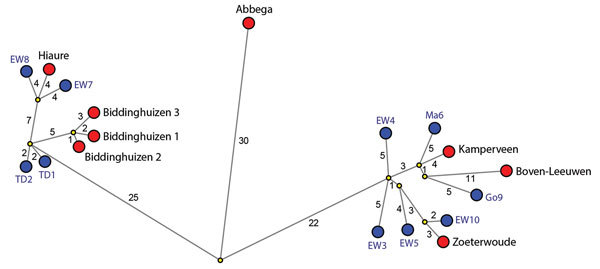
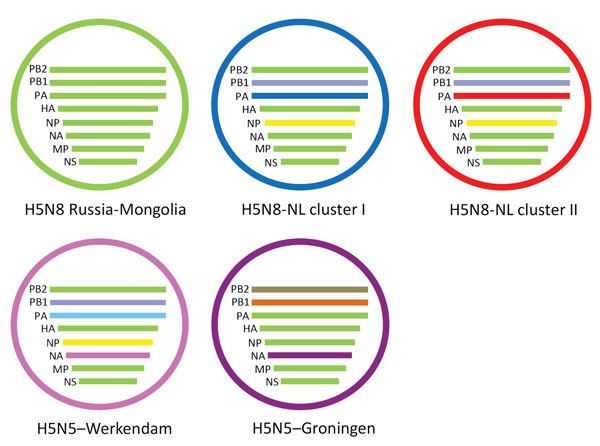
In 2016, an epidemic of highly pathogenic avian influenza A virus subtype H5N8 in the Netherlands caused mass deaths among wild birds, and several commercial poultry farms and captive bird holdings were affected. We performed complete genome sequencing to study the relationship between the wild bird and poultry viruses. Phylogenetic analysis showed that the viruses are related to H5 clade 2.3.4.4 viruses detected in Russia in May 2016 but contained novel polymerase basic 2 and nucleoprotein gene segments and 2 different variants of the polymerase acidic segment. Molecular dating suggests that the reassortment events most likely occurred in wild birds in Russia or Mongolia. Furthermore, 2 genetically distinct H5N5 reassortant viruses were detected in wild birds in the Netherlands. Our study provides evidence for fast and continuing reassortment of H5 clade 2.3.4.4 viruses, which might lead to rapid changes in virus characteristics, such as pathogenicity, infectivity, transmission, and zoonotic potential.
2016 年,荷兰发生高致病性禽流感病毒 H5N8 亚型疫情,导致大量野生鸟类死亡,数家商业家禽养殖场和圈养鸟类饲养场受到影响。我们进行了全基因组测序,以研究野鸟和家禽病毒之间的关系。系统进化分析显示,这些病毒与 2016 年 5 月在俄罗斯检测到的 H5 分支 2.3.4.4 病毒有关,但包含新型聚合酶碱性 2 和核蛋白基因片段以及聚合酶酸性片段的 2 种不同变体。分子年代测定表明,重配事件最有可能发生在俄罗斯或蒙古的野鸟中。此外,在荷兰的野生鸟类中还检测到 2 种具有遗传差异的 H5N5 重配病毒。本研究为 H5 分支 2.3.4.4 病毒的快速持续重配提供了证据,这可能导致病毒特征(如致病性、感染力、传播性和人畜共患潜力)发生快速变化。