Queensland Brain Institute, The University of Queensland, Brisbane, QLD, 4072, Australia.
Institute for Molecular Bioscience, The University of Queensland, Brisbane, QLD, 4072, Australia.
Genome Med. 2017 Nov 17;9(1):97. doi: 10.1186/s13073-017-0487-0.
Amyotrophic lateral sclerosis (ALS) is a progressive neurological disease characterised by the degeneration of motor neurons, which are responsible for voluntary movement. There remains limited understanding of disease aetiology, with median survival of ALS of three years and no effective treatment. Identifying genes that contribute to ALS susceptibility is an important step towards understanding aetiology. The vast majority of published human genetic studies, including for ALS, have used samples of European ancestry. The importance of trans-ethnic studies in human genetic studies is widely recognised, yet a dearth of studies of non-European ancestries remains. Here, we report analyses of novel whole-exome sequencing (WES) data from Chinese ALS and control individuals.
WES data were generated for 610 ALS cases and 460 controls drawn from Chinese populations. We assessed evidence for an excess of rare damaging mutations at the gene level and the gene set level, considering only singleton variants filtered to have allele frequency less than 5 × 10 in reference databases. To meta-analyse our results with a published study of European ancestry, we used a Cochran-Mantel-Haenszel test to compare gene-level variant counts in cases vs controls.
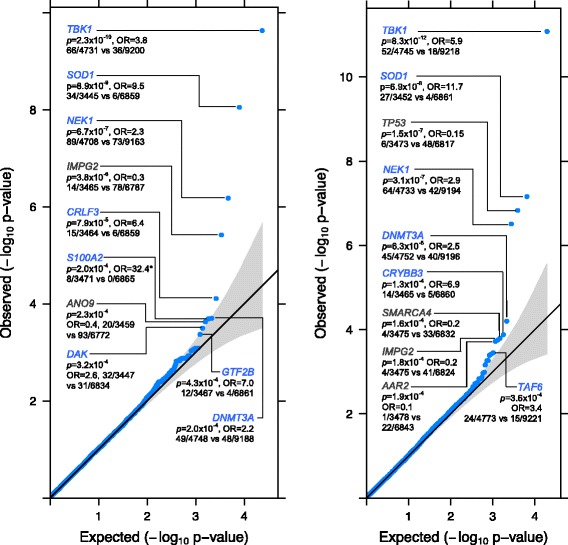
No gene passed the genome-wide significance threshold with ALS in Chinese samples alone. Combining rare variant counts in Chinese with those from the largest WES study of European ancestry resulted in three genes surpassing genome-wide significance: TBK1 (p = 8.3 × 10), SOD1 (p = 8.9 × 10) and NEK1 (p = 1.1 × 10). In the Chinese data alone, SOD1 and NEK1 were nominally significantly associated with ALS (p = 0.04 and p = 7 × 10, respectively) and the case/control frequencies of rare coding variants in these genes were similar in Chinese and Europeans (SOD1: 1.5%/0.2% vs 0.9%/0.1%, NEK1 1.8%/0.4% vs 1.9%/0.8%). This was also true for TBK1 (1.2%/0.2% vs 1.4%/0.4%), but the association with ALS in Chinese was not significant (p = 0.14).
While SOD1 is already recognised as an ALS-associated gene in Chinese, we provide novel evidence for association of NEK1 with ALS in Chinese, reporting variants in these genes not previously found in Europeans.
肌萎缩侧索硬化症(ALS)是一种进行性神经系统疾病,其特征是运动神经元的退化,而运动神经元负责随意运动。目前对疾病病因的了解有限,ALS 的中位生存期为三年,且尚无有效治疗方法。确定导致 ALS 易感性的基因是了解病因的重要步骤。绝大多数已发表的人类遗传研究,包括 ALS 研究,都使用了欧洲血统的样本。在人类遗传研究中,跨种族研究的重要性已得到广泛认可,但仍缺乏对非欧洲血统的研究。在这里,我们报告了来自中国 ALS 患者和对照个体的新型全外显子测序(WES)数据的分析结果。
我们从中国人群中抽取了 610 例 ALS 病例和 460 例对照,生成了 WES 数据。我们评估了在基因水平和基因集水平上是否存在过多的罕见有害突变,仅考虑过滤后等位基因频率在参考数据库中小于 5×10 的单倍型变体。为了与一项已发表的欧洲血统研究的结果进行荟萃分析,我们使用 Cochran-Mantel-Haenszel 检验比较了病例与对照中基因水平的变异计数。
仅在中国样本中,没有一个基因与 ALS 通过全基因组显著水平。将中国人群中罕见变异计数与最大的欧洲血统 WES 研究中的计数相结合,结果有三个基因超过了全基因组显著水平:TBK1(p=8.3×10)、SOD1(p=8.9×10)和 NEK1(p=1.1×10)。在中国人群中,SOD1 和 NEK1 与 ALS 呈显著相关(p=0.04 和 p=7×10,分别),并且这两个基因在中国和欧洲人中的罕见编码变异的病例/对照频率相似(SOD1:1.5%/0.2%对 0.9%/0.1%,NEK1 1.8%/0.4%对 1.9%/0.8%)。TBK1 也是如此(1.2%/0.2%对 1.4%/0.4%),但在中国与 ALS 的相关性不显著(p=0.14)。
虽然 SOD1 已被认为是中国人中与 ALS 相关的基因,但我们提供了新的证据表明 NEK1 与中国人的 ALS 相关,报告了这些基因中的先前在欧洲人中未发现的变异。