Department of Plant Physiology, Umeå University, Umeå Plant Science Centre (UPSC), SE-901 87, Umeå, Sweden.
Department of Chemistry, Umeå University, SE-901 87, Umeå, Sweden.
Sci Rep. 2017 Nov 17;7(1):15798. doi: 10.1038/s41598-017-16013-0.
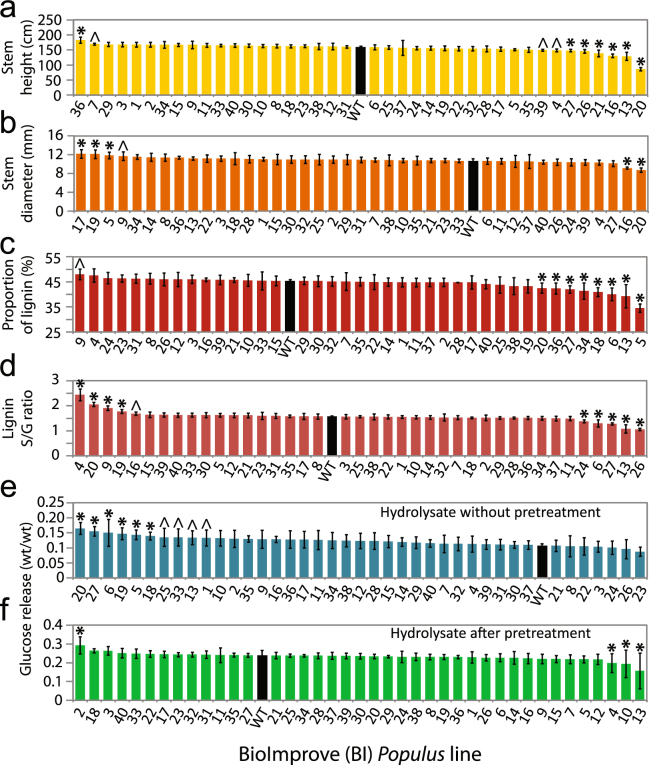
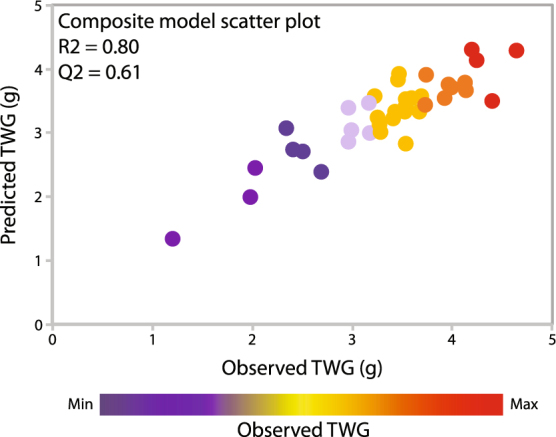
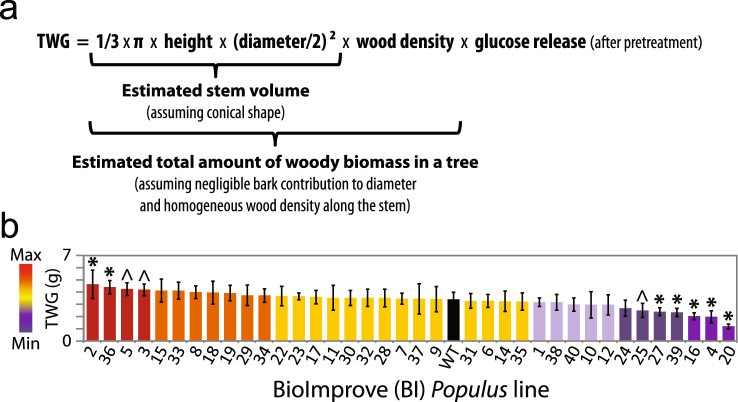
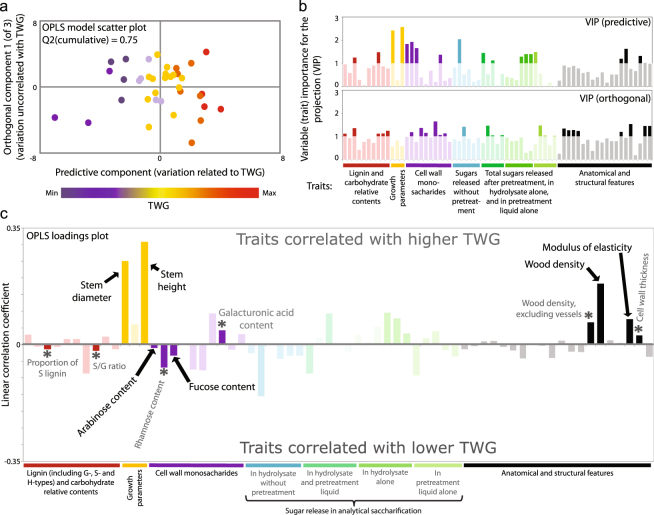
Wood represents a promising source of sugars to produce bio-based renewables, including biofuels. However, breaking down lignocellulose requires costly pretreatments because lignocellulose is recalcitrant to enzymatic saccharification. Increasing saccharification potential would greatly contribute to make wood a competitive alternative to petroleum, but this requires improving wood properties. To identify wood biomass traits associated with saccharification, we analyzed a total of 65 traits related to wood chemistry, anatomy and structure, biomass production and saccharification in 40 genetically engineered Populus tree lines. These lines exhibited broad variation in quantitative traits, allowing for multivariate analyses and mathematical modeling. Modeling revealed that seven wood biomass traits associated in a predictive manner with saccharification of glucose after pretreatment. Four of these seven traits were also negatively associated with biomass production, suggesting a trade-off between saccharification potential and total biomass, which has previously been observed to offset the overall sugar yield from whole trees. We therefore estimated the "total-wood glucose yield" (TWG) from whole trees and found 22 biomass traits predictive of TWG after pretreatment. Both saccharification and TWG were associated with low abundant, often overlooked matrix polysaccharides such as arabinose and rhamnose which possibly represent new markers for improved Populus feedstocks.
木材是一种很有前途的糖源,可以用来生产生物基可再生能源,包括生物燃料。然而,要分解木质纤维素,需要进行昂贵的预处理,因为木质纤维素很难进行酶解。提高糖化潜力将极大地有助于使木材成为石油的一种有竞争力的替代品,但这需要改善木材的特性。为了确定与糖化相关的木材生物质特性,我们分析了 40 条基因工程杨树品系的 65 种与木材化学、解剖结构、生物质生产和糖化相关的特性。这些系表现出定量性状的广泛变异,允许进行多元分析和数学建模。模型表明,有 7 种木材生物质特性可以以预测的方式与预处理后的葡萄糖糖化相关。这七个特性中的四个也与生物质生产呈负相关,这表明糖化潜力和总生物质之间存在权衡,这以前曾被观察到会抵消整棵树的总糖产量。因此,我们估计了整棵树的“总木材葡萄糖产量”(TWG),并发现了 22 种与预处理后 TWG 相关的生物质特性。糖化和 TWG 都与低丰度、经常被忽视的基质多糖有关,如阿拉伯糖和鼠李糖,它们可能代表了改良杨树原料的新标记。