The Center for Infectious Medicine, Department of Medicine, Karolinska Institutet, Karolinska University Hospital Huddinge, F59, SE-141 86, Stockholm, Sweden.
Faculty of Medicine and Life Sciences, University of Tampere, Tampere, Finland.
Diabetologia. 2018 Feb;61(2):476-481. doi: 10.1007/s00125-017-4492-z. Epub 2017 Nov 18.
AIMS/HYPOTHESIS: Epidemiological studies suggest a role for Coxsackievirus B (CVB) serotypes in the pathogenesis of type 1 diabetes, but their actual contribution remains elusive. In the present study, we have produced a CVB1 vaccine to test whether vaccination against CVBs can prevent virus-induced diabetes in an experimental model.
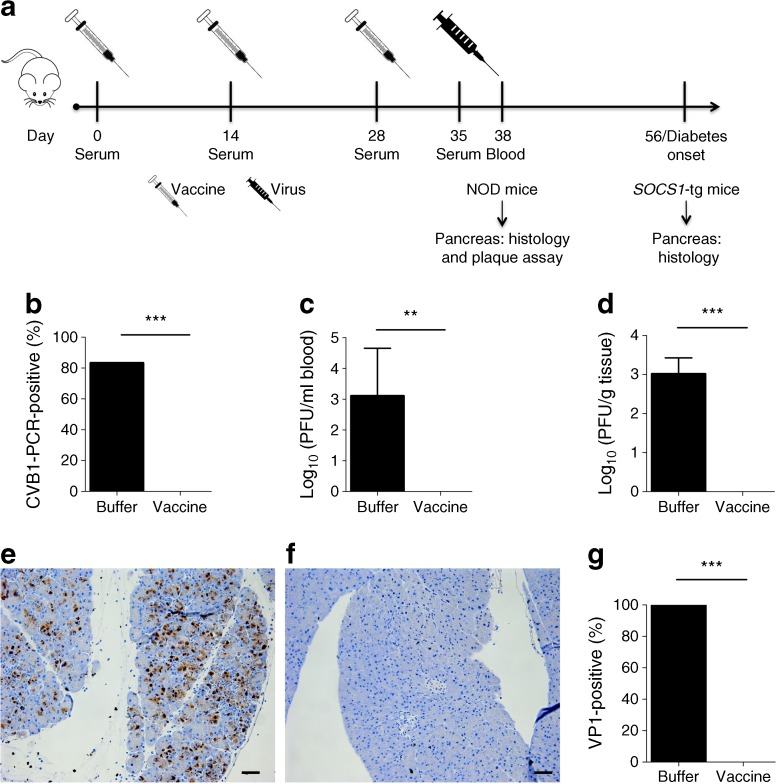
NOD and SOCS1-tg mice were vaccinated three times with either a formalin-fixed non-adjuvanted CVB1 vaccine or a buffer control. Serum was collected for measurement of neutralising antibodies using a virus neutralisation assay. Vaccinated and buffer-treated mice were infected with CVB1. Viraemia and viral replication in the pancreas were measured using standard plaque assay and PCR. The development of diabetes was monitored by blood glucose measurements. Histological analysis and immunostaining for viral capsid protein 1 (VP1), insulin and glucagon in formalin-fixed paraffin embedded pancreas was performed.
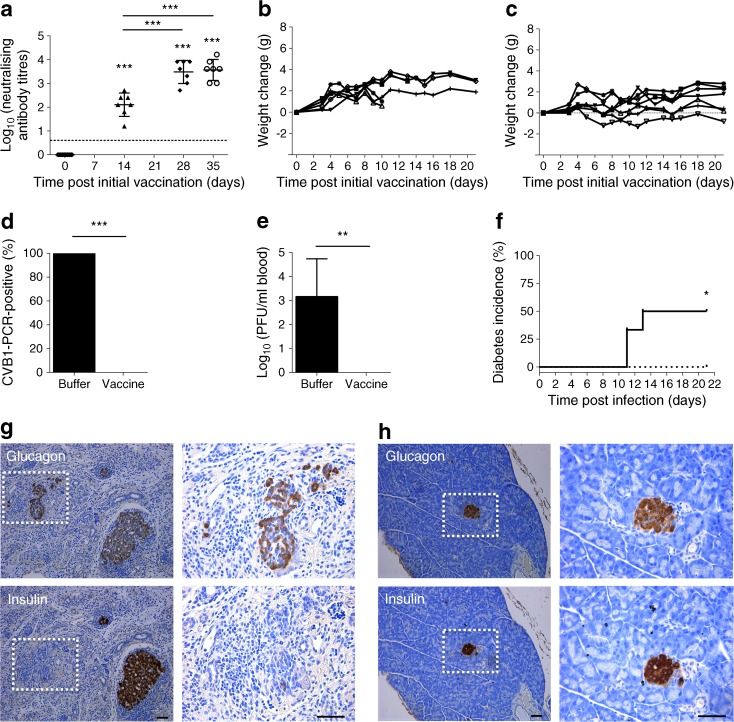
The CVB1 vaccine induced strong neutralising antibody responses and protected against viraemia and the dissemination of virus to the pancreas in both NOD mice (n = 8) and SOCS1-tg mice (n = 7). Conversely, 100% of the buffer-treated NOD and SOCS1-tg mice were viraemic on day 3 post infection. Furthermore, half (3/6) of the buffer-treated SOCS1-tg mice developed diabetes upon infection with CVB1, with a loss of the insulin-positive beta cells and damage to the exocrine pancreas. In contrast, all (7/7) vaccinated SOCS1-tg mice were protected from virus-induced diabetes and showed no signs of beta cell loss or pancreas destruction (p < 0.05).
CONCLUSIONS/INTERPRETATION: CVB1 vaccine can efficiently protect against both CVB1 infection and CVB1-induced diabetes. This preclinical proof of concept study provides a base for further studies aimed at developing a vaccine for use in elucidating the role of enteroviruses in human type 1 diabetes.
目的/假设:流行病学研究表明柯萨奇病毒 B(CVB)血清型在 1 型糖尿病的发病机制中起作用,但它们的实际贡献仍不清楚。在本研究中,我们制备了 CVB1 疫苗,以测试针对 CVB 进行疫苗接种是否可以在实验模型中预防病毒引起的糖尿病。
NOD 和 SOCS1-tg 小鼠用福尔马林固定的非佐剂 CVB1 疫苗或缓冲液对照进行三次免疫接种。使用病毒中和测定法测量血清中的中和抗体。用 CVB1 感染接种和缓冲处理的小鼠。使用标准噬斑测定法和 PCR 测量病毒血症和胰腺中的病毒复制。通过血糖测量监测糖尿病的发展。对福尔马林固定的石蜡包埋胰腺进行病毒衣壳蛋白 1(VP1)、胰岛素和胰高血糖素的组织学分析和免疫染色。
CVB1 疫苗诱导了强烈的中和抗体反应,并在 NOD 小鼠(n=8)和 SOCS1-tg 小鼠(n=7)中均防止了病毒血症和病毒向胰腺的传播。相反,100%的缓冲处理的 NOD 和 SOCS1-tg 小鼠在感染后第 3 天发生病毒血症。此外,缓冲处理的 SOCS1-tg 小鼠中有一半(3/6)在感染 CVB1 后发生糖尿病,胰岛素阳性β细胞丧失和外分泌胰腺损伤。相比之下,所有(7/7)接种的 SOCS1-tg 小鼠均免受病毒引起的糖尿病的侵害,并且没有β细胞丧失或胰腺破坏的迹象(p<0.05)。
结论/解释:CVB1 疫苗能有效地预防 CVB1 感染和 CVB1 诱导的糖尿病。这项临床前概念验证研究为进一步研究开发用于阐明肠道病毒在人类 1 型糖尿病中的作用的疫苗提供了基础。