Liu Xin, Huang You-Guang, Jin Cong-Guo, Zhou Yong-Chun, Chen Xiao-Qun, Li Jia, Chen Yan, Li Mei, Yao Qian, Li Ke, Lan Min, Ye Jia-Gui, Wang Xi-Cai
Tumor Institute, The Third Affiliated Hospital of Kunming Medical University, Tumor Hospital of Yunnan Province, Kunming, China.
Pathological Department, The Third Affiliated Hospital of Kunming Medical University, Tumor Hospital of Yunnan Province, Kunming, China.
Oncotarget. 2017 Oct 4;8(50):88139-88151. doi: 10.18632/oncotarget.21537. eCollection 2017 Oct 20.
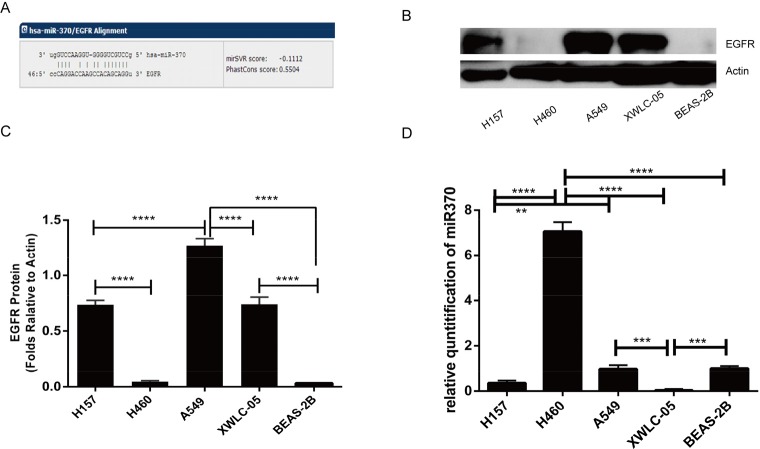
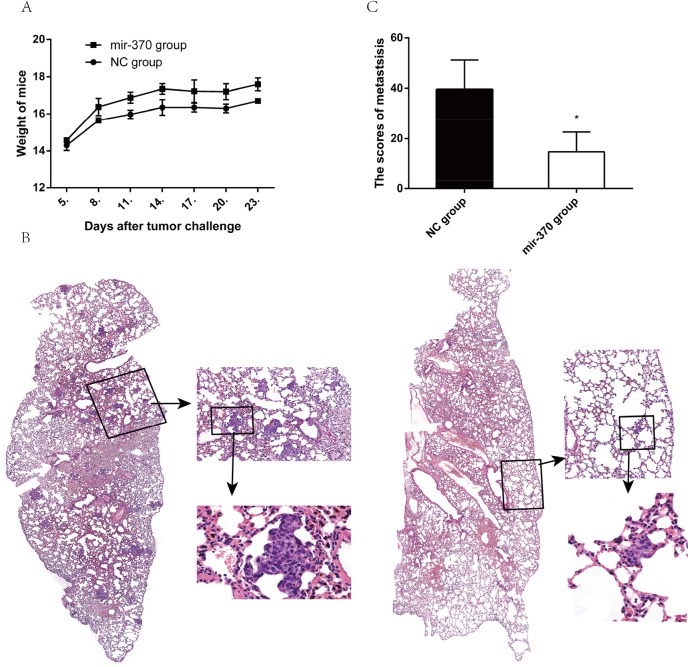
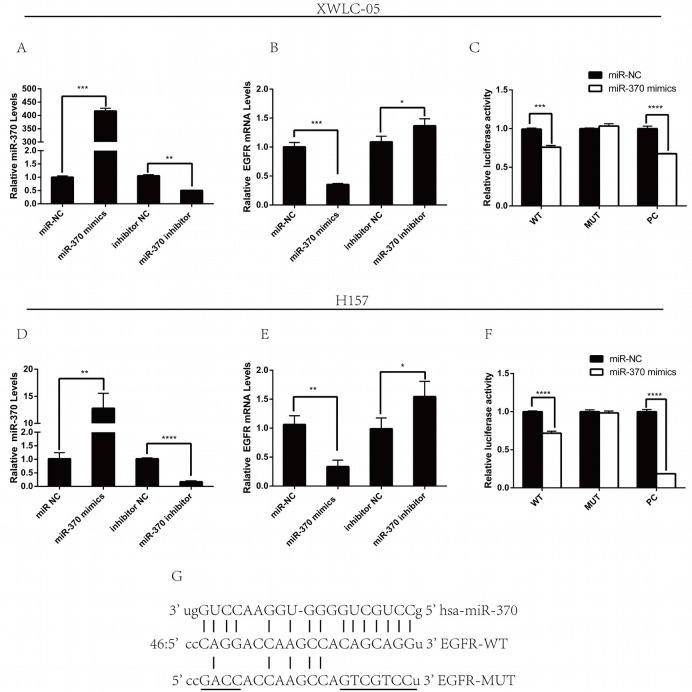
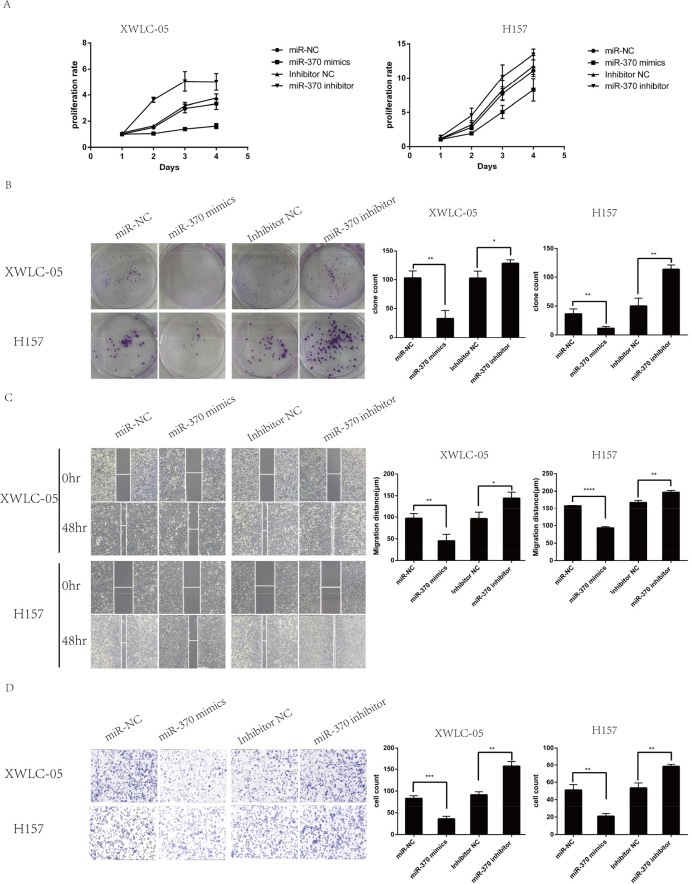
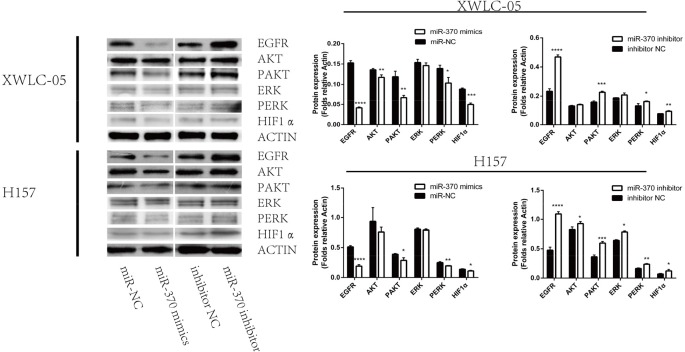
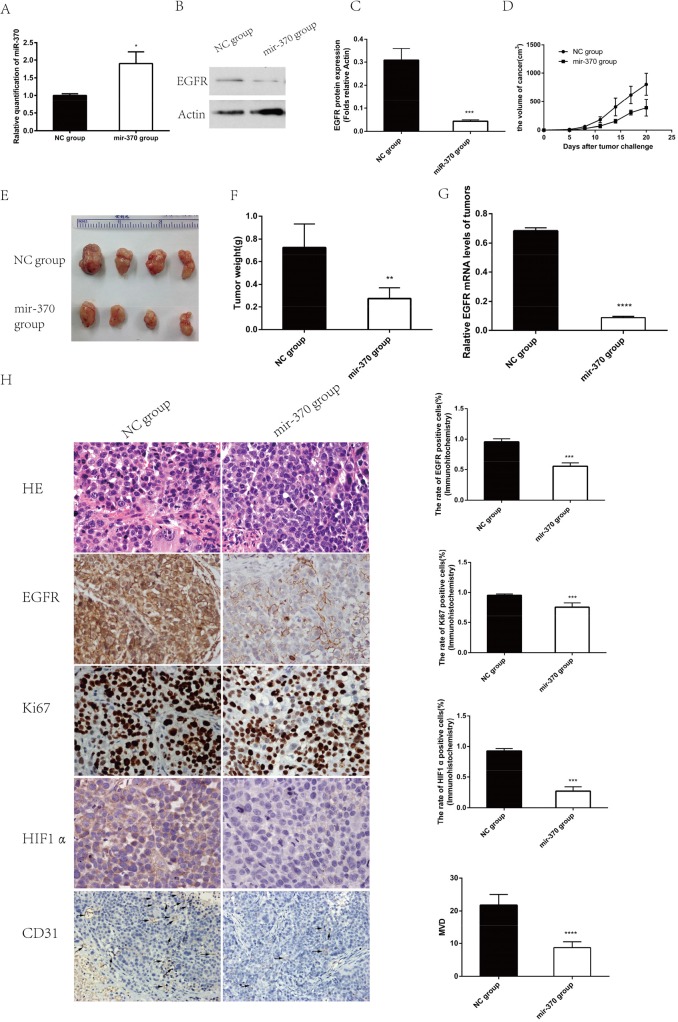
Abnormal microRNA-370 (miR-370) expression has been frequently reported in several types of cancers, including lung cancer. However, the role and molecular mechanisms of miR-370 in regulating the growth and metastasis of lung cancer have not been clarified. Here, we show higher levels of epidermal growth factor receptor (EGFR), but lower levels of miR-370 expression in most human lung cancer cells and non-tumor cells. Induction of miR-370 over-expression significantly reduced the levels of EGFR expression and the EGFR 3'untranslated region (UTR)-regulated luciferase activity in XWLC-05 and H157 cells, suggesting that miR-370 may bind to the 3'UTR of EGFR mRNA. Compared with the control cells, induction of miR370 overexpression significantly inhibited the proliferation, clone formation capacity, migration and invasion of XWLC-05 and H157 cells while miR-370 inhibitor over-expression enhanced their tumor behaviors . Furthermore, miR-370 over-expression down-regulated the EGFR and hypoxia-inducible factor (HIF)-1α expression, and attenuated the extracellular single-regulated kinase (ERK)1/2 and AKT phosphorylation in XWLC-05 and H157 cells. In contrast, miR370 inhibitor over-expression increased the EGFR and HIF-1α expression as well as the ERK1/2 and AKT phosphorylation in XWLC-05 and H157 cells. Moreover, miR-370 over-expression significantly reduced the levels of EGFR and CD31 expression and inhibited the growth and lung metastasis of xenograft NSCLC tumors in mice. Our study indicates that miR-370 may bind to the 3'UTR of EGFR to inhibit EGFR expression and the growth, angiogenesis and metastasis of non-small cell lung cancer by down-regulating the ERK1/2 and AKT signaling.
异常的微小RNA-370(miR-370)表达在包括肺癌在内的多种癌症中经常被报道。然而,miR-370在调节肺癌生长和转移中的作用及分子机制尚未阐明。在此,我们发现大多数人肺癌细胞和非肿瘤细胞中表皮生长因子受体(EGFR)水平较高,但miR-370表达水平较低。在XWLC-05和H157细胞中诱导miR-370过表达显著降低了EGFR表达水平以及EGFR 3'非翻译区(UTR)调控的荧光素酶活性,这表明miR-370可能与EGFR mRNA的3'UTR结合。与对照细胞相比,诱导miR370过表达显著抑制了XWLC-05和H157细胞的增殖、克隆形成能力、迁移和侵袭,而miR-370抑制剂过表达则增强了它们的肿瘤行为。此外,miR-370过表达下调了XWLC-05和H157细胞中EGFR和缺氧诱导因子(HIF)-1α的表达,并减弱了细胞外信号调节激酶(ERK)1/2和AKT的磷酸化。相反,miR370抑制剂过表达增加了XWLC-05和H157细胞中EGFR和HIF-1α的表达以及ERK1/2和AKT的磷酸化。此外,miR-370过表达显著降低了EGFR和CD31的表达水平,并抑制了小鼠异种移植非小细胞肺癌肿瘤的生长和肺转移。我们的研究表明,miR-370可能与EGFR的3'UTR结合,通过下调ERK1/2和AKT信号来抑制EGFR表达以及非小细胞肺癌的生长、血管生成和转移。