Hagenaars Muriel A, Holmes Emily A, Klaassen Fayette, Elzinga Bernet
Leiden Institute for Brain and Cognition (LIBC), Leiden, The Netherlands.
Department of Clinical Psychology, Utrecht University, Utrecht, The Netherlands.
Eur J Psychotraumatol. 2017 Oct 31;8(sup1):1386959. doi: 10.1080/20008198.2017.1386959. eCollection 2017.
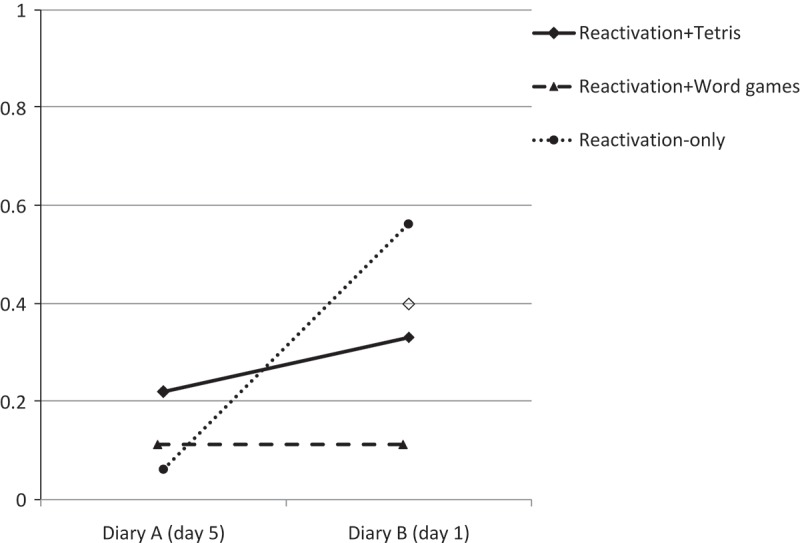
: Intrusive trauma memories are a key symptom of posttraumatic stress disorder (PTSD), so disrupting their recurrence is highly important. Intrusion development was hindered by visuospatial interventions administered up to 24 hours after analogue trauma. It is unknown whether interventions can be applied later, and whether modality or working-memory load are crucial factors. : This study tested: (1) whether a visuospatial task would lead to fewer intrusions compared to a reactivation-only group when applied after memory reactivation four days after analogue trauma exposure (extended replication), (2) whether both tasks (i.e. one aimed to be visuospatial, one more verbal) would lead to fewer intrusions than the reactivation-only group (intervention effect), and (3) whether supposed task modality (visuospatial or verbal) is a critical component (modality effect). : Fifty-four participants were randomly assigned to reactivation+Tetris (visuospatial), reactivation+Word games (verbal), or reactivation-only (no task). They watched an aversive film (day 0) and recorded intrusive memories of the film in diary A. On day 4, memory was reactivated, after which participants played Tetris, Word games, or had no task for 10 minutes. They then kept a second diary (B). Informative hypotheses were evaluated using Bayes factors. : Reactivation+Tetris and reactivation+Word games resulted in relatively fewer intrusions from the last day of diary A to the first day of diary B than reactivation-only (objective 1 and 2). Thus, both tasks were effective even when applied days after analogue trauma. Reactivation-only was not effective. Reactivation+Word games appeared to result in fewer intrusions than reactivation+Tetris (objective 3; modality effect), but this evidence was weak. Explorative analyses showed that Word games were more difficult than Tetris. : Applying a task four days after the trauma film (during memory reconsolidation) was effective. The modality versus working-memory load issue is inconclusive.
侵入性创伤记忆是创伤后应激障碍(PTSD)的关键症状,因此干扰其重现非常重要。在模拟创伤后长达24小时进行的视觉空间干预会阻碍侵入的发展。尚不清楚干预措施是否可以在更晚的时候应用,以及方式或工作记忆负荷是否是关键因素。本研究测试了:(1)在模拟创伤暴露四天后的记忆重新激活后应用视觉空间任务时,与仅进行重新激活的组相比,是否会导致更少的侵入(扩展复制);(2)两个任务(即一个旨在为视觉空间任务,一个更多为语言任务)是否比仅进行重新激活的组导致更少的侵入(干预效果);以及(3)假定的任务方式(视觉空间或语言)是否是一个关键组成部分(方式效果)。54名参与者被随机分配到重新激活+俄罗斯方块(视觉空间)组、重新激活+文字游戏(语言)组或仅重新激活(无任务)组。他们观看了一部厌恶影片(第0天),并在日记A中记录对该影片的侵入性记忆。在第4天,记忆被重新激活,之后参与者玩俄罗斯方块、文字游戏或无任务10分钟。然后他们保留第二本日记(B)。使用贝叶斯因子评估信息性假设。从日记A的最后一天到日记B的第一天,重新激活+俄罗斯方块组和重新激活+文字游戏组的侵入相对少于仅重新激活组(目标1和2)。因此,即使在模拟创伤数天后应用,两个任务都是有效的。仅重新激活无效。重新激活+文字游戏组似乎比重新激活+俄罗斯方块组导致更少的侵入(目标3;方式效果),但这一证据较弱。探索性分析表明文字游戏比俄罗斯方块更难。在创伤影片四天后(在记忆重新巩固期间)应用一项任务是有效的。方式与工作记忆负荷问题尚无定论。